
How to Choose a Himalayan Salt Manufacturer: A B2B Buyer's Verification Checklist
- Zainab Abid
Key takeaways
- Manufacturers control quality; traders resell products. This affects consistency, pricing, and issue resolution.
- Certifications verify processes, not product quality. No single certificate guarantees good salt.
- “FDA approved” is misleading. The FDA registers facilities but does not approve or certify food products.
- Verify every certification. Request the certificate, issuer, and certificate number, then confirm them independently.
- A third-party Certificate of Analysis (COA) is essential. It should include key quality metrics and heavy metal testing.
- Question unsupported claims. If a supplier can’t verify a claim, don’t rely on it.
Choosing a Himalayan salt manufacturer is a trust decision made with limited information. Most of what a supplier claims cannot be seen from a website. This checklist turns that uncertainty into a repeatable process, the same due diligence buyers run before working out how to import Himalayan salt from Pakistan. Verify first, order second.
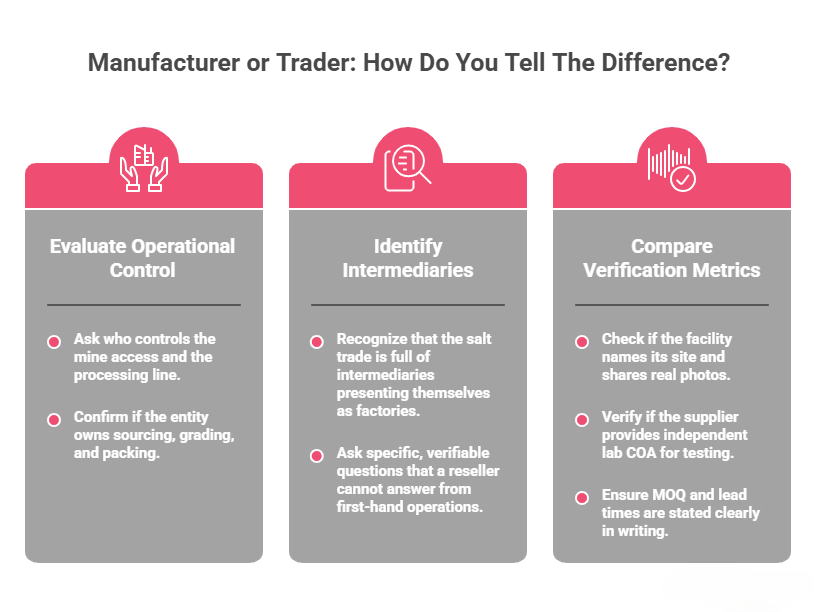
Manufacturer or Trader: How Do You Tell The Difference?
Ask who controls the mine access and the processing line. A true manufacturer owns sourcing, grading, and packing; a trader buys finished salt and resells it under its own name. That difference sets your price, your batch consistency, and whether anyone can actually correct a fault when one appears.
This matters because the salt trade is full of intermediaries presenting themselves as factories. The website looks identical. The distinction only surfaces when you ask specific, verifiable questions that a reseller cannot answer from first-hand operations.
Signal | A real manufacturer | A trader / middleman |
Facility | Names its site; shares real photos | Vague address; stock imagery |
Sourcing | Controls mine access and grading | Buys finished salt on demand |
Certificates | Issues numbers and issuing bodies | Shares logos, avoids specifics |
Testing | Provides independent lab COA | In-house sheet or none |
MOQ & lead time | Stated clearly in writing | Shifts with each enquiry |
Quality faults | Traces to a process step | Passes complaint up an unseen chain |
Why Buy From The Manufacturer Directly?
Because every layer between you and the source adds cost and removes accountability. Buying direct means one party owns quality, traceability, and correction. When a batch runs off-spec, a manufacturer can trace it to a stage in its own process; a trader can only relay your complaint up a chain you cannot see.
- Price: you pay the factory margin once, not a reseller’s markup on top.
- Consistency: the same line and grading standard produces the same salt each order.
- Traceability: origin can be documented from the mine to your container.
- Correction: a real manufacturer can adjust grain size, moisture, or packaging to spec.
- Continuity: your supply does not depend on a middleman’s own sourcing luck.
What Certifications Should a Himalayan Salt Manufacturer Hold?
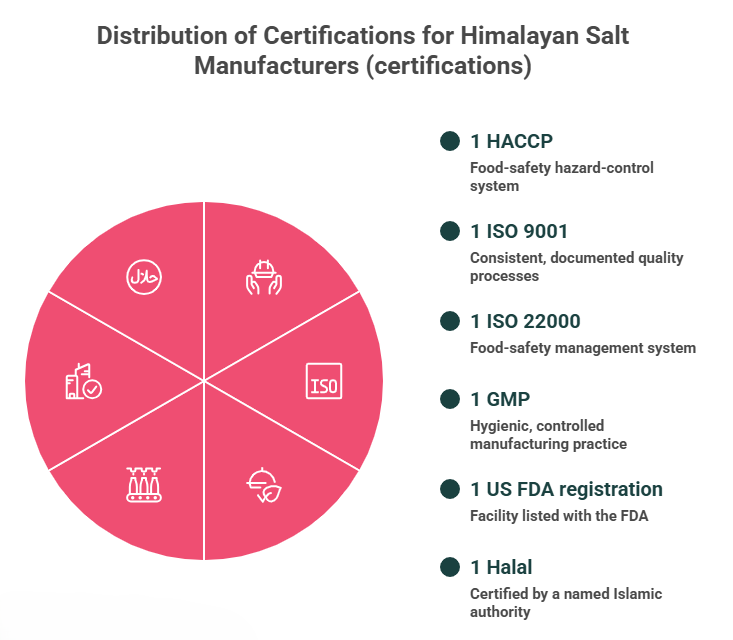
At minimum, look for a food-safety system, a quality-management system, Good Manufacturing Practices, and any registration your market requires. Each proves a different thing. Read them as a set, no single certificate proves the salt itself is good, and treating one as a guarantee is a common buyer mistake.
Certification | What it actually proves | What it does NOT prove |
HACCP | A working food-safety hazard-control system | That every batch is defect-free |
ISO 9001 | Consistent, documented quality processes | Anything about food safety specifically |
ISO 22000 | A food-safety management system | Product taste, grade, or origin |
GMP | Hygienic, controlled manufacturing practice | Independent product test results |
US FDA registration | The facility is listed with the FDA | FDA approval — no such thing exists |
Halal | Certified by a named Islamic authority | Validity if the certifier is unnamed |
The most important red flag:
“FDA approved” salt does not exist. The US FDA requires food facilities to register, but registration does not convey FDA approval or endorsement of the facility or its products, and the FDA issues no certificate.
Any supplier advertising “FDA approved” or “FDA certified” Himalayan salt is either misinformed or misleading you. The correct, verifiable claim is “US FDA registered facility” — ask for the registration and confirm it independently.
How Do You Verify a Certification is Actually Real?
Do not accept a logo on a page, ask for the document itself, then check it at source. A genuine manufacturer provides this without hesitation. Reluctance, delay, or a redirected subject is itself the answer you were looking for.
- Request the certificate as a file, showing the issuing body, scope, certificate number, and expiry date.
- Confirm the certifier is a named, accredited body, not an unnamed “international authority”.
- Check the certificate number against the issuing body’s own register where one is published.
- Match the scope to the product: a certificate covering a different product line does not cover your salt.
- Confirm the certificate is current, an expired date makes it worthless.
- For FDA, ask for the facility registration and treat any “approval” wording as a warning.
What Should You Check About Product Quality and Testing?
Ask for a recent Certificate of Analysis from an independent laboratory, not an in-house sheet. It should state grain size, purity, moisture, and a heavy-metal screen against a recognised standard. A manufacturer confident in its salt provides this before you ask. Hesitation at this step is the most telling signal of all.
- Independent COA: issued by a third-party lab, dated, and tied to a batch.
- Purity and moisture: stated as measured values, not marketing adjectives.
- Heavy-metal screen: natural rock salt can carry trace metals, so a screen against recognised contaminant limits matters.
- Grain grading: fine, coarse, and mesh sizes defined and repeatable order to order.
- Physical samples: sent on request so you verify grade and packaging in your own hands.
How Do You Assess Capacity and Reliability?
Match the supplier’s real output to your order size and timeline. A genuine manufacturer states a clear minimum order quantity, a realistic lead time, and packaging options in writing. Vague or shifting answers on volume or delivery usually mean the salt is being sourced elsewhere, order by order, rather than made in-house.
- Minimum order quantity: stated as a firm figure, not negotiated fresh each time.
- Lead time: a realistic window from confirmed order to dispatch.
- Packaging: defined formats, 25kg bags, retail packs, private-label options.
- Capacity headroom: the ability to scale with you as repeat volume grows.
What Do Export Capabilities Reveal About a Manufacturer?
Export fluency separates a factory that ships worldwide from one that has never cleared a container. Ask which documents they issue, which Incoterms they quote, and which markets they already serve. A manufacturer that handles export documentation daily answers instantly and specifically, without needing to check.
- Documentation: can issue commercial invoices, certificates of origin, and analysis on request.
- Incoterms: quotes FOB, CIF, or EXW knowingly and explains the difference.
- Market experience: names specific destination countries and their requirements.
- Compliance fluency: understands market rules such as EU food-safety requirements for imports.
What Are The Red Flags of An Unreliable Salt Supplier?
Most bad suppliers reveal themselves through the same handful of signals. None is subtle once you know to look. If two or more appear together, treat the quote with real caution regardless of the price.
- “FDA approved” or “FDA certified” salt, the FDA does neither for food facilities.
- Certificate logos with no issuing body, number, or expiry date.
- Only in-house test results, or reluctance to provide an independent COA.
- A minimum order quantity or lead time that changes with each enquiry.
- No verifiable facility address, and only stock or borrowed photography.
- Unverifiable superlatives “world’s number-one exporter” with nothing to substantiate them.
- Pressure to pay in full upfront with no samples and no written specification.
- A price far below the market, which often signals re-sourced or off-spec salt.
Your Final Verification Checklist
Run every shortlisted supplier through the same nine checks before you request a formal quote. Consistent questions produce comparable answers and expose the suppliers who cannot give them.
# | Verify | Pass condition |
1 | Manufacturer, not trader | Owns sourcing, grading, and packing |
2 | Named facility | Real address and genuine facility photos |
3 | Certifications | HACCP, ISO 9001/22000, GMP with numbers |
4 | FDA wording | “Registered facility”, never “approved” |
5 | Independent COA | Third-party lab, dated, with heavy-metal screen |
6 | Samples | Sent on request before commitment |
7 | MOQ & lead time | Stated firmly in writing |
8 | Export documents | Issued routinely; Incoterms quoted fluently |
9 | Claims substantiated | No unverifiable statistics relied upon |
How Sobaan Salts Measures Against This Checklist
Run this checklist against us, that is exactly how we would want a buyer to decide. Sobaan Salts manufactures at its own facility in Sialkot, Pakistan, and holds HACCP, ISO 9001, GMP, US FDA facility registration, and Halal certification. We supply more than 200 B2B clients across 90+ countries.
We provide certificate numbers and issuing bodies, an independent Certificate of Analysis, and physical samples on request because a claim you cannot verify should not influence your decision. Our minimum order quantity is 500 kg, typical lead time is four to six weeks, and we respond to quote requests within 7 working days.
Frequently Asked Questions
Is an FDA-registered salt manufacturer FDA-approved?
No. The FDA requires food facilities to register, but registration does not mean the FDA has approved, endorsed, or certified the facility or its salt, and the agency issues no certificate. The accurate term is “US FDA registered facility”. Any supplier claiming “FDA approved” salt is a warning sign.
How can I tell a manufacturer from a trader?
A manufacturer controls sourcing, grading, and packing and can trace a fault to its own process. A trader resells finished salt bought on demand. Ask for the facility address, real photos, certificate numbers, and an independent Certificate of Analysis, a reseller struggles to provide all four.
What certifications matter most for food-grade Himalayan salt?
Look for a food-safety system such as HACCP, a quality system such as ISO 9001, Good Manufacturing Practices, and any market registration you need, US FDA facility registration for the United States, and Halal where relevant. Read them together; none alone proves the salt is good.
Should I ask for samples before placing a bulk order?
Yes, always. A genuine manufacturer sends physical samples and an independent Certificate of Analysis so you can verify grade, grain size, and packaging before committing. Reluctance to provide samples or third-party testing is one of the clearest signals to walk away.
Why are unverifiable statistics a warning sign?
Because a sourcing decision should rest on what you can check. A supplier that leans on claims it cannot substantiate, unnamed awards, superlatives, round numbers with no source — is asking for trust it has not evidenced. Hold every supplier, including your eventual choice, to that standard.
Sources
- U.S. Food and Drug Administration — Registration of Food Facilities (FSMA, section 415 FD&C Act); registration does not convey FDA approval or endorsement. https://www.fda.gov/food/guidance-regulation-food-and-dietary-supplements/registration-food-facilities-and-other-submissions
- Codex Alimentarius Commission (FAO/WHO), General Principles of Food Hygiene (CXC 1-1969) and the HACCP system and guidelines for its application. PDF Link
- Codex Alimentarius Commission (FAO/WHO) — General Standard for Contaminants and Toxins in Food and Feed (CXS 193-1995). PDF Link
- International Organization for Standardization — ISO 9001 Quality management systems; ISO 22000 Food safety management systems.
https://www.iso.org/iso-22000-food-safety-management.html - International Chamber of Commerce — Incoterms 2020 rules.
https://iccwbo.org/business-solutions/incoterms-rules/incoterms-2020/
Share This Post
Article By

Zainab Abid is the Sales and Content Manager at Sobaan Salts, where she works with international buyers and businesses sourcing premium Himalayan salt products. She writes about Himalayan salt, its applications, export processes, and industry best practices, combining practical experience with insights gained from working closely with manufacturers and global customers. Her goal is to make technical topics easy to understand while helping readers make informed decisions about Himalayan salt products.
Related posts
Table of Contents
Need Bulk Himalayan Salt for Winter Surface Maintenance?
Source premium Himalayan salt directly from a verified Pakistani manufacturer trusted by distributors and importers in over 90 countries.


