
Halal Certification for Himalayan Salt: A Complete Guide for GCC & Muslim Markets
- Zainab Abid

Key takeaways
- Himalayan salt is naturally halal, it contains no animal products and no alcohol but importers in GCC and Muslim-majority markets still require a halal certificate for customs clearance
- The halal certificate confirms the supplier’s facility and supply chain are halal-compliant, not just the salt itself covering cross-contamination, packaging, and handling
- GCC countries (UAE, Saudi Arabia, Qatar, Kuwait, Bahrain, Oman) accept certificates aligned with the GSO 2055 standard; the UAE specifically requires certifiers recognized by MOIAT
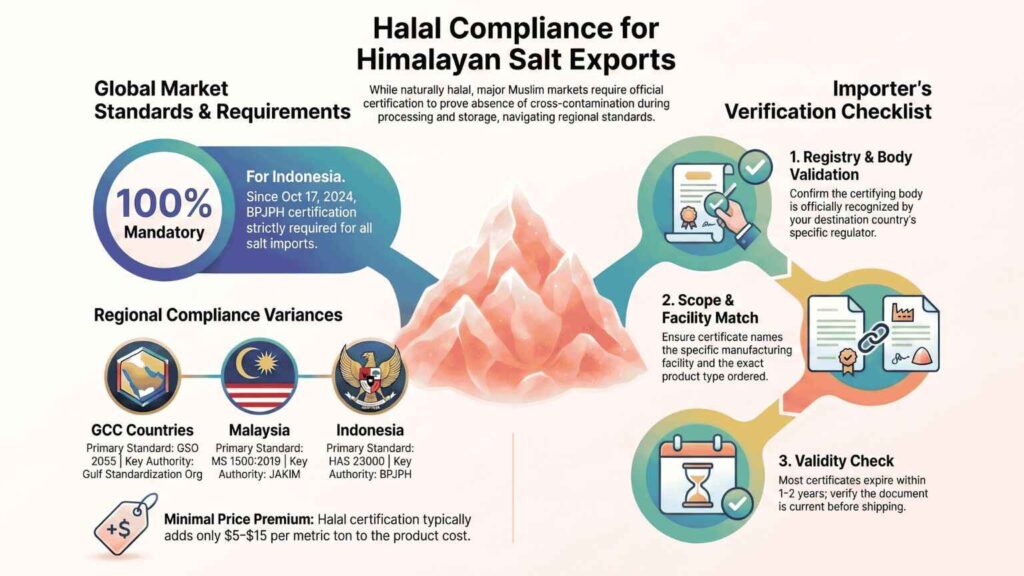
- Indonesia made halal certification mandatory for all imported food on October 17, 2024 under BPJPH, currently the strictest enforcement worldwide
- Always verify the certifying body is recognized in your destination country before accepting a supplier’s halal certificate, even from established Pakistani exporters
If you are importing Himalayan salt into the GCC, Malaysia, Indonesia, or any Muslim-majority market, your customs broker will ask for a halal certificate. This applies even though salt itself is naturally permissible under Islamic law. This guide explains what halal certification covers, which certifying bodies are recognized in each major market, what the certificate actually proves, and how to verify it before placing a bulk order with a Pakistani manufacturer.
Is Himalayan Salt Naturally Halal?
Yes. Himalayan salt is mined rock salt, sodium chloride with trace minerals, containing no animal products, no alcohol, and no other substances forbidden under Islamic dietary law. By its raw composition, it is fully halal.
Most Islamic scholars agree that products like salt, sugar, water, and other naturally occurring minerals do not technically require halal certification because they are inherently permissible. However, this religious view and customs requirements are two different things.
Why Do GCC and Muslim Markets Still Require a Halal Certificate?
Customs authorities and retail buyers in halal-aware markets require the paper trail not because the salt itself is in question, but because the certificate confirms three things about the supplier:
- The manufacturing facility is free from cross-contamination with non-halal products (no shared equipment with pork, alcohol-based, or other non-halal lines)
- Packaging, storage, and transportation comply with halal handling standards
- The supplier has been audited by a recognized third-party body, providing legal accountability
Without this paperwork, even halal-by-nature products like salt can be held at customs. In some markets, Indonesia is the strictest example, uncertified products are simply refused entry. The certificate is the importer’s protection, not a religious judgment on the salt.
Which Halal Standards Apply to Imported Salt?
Different markets recognize different standards. The five most important for Himalayan salt exports from Pakistan are:
Standard | Issued By | Used In |
GSO 2055 | Gulf Standardization Organization (GSO) | All 6 GCC countries, the harmonized standard |
OIC/SMIIC 1:2019 | Standards and Metrology Institute for Islamic Countries | 57 OIC member states, international reference standard |
UAE.S 2055-1 | Originally Emirates Authority for Standardization and Metrology (ESMA), now administered through MOIAT | UAE-specific (aligned with GSO 2055) |
MS 1500:2019 | Department of Standards Malaysia / JAKIM | Malaysia (strict interpretation, JAKIM enforces) |
HAS 23000 series (BPJPH) | Indonesian Halal Product Assurance Agency (BPJPH) | Indonesia (mandatory since October 17, 2024) |
Pakistani exporters typically certify against OIC/SMIIC and GSO 2055 because these are the most widely accepted across the GCC and Muslim markets. A supplier holding only a generic “Halal Certified” claim without naming the underlying standard is a red flag, the document may not be accepted at customs.
Which Halal Certifying Bodies Should Pakistani Suppliers Hold?
Pakistan has its own national halal authority, the Pakistan Halal Authority (PHA) established under federal law. But for export, what matters is whether the certifying body is recognized in your destination market. Here are the bodies that matter:
Pakistan-Based Bodies
- Pakistan Halal Authority (PHA): the national regulator established under federal law
- SANHA Halal Associates Pakistan: Pakistan branch of the South African National Halal Authority network
- Halal Research Council Pakistan: Karachi-based certification body
Verify with your destination country’s regulator that your supplier’s specific certifying body is on its accepted list — Pakistani body recognition varies by market and changes periodically.
Globally Recognized Bodies (Also Widely Accepted)
- JAKIM (Malaysia): mandatory for Malaysia, widely regarded as among the strictest standards globally
- BPJPH (Indonesia): required for Indonesia since October 17, 2024
- MOIAT (UAE): direct recognition for UAE imports
- IFANCA (USA): accepted in many GCC markets via mutual recognition
Sobaan Salts holds halal certification recognized for GCC and broader Muslim markets, you can review our complete certifications and quality documents before placing an order.
Market-by-Market Requirements for Halal Salt Imports
Each major market has its own specific requirements. Here is what an importer needs to know for the four most important destinations:
UAE
Halal certificates must come from a body recognized by MOIAT (Ministry of Industry and Advanced Technology). The certificate must reference UAE.S 2055-1 or GSO 2055. Arabic-language ingredient declarations on packaging may be required for retail distribution. The UAE often serves as a hub for re-export to other Gulf states and South Asia, so a UAE-accepted certificate has wide secondary value.
Saudi Arabia
Certificates must align with the Saudi Halal Center under SFDA (Saudi Food and Drug Authority). The country tightened its accreditation rules in 2023, only certifying bodies on the approved Saudi list are accepted. Arabic ingredient declarations are required. Saudi Arabia is the largest GCC market by volume and the most rigorous on documentation enforcement.
Malaysia
JAKIM is the only domestic authority and runs one of the strictest halal programs globally. Imported salt with JAKIM-recognized certification clears customs and qualifies for Malaysian retail. JAKIM has bilateral recognition agreements with selected international bodies to confirm the supplier’s certifying body is on JAKIM’s recognized list before ordering.
Indonesia
The strictest market currently. Under Law No. 33/2014, halal certification became mandatory for all imported food, beverage, and consumer products on October 17, 2024. BPJPH (Halal Product Assurance Agency) is the sole national authority. Foreign halal certifying bodies must have a mutual recognition agreement with BPJPH for their certificates to be accepted. Importers without proper BPJPH-recognized halal documentation face shipment refusal.
If you are importing Himalayan salt into Indonesia: this is the highest-stakes halal market currently. Verify BPJPH recognition of your supplier’s certifying body before contract not after the shipment is on the water.
How Do You Verify a Supplier's Halal Certificate Is Genuine?
Halal certificate fraud exists, especially in commodity products like salt. Before accepting any halal certificate from a Pakistani supplier, run these checks:
- Confirm the certifying body is listed on the official registry of your destination country (MOIAT, SFDA, JAKIM, or BPJPH website)
- Check the certificate has a unique reference number that can be verified directly with the issuing body
- Verify the certificate names the supplier’s specific facility, not just the trade name or parent company
- Confirm the certificate is current, most halal certificates are valid for 1 to 2 years and require periodic renewal
- Match the product list on the certificate with what you are actually ordering (a halal certificate for edible salt does not automatically cover industrial or bath salt)
Does Halal Certification Affect the Price of Himalayan Salt?
Slightly. Suppliers who carry halal certification typically charge USD 5 to 15 more per metric ton compared to uncertified products, to recover their certification and audit costs. This is a small premium relative to the market access it unlocks.
For full context on what bulk Himalayan salt costs and how certifications affect quotes, see our Himalayan salt wholesale pricing and MOQ guide.
Where Does Halal Certification Fit in the Import Process?
Halal certification is one of several compliance documents your customs broker will need at the destination port. For the complete sequence of documents and the full import workflow from supplier selection to warehouse delivery, see our step-by-step guide to importing Himalayan salt from Pakistan.
Frequently Asked Questions
Is Himalayan salt halal?
Yes. Himalayan salt is mined rock salt containing no animal products and no alcohol, so it is naturally halal under Islamic dietary law. However, importers in GCC and other Muslim-majority markets still require a halal certificate from a recognized certifying body for customs clearance.
Why does naturally halal salt still need a halal certificate?
The certificate confirms the supplier’s manufacturing facility is free from cross-contamination with non-halal products, that packaging and handling meet halal standards, and that the supplier has been audited by an accredited third-party body. The certificate is the importer’s paper trail, not a religious judgment.
Which halal certification is accepted in the UAE for imported salt?
The UAE accepts halal certificates from bodies recognized by MOIAT (Ministry of Industry and Advanced Technology). The certificate must reference either UAE.S 2055-1 or the broader GSO 2055 standard. Always verify the supplier’s certifying body is on the current MOIAT-approved list.
Is halal certification mandatory in Indonesia?
Yes. Since October 17, 2024, halal certification has been mandatory for all imported food, beverage, and consumer products in Indonesia under Law No. 33/2014, enforced by BPJPH. Foreign halal certifying bodies must have a mutual recognition agreement with BPJPH for their certificates to be accepted.
How can I verify if a supplier’s halal certificate is genuine?
Verify the certifying body is listed on the official registry of your destination country (MOIAT, SFDA, JAKIM, or BPJPH). Check the unique reference number with the issuing body directly. Confirm the certificate names the supplier’s specific facility, is current (most expire within 1-2 years), and covers the exact product you are ordering.
Sources:
- Gulf Standardization Organization (GSO) — GSO 2055-1:2015 Halal Food General Requirements: https://www.gso.org.sa/store/standards/GSO:693304/GSO%202055-1:2015?lang=en
- Standards and Metrology Institute for Islamic Countries (SMIIC) — OIC/SMIIC 1:2019:
https://smiic.org/en/project/24 - Ministry of Industry and Advanced Technology UAE (MOIAT) — Halal National Mark and recognized certifying bodies: https://moiat.gov.ae/en/programs/halal/registered-halal-certification-bodies
- Saudi Food and Drug Authority (SFDA) — Saudi Halal Center accredited bodies list: https://sfda.gov.sa/sites/default/files/2020-08/sfda-halal.pdf
- Department of Islamic Development Malaysia (JAKIM) — Recognized Foreign Halal Certification Bodies: https://myehalal.halal.gov.my/portal-halal/v1/index.php
- Indonesian Halal Product Assurance Agency (BPJPH) — Halal Product Law No. 33/2014 implementing regulations: https://bpjph.halal.go.id/
- Pakistan Halal Authority (PHA) — Official site:
https://www.pakistanhalalauthority.gov.pk/
Share This Post
Article By

Zainab Abid is the Sales and Content Manager at Sobaan Salts, where she works with international buyers and businesses sourcing premium Himalayan salt products. She writes about Himalayan salt, its applications, export processes, and industry best practices, combining practical experience with insights gained from working closely with manufacturers and global customers. Her goal is to make technical topics easy to understand while helping readers make informed decisions about Himalayan salt products.
our latest posts
Table of Contents
Sourcing Halal-Certified Himalayan Salt for the GCC?
Sobaan Salts holds GCC-recognized halal certification · ISO-certified manufacturer · Ships to 90+ countries · MOQ from 1 metric ton · Private label available


