
Incoterms for Himalayan Salt Buyers: FOB, CIF, DAP & DDP
- Zainab Abid
Key takeaways
- Incoterms are standardized three-letter rules from the International Chamber of Commerce that define who pays for shipping, insurance, and customs at each stage
- FOB and CIF apply only to sea freight, which is how almost all bulk Himalayan salt ships from Pakistan
- FOB gives the buyer the most control over freight cost; DDP gives the buyer the least work, with the seller handling everything including import duties
- Never compare a FOB price from one supplier with a CIF or DDP price from another, they cover different cost stages
- For a first salt order, CIF or DAP is usually the safest balance of cost and simplicity; FOB suits buyers with their own freight forwarder
When you request a quote for bulk Himalayan salt from Pakistan, the price always comes attached to a three-letter code FOB, CIF, DAP, or DDP. These are Incoterms, and they decide who pays for what at every stage of the shipment. Getting them wrong is one of the most common and most expensive mistakes a first-time salt importer makes. This guide explains the four Incoterms you will actually see in salt trade, in plain language, with salt-specific examples.
What Are Incoterms?
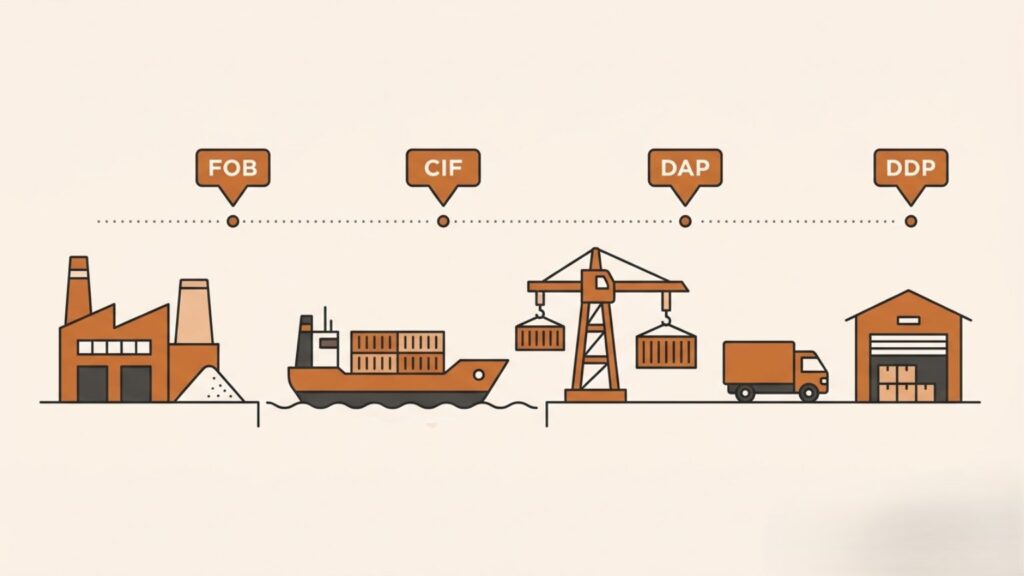
Incoterms short for International Commercial Terms are a set of standardized rules published by the International Chamber of Commerce (ICC). They define exactly where the seller’s responsibility ends and the buyer’s responsibility begins in an international shipment.
The current version is Incoterms 2020. Each rule answers three questions: who pays for transport, who pays for insurance, and who handles customs clearance at each stage. There are 11 Incoterms in total, but only four come up regularly in the Himalayan salt trade FOB, CIF, DAP, and DDP. The others are either designed for specialized logistics or are rarely used for bulk commodity shipments like salt.
Why Do Incoterms Matter When Importing Salt?
Incoterms matter because they directly change your total landed cost, the real amount you pay to get salt from the mine in Pakistan to your warehouse. A quote of “USD 120 per metric ton” means very different things under FOB versus DDP.
Under FOB, that USD 120 covers only the salt and getting it onto the ship in Pakistan. You still pay ocean freight, insurance, destination port fees, customs duty, and inland delivery on top. Under DDP, that price would include almost everything up to your door. This is why two supplier quotes can look far apart in price but actually be very close once you compare them on the same Incoterm.
What Does FOB (Free On Board) Mean?
FOB means the seller is responsible for the salt until it is loaded onto the ship at the port of origin for Pakistani salt, this is almost always Port Qasim or Karachi Port. Once the salt is on board the vessel, all responsibility and cost transfers to you, the buyer.
Under FOB, the seller pays for:
- Producing and packaging the salt
- Inland transport from the factory to the port in Pakistan
- Export clearance and loading the cargo onto the vessel
Under FOB, you (the buyer) pay for:
- Ocean freight from Pakistan to your destination port
- Marine insurance
- Destination port handling, customs duty, and clearance
- Inland delivery from the destination port to your warehouse
FOB is the best choice if you have your own freight forwarder. It gives you full control over which shipping line you use and what you pay for freight. The FOB price also looks lower than CIF or DDP because it excludes everything after loading, so always remember you have more costs to add.
What Does CIF (Cost, Insurance, Freight) Mean?
CIF means the seller covers the cost of the salt, the ocean freight to your destination port, and marine insurance during the voyage. Once the salt reaches your destination port, you take over, paying for port handling, customs duty, clearance, and inland delivery.
The important detail with CIF is that even though the seller pays for freight and insurance, the risk still transfers to you once the salt is loaded onto the ship in Pakistan. The seller is paying for the journey, but if something happens mid-ocean, it is your insurance claim to make.
CIF is a good choice for first-time buyers who do not yet have a freight forwarder relationship. The seller handles the main shipping leg, and you get a predictable cost to your destination port. CIF and FOB both apply only to sea freight, which works well because nearly all bulk Himalayan salt ships by sea.
What Does DAP (Delivered at Place) Mean?
DAP means the seller delivers the salt all the way to a named place in your country, usually your warehouse or a nominated address. The seller pays for everything up to that point: the salt, ocean freight, insurance, destination port charges, and inland transport. You are responsible for only two things, import customs duty and taxes and unloading the salt at your location.
DAP is a strong middle-ground option. You get door-level delivery without the seller having to navigate your country’s import tax system. It is well suited to buyers who want simplicity but are comfortable handling their own customs duty payment, which is often easier for a local company than a foreign seller.
What Does DDP (Delivered Duty Paid) Mean?
DDP means the seller handles everything, the salt, all freight, insurance, destination port charges, import customs clearance, duties, taxes, and final delivery to your door. You, the buyer, only need to receive and unload the shipment. DDP places the maximum responsibility on the seller and the minimum on the buyer.
DDP sounds ideal, but it has one real-world limitation worth knowing. In some countries, a foreign seller is not legally allowed to act as the importer of record, which makes it difficult or impossible for them to pay import duties directly. When that happens, DAP is the better choice, the seller delivers to your door, and you handle the import formalities. Always confirm with your customs broker whether DDP is workable in your country before agreeing to it.
FOB vs CIF vs DAP vs DDP: Side-by-Side Comparison
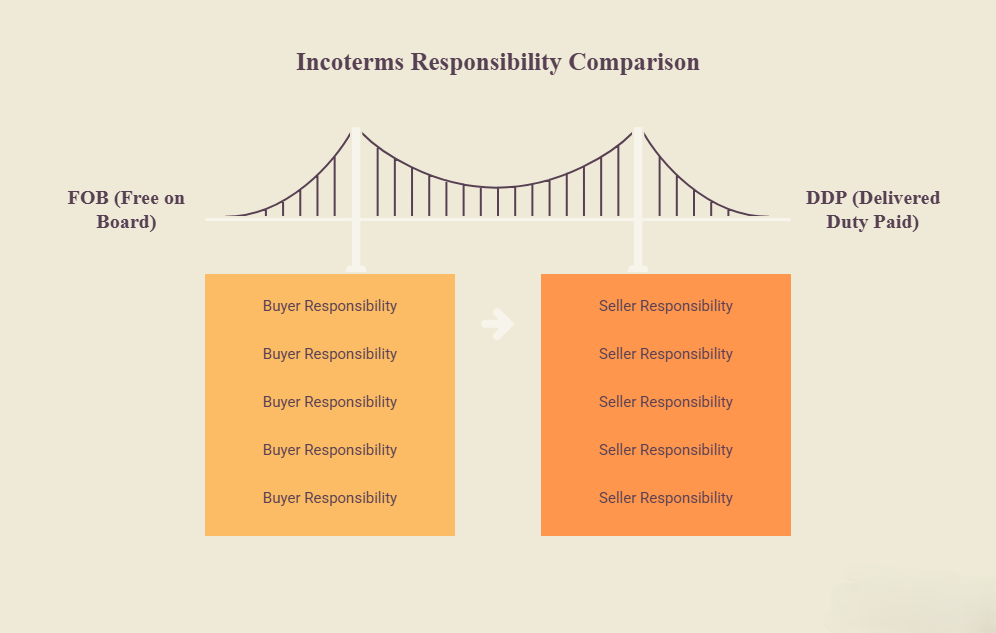
This table shows who is responsible for each cost stage under the four Incoterms used in Himalayan salt trade:
Cost Stage | FOB | CIF | DAP | DDP |
Salt + export packing | Seller | Seller | Seller | Seller |
Inland transport in Pakistan | Seller | Seller | Seller | Seller |
Export clearance + loading | Seller | Seller | Seller | Seller |
Ocean freight | Buyer | Seller | Seller | Seller |
Marine insurance | Buyer | Seller | Seller | Seller |
Destination port charges | Buyer | Buyer | Seller | Seller |
Import duty + taxes | Buyer | Buyer | Buyer | Seller |
Inland delivery to warehouse | Buyer | Buyer | Seller | Seller |
Which Incoterm Should You Choose for Your Salt Order?
There is no single best Incoterm, the right choice depends on your shipping experience and how much of the process you want to manage. Here is a practical guide:
Your Situation | Best Incoterm | Why |
You have your own freight forwarder | FOB | You control freight cost and carrier choice, usually the lowest total cost |
First salt order, no forwarder yet | CIF | Seller handles the main sea voyage; you get a predictable cost to your port |
You want door delivery but can handle customs | DAP | Seller delivers to your warehouse; you only handle import duty |
You want zero logistics involvement | DDP | Seller handles everything but confirm DDP is legally workable in your country first |
Small trial order to test a supplier | CIF or DDP | Simplicity matters more than squeezing the lowest freight rate on a small order |
The golden rule for comparing quotes:
always ask every supplier for a quote on the same Incoterm. A FOB price of USD 110 per ton and a CIF price of USD 145 per ton may actually be the same deal once freight is added. Comparing different Incoterms side by side is the fastest way to misjudge a supplier’s real price.
One Detail US Buyers Should Know: The Importer of Record
If you are importing salt into the United States, the Incoterm affects who files the Importer Security Filing (the ISF, sometimes called 10+2) with US Customs. Under FOB, CIF, and DAP, you, the US buyer, are the importer of record and file the ISF. Under DDP, the seller takes on that role.
Because most foreign sellers are not set up to be the US importer of record, FOB, CIF, or DAP are the more practical choices for US-bound salt shipments. For the full picture of US import requirements, including FDA registration and prior notice, see our guide to FDA requirements for salt export to the USA.
Incoterms Are One Part of the Bigger Import Process
Choosing an Incoterm is one step in a larger sequence, finding a supplier, agreeing on payment terms, preparing customs documents, and arranging shipping. If you are planning your first bulk purchase, our complete step-by-step guide to importing Himalayan salt from Pakistan walks through the entire process from first quote to warehouse delivery, with Incoterms covered as part of the full workflow.
Frequently Asked Questions
What is the difference between FOB and CIF?
Under FOB, the seller’s price covers the salt and loading it onto the ship in Pakistan, you pay ocean freight and insurance. Under CIF, the seller also pays the ocean freight and marine insurance to your destination port. In both cases, risk transfers to you once the salt is loaded onto the vessel.
Which Incoterm is cheapest for importing salt?
FOB usually has the lowest total cost if you have your own freight forwarder, because you control the freight rate. However, the FOB quote itself looks lower only because it excludes freight, insurance, and destination costs that you still have to pay separately.
What is the difference between DAP and DDP?
Under DAP, the seller delivers to your address but you pay import duty and taxes. Under DDP, the seller also pays the import duty and taxes. DDP is not always possible because some countries do not allow a foreign seller to act as the importer of record.
Can FOB and CIF be used for air freight?
No. FOB and CIF apply only to sea and inland waterway transport. Since almost all bulk Himalayan salt ships by sea, this is rarely a problem but if you ship salt samples by air, a different Incoterm such as CPT or DAP would apply.
Which Incoterm is best for a first-time salt importer?
CIF or DAP are usually best for a first order. CIF gives you a predictable cost to your destination port with the seller handling the sea voyage. DAP delivers to your door while leaving you in control of import customs, often simpler for a local company than for a foreign seller.
Sources:
- International Chamber of Commerce (ICC) — Incoterms 2020 Rules: https://iccwbo.org/business-solutions/incoterms-rules/incoterms-2020/
- ICC Academy — “Incoterms 2020: DAP or DDP?”:
https://academy.iccwbo.org/knowledge-hub/incoterms/ - U.S. Department of Commerce, International Trade Administration — Know Your Incoterms: https://www.trade.gov/know-your-incoterms
- U.S. Customs and Border Protection — Importer Security Filing (10+2): https://www.cbp.gov/border-security/ports-entry/cargo-security/importer-security-filing-102
- Trade Development Authority of Pakistan (TDAP) — Export Procedures:
https://tdap.gov.pk/wp-content/uploads/2022/04/Step-by-Step-Guide-for-New-Exporters-Export-Procedures.pdf
Share This Post
Article By

Zainab Abid is the Sales and Content Manager at Sobaan Salts, where she works with international buyers and businesses sourcing premium Himalayan salt products. She writes about Himalayan salt, its applications, export processes, and industry best practices, combining practical experience with insights gained from working closely with manufacturers and global customers. Her goal is to make technical topics easy to understand while helping readers make informed decisions about Himalayan salt products.
our latest posts
Table of Contents
Need a Clear Quote on Your Preferred Incoterm?
Sobaan Salts quotes FOB, CIF, DAP, and DDP · ISO-certified manufacturer · Ships to 90+ countries · MOQ from 1 metric ton


