
Private Label Himalayan Salt: How to Choose the Right OEM/ODM Supplier
- Zainab Abid
Key takeaways
- ODM is the standard model for private label Himalayan salt, the manufacturer produces their existing product specifications under your brand name, with your custom packaging and labeling
- OEM is rarer for salt, it means the manufacturer produces a product to your custom specifications (custom grain size blends, mineral profile, or specialty formulations)
- Verify five things in any supplier: food safety certifications, direct factory ownership (not a broker), sample policy, packaging capabilities, and export documentation experience
- Typical private label MOQs run 500 kg to 1 metric ton; lead times are usually 6 to 10 weeks from order confirmation to shipment ready
- The biggest red flag is a supplier who cannot show you their factory by video call or provide third-party lab analysis on their salt
Launching your own brand of Himalayan salt? whether for food retail, wellness, or hospitality, does not require building your own manufacturing operation. Most successful global salt brands source their product from established OEM or ODM manufacturers in Pakistan, the world’s only authentic source of pink Himalayan salt, and brand it under their own label. The hard part is choosing the right supplier. This guide explains the difference between OEM and ODM for salt, what to verify before placing an order, what packaging and MOQ to expect, and the red flags that separate genuine manufacturers from brokers.
What's the Difference Between OEM and ODM for Private Label Salt?
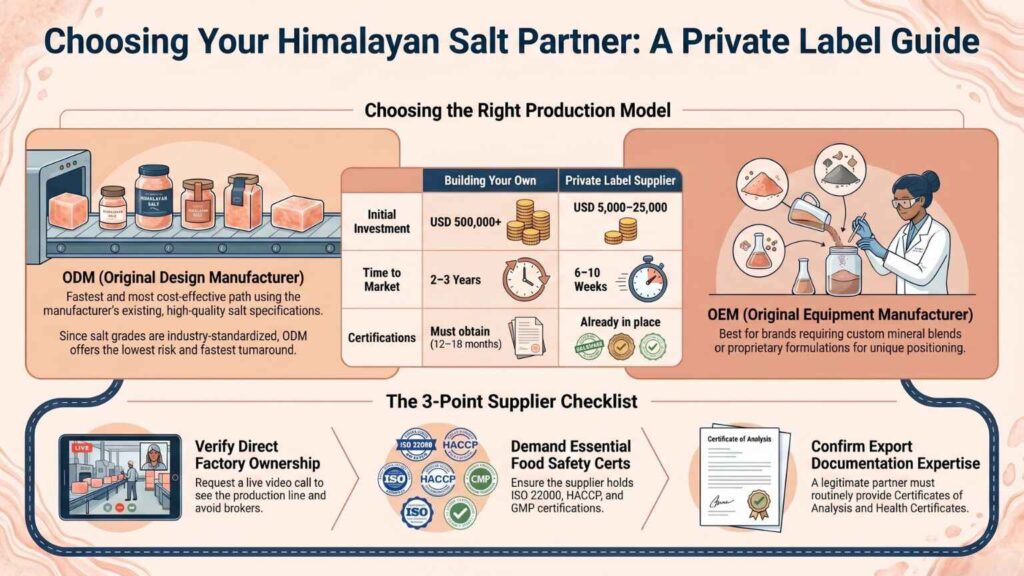
OEM and ODM are often used interchangeably in private label marketing, but they describe different production models. Knowing the difference helps you choose the right type of supplier for what you actually need.
Model | What It Means | Best For |
ODM (Original Design Manufacturer) | The manufacturer produces their existing salt product specifications (grain size, grade, processing) under your brand name and packaging | Most private label salt brands fastest, most cost-effective, lowest risk |
OEM (Original Equipment Manufacturer) | The manufacturer produces a product to your specific custom specifications, unique grain blend, special grade, or formulated mix | Brands with technical specifications that go beyond standard offerings |
White Label | Same as ODM but with multiple resellers using identical product under different brand names | Reseller models where exclusivity isn’t required |
For most Himalayan salt brands, ODM is the practical choice. Salt is a natural product, the grain sizes, color grades, and purity levels are already standardized across the industry. Branding the existing product under your label and customizing the packaging is faster, less expensive, and lower risk than commissioning a unique formulation. OEM makes sense only when you need something genuinely different, for example, a custom mineral-enhanced blend, a specific grain mix for a chef’s restaurant, or a proprietary spa formulation.
Why Choose Private Label Over Building Your Own Production?
Setting up a salt manufacturing facility from scratch mining licenses, processing equipment, food safety certifications, export registrations requires years of investment and millions of dollars. Private labeling lets you reach the market without that commitment.
Factor | Building Your Own Production | Working with a Private Label Supplier |
Initial investment | USD 500,000+ for a basic facility | USD 5,000–25,000 for a first private label order |
Time to market | 2–3 years | 6–10 weeks |
Certifications | You must obtain (12–18 months) | Already in place at the manufacturer |
Production expertise | You must build a team | Already established at the manufacturer |
Flexibility to scale | Limited by your capacity | Scale up or down per order |
Best for | Major brands committed for 10+ years | Most B2B brands and growing distributors |
What Should You Look for in a Private Label Himalayan Salt Supplier?
Use this checklist for every supplier you contact. A legitimate manufacturer should pass all five tests without hesitation.
1. Direct Factory Ownership (Not A Broker)
Many sellers online present themselves as manufacturers when they are actually brokers reselling other people’s products. A real manufacturer can show you their factory by video call, provide photos and videos of the production line, and explain their own quality control process. Brokers cannot.
2. Food Safety Certifications
For edible salt: ISO 22000 (food safety management), HACCP (hazard analysis), and GMP (good manufacturing practice) are the baseline. For US-bound orders, the supplier’s facility must also be FDA-registered. For specific markets GCC, Malaysia, Indonesia halal certification from a recognized body is required.
3. Open Sample Policy
A serious supplier will send physical samples to you, usually by courier, before any bulk order. Most cover the salt cost for a first sample; you pay courier. A supplier who refuses to send samples, or who only sends generic photos instead of actual product, is a red flag.
4. Real Packaging Capabilities
Ask for photos of their actual packaging line and examples of recent private label work for other clients (with permission). A supplier with real capabilities can show you the machinery bottle fillers, pouch sealers, label printers and previous packaging examples.
5. Export Documentation Experience
A good supplier handles export documents, commercial invoice, packing list, certificate of origin, certificate of analysis, health certificate as a routine part of every order. Ask which markets they regularly ship to. If they hesitate or claim not to be familiar with documentation for your country, they are not the right supplier for an international order.
Sobaan Salts has been manufacturing and exporting Himalayan salt since 2001, ships to over 90 countries, and holds ISO 9001, HACCP, and GMP certifications. You can review our complete list of certifications and quality documents before placing any inquiry.
What Packaging Options Should a Good Private Label Supplier Offer?
Packaging is where a private label most visibly differentiates your brand. A capable supplier should offer flexibility across format, size, and branding. Standard private label packaging options for Himalayan salt include:
Packaging Format | Common Sizes | Best For |
Glass jars (with cork or screw lid) | 100g, 250g, 500g, 1kg | Retail food brands, gourmet positioning, gift sets |
Grinder bottles | 100g, 200g | Cooking salt brands sold in supermarkets |
Kraft paper pouches (stand-up) | 100g, 250g, 500g, 1kg | Wellness, organic positioning, modern retail |
PET plastic pouches | 100g to 5kg | Mass-market retail, food service |
Plastic shakers / sprinkler bottles | 100g, 200g | Restaurant supply, hospitality |
PP woven bags (industrial) | 25kg, 50kg | Bulk distributors, repackers, food service |
FIBC jumbo bags | 500kg, 1,000kg | Large-volume B2B buyers, repackers |
Beyond the container itself, branding customization should cover full-color label printing, embossed or foil-stamped logos, custom shape labels, nutritional information panels formatted for your market’s regulations, QR codes, and barcodes. A capable manufacturer handles label design support if you do not have a designer.
What MOQ and Lead Times Should You Expect for Private Label Salt?
Minimum order quantity and lead time vary by manufacturer, but typical industry standards for private label Himalayan salt are:
Product Type | Typical MOQ | Typical Lead Time |
Bulk private label (25kg/50kg PP bags) | 1 metric ton | 3–6 weeks |
Retail private label (jars, pouches, grinders) | 500 kg or 5,000 units | 6–10 weeks |
Premium custom packaging (glass jars + custom labels) | 500 kg or 3,000 units | 8–12 weeks |
Bath salt private label | 500 kg to 1 metric ton | 5–8 weeks |
Salt lamp private label | 500 pieces | 8–12 weeks |
MOQ can be flexible for established buyer relationships, but the first order usually needs to meet the standard minimum to make the production setup commercially viable. For a full breakdown of how pricing changes with volume, see our Himalayan salt wholesale pricing and MOQ guide.
What's the Step-by-Step Process for Private Label Salt Production?
A typical private label salt order moves through these stages:
- Initial inquiry: share your product type, target market, packaging format, branding requirements, and order quantity
- Quote and sample: supplier provides a quote per unit, plus ships a sample of the base salt by courier for your quality testing
- Approve sample and design: once you approve the sample, you provide brand design files (label artwork, dieline) or work with the supplier’s design team
- Production approval: supplier produces a packaging mock-up or pre-production sample for your final sign-off before mass production
- Production: once approved, production typically takes 4–8 weeks depending on volume and packaging complexity
- Pre-shipment inspection: supplier sends production photos and a packing list for your review before the shipment leaves the factory
- Export documentation: supplier prepares commercial invoice, packing list, certificate of origin, COA, and health certificate
- Shipment: supplier loads the container, the shipment moves to port, and the Bill of Lading is issued
What Red Flags Should You Watch Out For?
Most legitimate manufacturers in Pakistan are professional and reliable. But the industry has its share of brokers and underperformers. Common warning signs include:
- Refusal to do a video call from the actual factory: a manufacturer should be able to show their production floor on demand
- No third-party lab analysis on the salt: a legitimate supplier provides a Certificate of Analysis from an independent lab, not a self-issued document
- Vague or evasive answers about MOQ and pricing: a serious supplier gives concrete numbers in writing
- Inability to name specific markets they currently export to or provide buyer references
- Generic certificate images instead of actual certificate documents with verifiable issuing-body numbers
- Communication only through WhatsApp or generic email, no company domain email address
- Prices significantly below the industry range without explanation: this often signals lower grade or undocumented product
If you are sourcing private label salt for the first time, plan for one round of trial orders before committing to a long-term supplier. A 1-ton trial order costs less than the price of a bad full-container shipment, and it lets you verify the supplier’s actual quality, communication, and documentation in real conditions.
How Does Sobaan Salts Approach Private Label Manufacturing?
Sobaan Salts manufactures private label Himalayan salt for food brands, wellness companies, and distributors across more than 90 countries. The approach is straightforward:
- Direct factory ownership in Sialkot, Pakistan. no broker layer between you and production
- ISO 9001, HACCP, and GMP certified facility with FDA-registered status for US-bound orders
- MOQ from 1 metric ton for bulk private label; 500 kg for retail packaging formats
- Packaging options across all standard formats, glass jars, kraft pouches, grinder bottles, custom shapes, and bulk PP/FIBC bags
- Full export documentation handled in-house commercial invoice, COA, certificate of origin, health certificate
- Halal certification recognized for GCC and broader Muslim markets
For full details on packaging options, branding support, and minimum order quantities, visit Himalayan salt private labeling or request a custom quote for your specific brand requirements.
Where Does Supplier Selection Fit in the Bigger Import Process?
Choosing your supplier is the first major decision in the import process but it’s only the beginning. For the full workflow from supplier selection to warehouse delivery, including documents, shipping, and customs clearance, see our step-by-step guide to importing Himalayan salt from Pakistan.
Frequently Asked Questions
What’s the difference between OEM and ODM for private label salt?
ODM means the manufacturer produces their existing salt product under your brand name with your packaging, the standard arrangement for most salt brands. OEM means the manufacturer produces a product to your specific custom specifications, which is rarer for salt because the product is already naturally standardized.
What’s the minimum order quantity for private label Himalayan salt?
Typical MOQs are 1 metric ton for bulk private label packaging (25kg or 50kg bags) and 500 kg for retail formats like jars, pouches, and grinder bottles. Salt lamp private labels usually start at 500 pieces. MOQ may be flexible for established buyer relationships.
How long does private label Himalayan salt production take?
From order confirmation to shipment-ready, typical lead times are 3 to 6 weeks for bulk packaging, 6 to 10 weeks for retail formats, and 8 to 12 weeks for premium custom packaging like glass jars with custom labels. Add ocean freight time for delivery to your destination.
How can I verify a private label supplier is a real manufacturer and not a broker?
Ask for a live video call from the factory floor. A real manufacturer can show production lines, packaging machinery, and quality control in real time. Brokers cannot. Also verify their certifications directly with the issuing bodies and request buyer references in your destination market.
Does Sobaan Salts offer private label services?
Yes. Sobaan Salts manufactures private label Himalayan salt for food brands, wellness companies, and distributors in over 90 countries. We offer bulk and retail packaging options with full export documentation. Minimum order quantities start at 500 kg for retail formats and 1 metric ton for bulk.
Sources:
- International Organization for Standardization (ISO) ISO 22000 Food Safety Management Systems:
https://www.iso.org/iso-22000-food-safety-management.html - U.S. Food and Drug Administration (FDA) Food Facility Registration: https://www.fda.gov/food/guidance-regulation-food-and-dietary-supplements/registration-food-facilities-and-other-submissions
- Codex Alimentarius (FAO/WHO) Hazard Analysis and Critical Control Point (HACCP) System and Guidelines:
https://www.fao.org/fao-who-codexalimentarius - Trade Development Authority of Pakistan (TDAP) Pakistan Salt Sector Report:
https://tdap.gov.pk/wp-content/uploads/2022/03/Report-on-Salt.pdf - World Trade Organization (WTO) Technical Barriers to Trade and Private Standards:
https://www.wto.org/english/tratop_e/tbt_e/tbt_e.htm - U.S. International Trade Administration, How to Vet International Suppliers:
https://www.trade.gov/find-buyers-and-partners
Share This Post
Article By

Zainab Abid is the Sales and Content Manager at Sobaan Salts, where she works with international buyers and businesses sourcing premium Himalayan salt products. She writes about Himalayan salt, its applications, export processes, and industry best practices, combining practical experience with insights gained from working closely with manufacturers and global customers. Her goal is to make technical topics easy to understand while helping readers make informed decisions about Himalayan salt products.
our latest posts
Table of Contents
Ready to Launch Your Private Label Himalayan Salt Brand?
Sobaan Salts — Direct manufacturer since 2001 · ISO/HACCP/GMP certified · Ships to 90+ countries · Private label MOQ from 500 kg · Full export documentation


