
FCL vs LCL for Bulk Salt Shipping: Which One Fits Your Order Size
- Zainab Abid
Key takeaways
- Salt is dense cargo. LCL freight is billed on weight or volume, whichever is greater — and salt almost always bills on weight. The common “LCL is cheaper up to 15 CBM” advice does not apply to salt.
- A container filled with salt runs out of weight long before it runs out of space. You will hit the payload limit at roughly 23 cubic metres in a 20ft container that holds about 33.
- A 40ft container carries less salt than a 20ft. Both share the same maximum gross weight rating, and the 40ft’s heavier steel eats into the payload. For salt, 20ft is the working standard.
- LCL fits trial orders, new-market testing and small first purchases at the 500 kg minimum. FCL takes over once your tonnage makes the flat container rate cheaper per tonne.
- Cost is not the only switch trigger. Moisture, cross-contamination and breakage risk push food-grade salt and salt lamps toward FCL earlier than the arithmetic alone suggests.
- Never compare an LCL per-tonne rate against an FCL ocean rate. Compare all-in delivered cost against all-in delivered cost, with every origin and destination charge included.
What is The Difference Between FCL and LCL Salt Shipping?
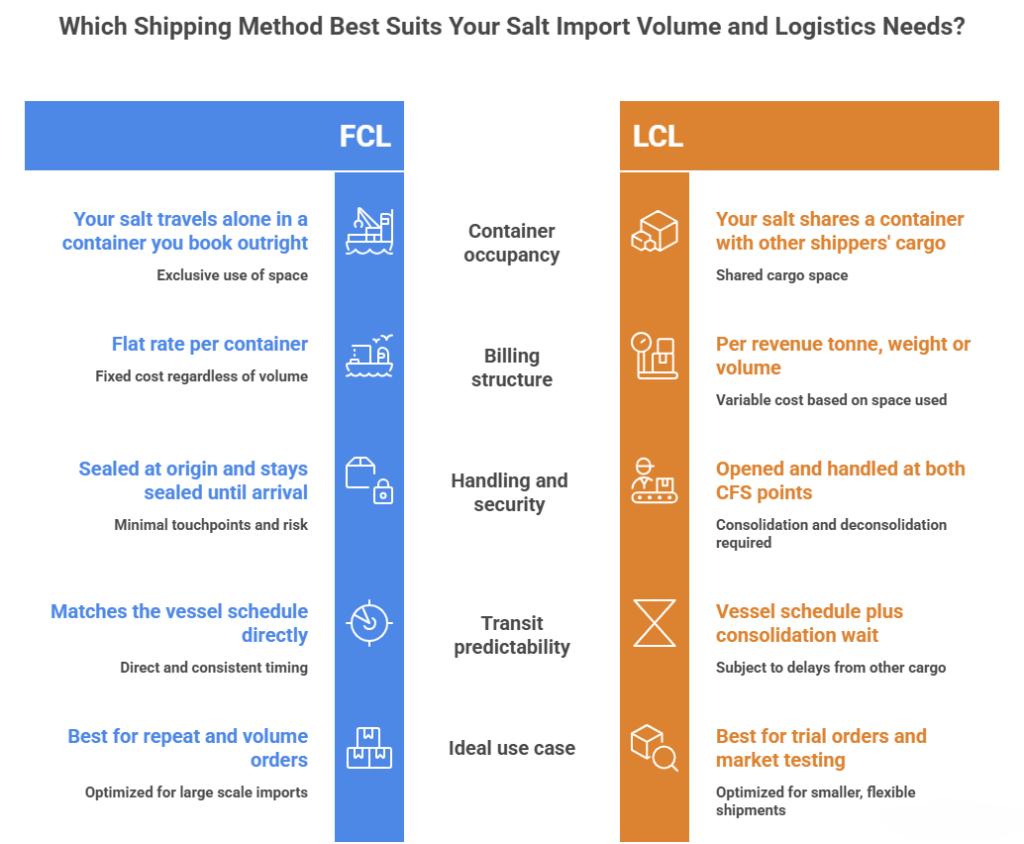
FCL means your salt travels alone in a container you book outright; LCL means your salt shares a container with other shippers’ cargo. That single difference drives every other cost, timeline and risk difference between the two modes.
In FCL, the container is stuffed at origin, sealed, and stays sealed until it reaches you. In LCL, your bags go to a Container Freight Station (CFS), wait for other cargo to fill the box, travel together, then get separated again at a destination CFS.
Factor | FCL (Full Container Load) | LCL (Less than Container Load) |
Container | Yours alone | Shared with other shippers |
Billing basis | Flat rate per container | Per revenue tonne, weight or volume, whichever is greater |
Seal | Sealed at origin, opened at destination | Opened and handled at both CFS points |
Handling touchpoints | Fewest | Consolidation plus deconsolidation |
Transit predictability | Matches the vessel schedule | Vessel schedule plus consolidation wait |
Co-loading risk | None | Shares air with unknown neighbouring cargo |
Best for salt buyers | Repeat and volume orders | Trial orders and market testing |
Most buyers meet this decision on their very first order, usually right after working out how to import Himalayan salt from Pakistan and discovering the freight choice was never explained. FCL or LCL is not a paperwork detail, it sets your cost per tonne, your transit time, and whether your salt arrives dry.
Why Does Salt Cost More To Ship LCL Than Most Cargo?
Because salt is heavy for its size, and LCL pricing punishes weight. Forwarders quote LCL on a revenue tonne, one cubic metre or one tonne, whichever is greater. Light, bulky cargo bills on volume. Salt bills on weight, every time.
Packed Himalayan salt runs roughly 1.1 to 1.3 tonnes per cubic metre depending on grain size and how it is bagged. So one cubic metre of your cargo is charged as at least 1.1 revenue tonnes, while a shipper of pillows in the same container pays for volume they barely weigh.
The insight most freight guides miss:
Generic advice says stay on LCL until roughly 13–15 CBM. That rule was written for average-density cargo.
Salt reaches the same chargeable cost at well under half that volume, because it is billed on tonnage rather than the space it occupies. A salt buyer who follows the generic rule overpays for LCL long before reaching it.
This is why order size for salt should be planned in tonnes, not cubic metres.
How Much Himalayan Salt Fits in A 20ft and 40ft Container?
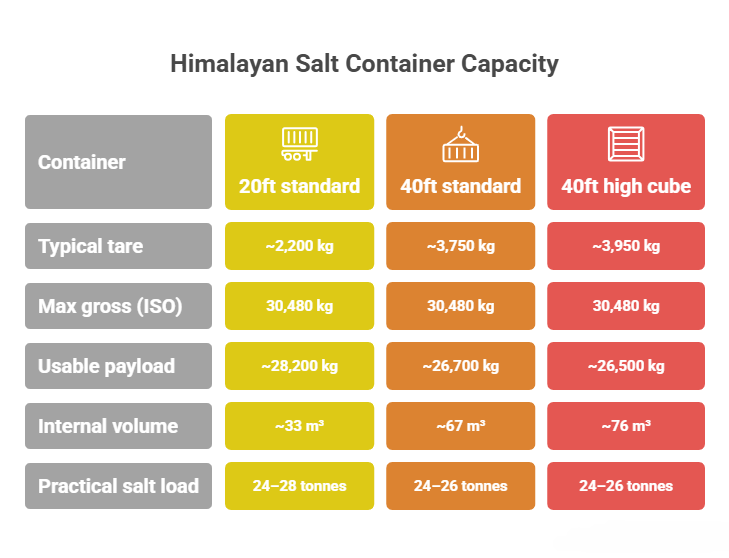
A 20ft container will typically take 24 to 28 tonnes of salt, and a 40ft slightly less. This surprises most first-time buyers, who assume double the length means double the load. It does not, the limit is weight, not floor space.
Under ISO 668, standard 20ft and 40ft dry containers share the same maximum gross weight rating of 30,480 kg. The 40ft is built from more steel, so its heavier empty weight comes straight out of your usable payload.
Container | Typical tare | Max gross (ISO) | Usable payload | Internal volume | Practical salt load |
20ft standard | ~2,200 kg | 30,480 kg | ~28,200 kg | ~33 m³ | 24–28 tonnes |
40ft standard | ~3,750 kg | 30,480 kg | ~26,700 kg | ~67 m³ | 24–26 tonnes |
40ft high cube | ~3,950 kg | 30,480 kg | ~26,500 kg | ~76 m³ | 24–26 tonnes |
Two cautions on those numbers. Some 20ft units are rated at 24,000 kg gross rather than 30,480 kg, so always read the CSC plate on the container door. And road weight limits in your own country may cap the load below the container’s rating before it ever reaches your warehouse.
Weighing Out Versus Cubing Out
Salt weighs out, it hits the weight ceiling before it fills the space. At roughly 1.2 tonnes per cubic metre, 28 tonnes of salt occupies about 23 cubic metres inside a 20ft box that offers 33. You pay for a full container and ship it visibly part-empty.
That is normal and correct. A container loaded to the roof with salt would be illegal to lift, and the shipper is legally responsible for declaring a verified gross mass before it is loaded onto the vessel.
When Should You Ship Salt As LCL?
LCL is the right choice when your order is too small to justify a container and flexibility matters more than freight efficiency. For most buyers this describes the first one or two orders, not the ongoing relationship.
- First orders and samples. Sobaan Salts sets a 500 kg minimum order quantity, which is well below a container, LCL is the only realistic route at that size.
- Testing a new market before committing to volume.
- Validating a supplier’s grade, grain size and packaging in practice.
- Protecting cash flow by ordering smaller lots more often.
- Topping up an existing stock position between full container shipments.
- Slow-moving specialty lines where a full container would sit in your warehouse for a year.
When Should You Switch From LCL To FCL?
Switch when your all-in LCL cost per tonne stops beating the flat container rate divided by your tonnage or when the cargo itself cannot afford the handling. Most salt buyers reach one of those two points sooner than they expect.
There is no universal tonnage that applies to every lane. Rates move constantly and vary by route, season and destination charges. What does not change is the shape of the decision, which comes down to five triggers.
Trigger | What it means | Action |
Cost crossover | All-in LCL cost meets or exceeds an all-in 20ft FCL quote | Quote both, compare delivered totals, book the cheaper |
Repeat ordering | You are placing LCL orders every few weeks | Consolidate into one FCL per quarter |
Moisture sensitivity | Caking is appearing on arrival | Move to FCL: shorter, sealed transit |
Food-grade supply | You supply food or wellness brands | Move to FCL to remove co-loading exposure |
Fragile lines | Lamps, bricks, tiles or slabs | Move to FCL: fewer handling points, less breakage |
How Do You Calculate Your Own FCL vs LCL Break-Even?
Do not trust a rule of thumb, run the arithmetic on your own lane. The calculation takes ten minutes and needs two quotes. It is the single most useful thing a new importer can do before booking freight.
- Confirm your order weight in tonnes and your total volume in cubic metres, including pallets and packaging.
- Ask your forwarder for an all-in LCL quote, door to door, itemised. Insist on origin CFS, destination CFS, deconsolidation, documentation and terminal charges being listed.
- Ask the same forwarder for an all-in 20ft FCL quote on the same lane, same terms.
- Divide the FCL total by your tonnage to get your FCL cost per tonne.
- Divide the LCL total by your tonnage to get your LCL cost per tonne.
- Compare the two. If LCL is within roughly ten percent of FCL, book FCL — the handling and moisture protection are worth more than the margin.
FCL cost per tonne = all-in 20ft container quote ÷ your tonnage
LCL cost per tonne = all-in LCL quote (incl. CFS charges) ÷ your tonnage
The trap is comparing an LCL rate against an FCL ocean rate. LCL quotes carry charges at both ends that do not appear on the headline number, and those charges are where LCL quietly becomes the expensive option. Which of them actually land on you depends on your agreed term, so read this alongside Incoterms for Himalayan salt buyers, FOB and CIF split costs differently once your cargo is consolidated with someone else’s.
What Risks Does LCL Add To A Salt Shipment?
LCL adds handling, time and neighbours and salt is sensitive to all three. These risks do not appear on a freight quote, which is why they get discovered on arrival rather than at booking.
- Moisture and caking. Salt is hygroscopic and pulls moisture from the air. A longer LCL journey with CFS stops at both ends means more hours in humid warehouse conditions.
- Cross-contamination. Your food-grade salt shares air with whatever else is in the box. Odorous or chemical cargo is a real exposure that a sealed FCL removes entirely.
- Breakage. Salt lamps, bricks and tiles are handled at consolidation and again at deconsolidation. Every extra touchpoint is another chance of a cracked pallet.
- Bag damage. Loose handling tears 25 kg bags, and a torn bag in a shared container becomes someone else’s problem too.
- Slower transit. Your cargo waits for the container to fill at origin, then waits to be sorted at destination.
- Demurrage and storage. Delays at a destination CFS can trigger charges. In the United States these are regulated by the Federal Maritime Commission, but they are still yours to pay.
- Shared fate on customs. A hold on another shipper’s cargo can slow the whole container.
Does FCL or LCL Matter For Food-Grade Salt Compliance?
Your customs and food-safety obligations are the same either way but FCL makes them easier to evidence. Documentation requirements do not soften because your shipment is small.
Food shipments into the United States require Prior Notice to the FDA, and ocean cargo requires an Importer Security Filing to CBP. Both filings depend on your product being classified correctly, and getting the HS code for Himalayan salt imports wrong is more costly on LCL than FCL, a classification query against your bags can hold the entire shared container, including seven other shippers’ cargo.
For buyers supplying food brands or private-label wellness lines, that sealed chain is often the deciding factor. It is far simpler to demonstrate traceability on a container that nobody else has opened.
How Sobaan Salts Handles FCL and LCL Orders
Sobaan Salts Manufacturer And Exporter ships both, and we will tell you which one your order actually needs. Our minimum order quantity is 500 kg, so a first order almost always moves LCL and that is the right call for a buyer still confirming grade and packaging.
From our facility in Sialkot, Pakistan, we have shipped to more than 90 countries and serve over 200 B2B clients. That experience means we can tell you at quote stage whether your tonnage is close to the FCL crossover on your particular lane.
Typical lead time is four to six weeks from confirmed order to dispatch, and we respond to quote requests within 24 hours. If your volumes are climbing, ask us to price both modes side by side rather than assuming LCL is still the cheaper route.
Frequently Asked Questions
Is LCL always cheaper than FCL for salt?
No. LCL is cheaper only at small tonnages, and for salt that window closes faster than for most cargo. Because LCL bills on weight rather than space, a dense product like salt reaches the crossover point at a much lower volume than generic freight advice suggests.
What is the minimum quantity for an LCL salt shipment?
Sobaan Salts accepts orders from 500 kg, which sits comfortably in LCL territory. Forwarders will generally consolidate from around one cubic metre, so a 500 kg to 1 tonne order ships as LCL without difficulty.
How much longer does LCL take than FCL?
LCL adds time at both ends rather than at sea. Your cargo waits at origin until the container is filled, and waits again at destination to be deconsolidated and sorted. The ocean leg itself is identical — the delay is in the warehouse, not on the water.
Can food-grade salt be shipped LCL?
Yes, and it is done routinely. The consideration is co-loading: in a shared container your salt travels alongside cargo you did not choose. Buyers supplying food brands often move to FCL specifically to keep the container sealed from origin to delivery.
Does salt get damaged more often in LCL shipping?
The risk is higher because handling is higher. Every consolidation and deconsolidation point adds a chance of torn bags or cracked salt bricks, and the longer warehouse exposure increases moisture pickup. Fragile lines such as lamps and tiles are the most affected.
Sources
- International Maritime Organization — Verification of the gross mass of a packed container (SOLAS regulation VI/2; resolution MSC.380(94); guidelines MSC.1/Circ.1475). https://www.imo.org/en/ourwork/safety/pages/verification-of-the-gross-mass.aspx
- International Organization for Standardization — ISO 668, Series 1 freight containers: classification, dimensions and ratings.
https://www.iso.org/standard/76912.html - U.S. Customs and Border Protection — Importer Security Filing (10+2) requirements for ocean cargo.
https://www.cbp.gov/border-security/ports-entry/cargo-security/importer-security-filing-102 - Federal Maritime Commission — Assessment and mitigation of demurrage and detention charges.
https://www.fmc.gov/detention-and-demurrage/ - International Chamber of Commerce — Incoterms 2020 rules.
https://iccwbo.org/business-solutions/incoterms-rules/incoterms-2020/ - U.S. Food and Drug Administration — Prior Notice of imported food shipments.
https://www.fda.gov/industry/fda-import-process/prior-notice-imported-foods
Share This Post
Article By

Zainab Abid is the Sales and Content Manager at Sobaan Salts, where she works with international buyers and businesses sourcing premium Himalayan salt products. She writes about Himalayan salt, its applications, export processes, and industry best practices, combining practical experience with insights gained from working closely with manufacturers and global customers. Her goal is to make technical topics easy to understand while helping readers make informed decisions about Himalayan salt products.
Related posts
Table of Contents
Need Bulk Himalayan Salt for Winter Surface Maintenance?
Source premium Himalayan salt directly from a verified Pakistani manufacturer trusted by distributors and importers in over 90 countries.


