
The Growing Demand for Himalayan Pink Salt: A Global Market Intelligence Report for B2B Buyers
- Zayan Rauf
Key takeaways
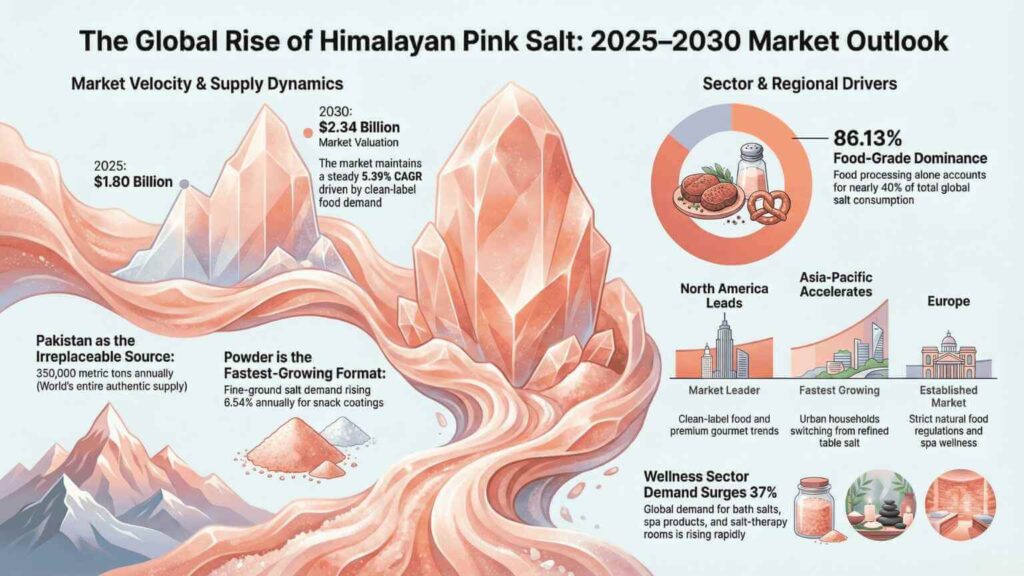
- The Himalayan pink salt market is valued at USD 1.80 billion in 2025 and is projected to reach USD 2.34 billion by 2030 at a steady 5.39% CAGR driven by clean-label food demand and global wellness growth.
- Pakistan supplies ~350,000 metric tons of pink salt annually, generating approximately USD 120 million in export value making it the world’s dominant and essentially irreplaceable source.
- Food-grade Himalayan salt holds 86.13% of the total market share, with the food processing segment alone accounting for 39.64% of global consumption.
- Asia-Pacific is the fastest-growing import region at 6.33% CAGR, driven by urban consumers switching from refined table salt. India’s imports alone grew from 462 to 642 metric tons between 2023 and 2024.
- The wellness sector bath salts, spa products, and halotherapy is the second largest demand driver after food processing, with wellness applications growing 37% and salt-therapy room installations rising 28% globally.
- For B2B buyers, this market trajectory means one thing: demand across food, wellness, and industrial applications is rising consistently in every major importing region and supply remains concentrated in one geography.
Himalayan pink salt has moved well beyond a niche health food item. It is now a mainstream B2B commodity across food manufacturing, wellness brands, private label retail, and industrial applications all over the world.
For B2B buyers distributors, food manufacturers, spa brands, and importers, understanding where demand is growing, which segments are accelerating, and what is driving buyer behaviour globally is the foundation of a sound sourcing strategy. This is that market intelligence briefing.
Global Market Snapshot: The Numbers That Matter
Here are the key data points every B2B buyer should know before entering or scaling in this market:
Metric | Data Point | Source |
Global market value (2025) | USD 1.80 billion | Mordor Intelligence, 2025 |
Projected value (2030) | USD 2.34 billion | Mordor Intelligence, 2025 |
Market CAGR (2025–2030) | 5.39% | Mordor Intelligence, 2025 |
Pakistan annual export volume | ~350,000 metric tons | Future Market Insights, 2025 |
Pakistan annual export value | ~USD 120 million | Future Market Insights, 2025 |
USA import value (2023) | USD 19.1 million | Future Market Insights, 2025 |
Food-grade share of total market | 86.13% (2024) | Mordor Intelligence, 2025 |
Food processing segment share | 39.64% (2024) | Mordor Intelligence, 2025 |
Fastest-growing format | Powder — 6.54% CAGR (to 2030) | Mordor Intelligence, 2025 |
Fastest-growing geography | Asia-Pacific — 6.33% CAGR | Mordor Intelligence, 2025 |
Pakistan is the world’s only large-scale producer of genuine Himalayan pink salt and that supply concentration is actually a commercial advantage for buyers who secure a reliable, certified supplier. Volume is available. The variable is quality verification and compliance documentation.
Did You Know?
The powder format is the fastest-growing grade of Himalayan salt projected at 6.54% CAGR through 2030. [1]
Where in the World Is Demand Growing? Regional Breakdown
Demand is not growing uniformly. Knowing which regions are leading, which are emerging, and what is driving each market helps buyers position their sourcing and distribution strategy correctly.
Region | Demand Status | Key Growth Driver | Fastest-Growing Application |
North America | Leading: 31.32% revenue share (2024) | Clean-label food trends, premium gourmet demand, wellness products | Retail & food processing |
Europe | Established: Germany, France, UK, Netherlands | Strict clean-label regulations, natural food preference, spa wellness | Private label food & bath products |
Asia-Pacific | Fastest-growing: 6.33% CAGR (2025–2030) | Urban households switching from table salt, rising health awareness | Edible food-grade, gourmet cooking |
GCC & Middle East | High growth: UAE, Saudi Arabia leading | Mineral deficiency awareness, electrolyte demand in hot climate, halal food boom | Edible & wellness (electrolyte products) |
Latin America | Emerging | Natural food movement, rising disposable income | Food seasoning & cosmetic grade |
India | Rapid import growth: 462 MT (2023) → 642 MT (2024) | Ayurvedic tradition, clean-label movement, cosmetic industry | Edible salt & skincare formulations |
North America remains the largest market by revenue. But Asia-Pacific and the GCC are where the rate of growth is most pronounced creating strong import demand in markets where Himalayan salt sourcing relationships are still being established.
4 Forces Driving Global Himalayan Salt Demand
1. The Clean-Label Movement in Food Manufacturing
Food manufacturers across North America, Europe, and Asia-Pacific are reformulating products to remove artificial additives, anti-caking agents, and synthetic fortification. Himalayan pink salt naturally unprocessed, mineral-rich, and additive-free fits this clean-label mandate precisely. It now appears in premium snacks, artisanal breads, charcuterie, gourmet seasoning blends, and clean-label ready meals. [3]
2. The Global Wellness Industry
Bath salts, scrubs, halotherapy chambers, spa treatments, and skincare formulations account for a growing share of Himalayan salt’s global consumption. Salt-therapy room installations grew 28% globally, and wellness-sector demand rose 37%. [4] Brands formulating spa and therapeutic products are sourcing Himalayan salt in cosmetic and food-grade specifications at increasing volumes.
3. Premium Foodservice & Restaurant Demand
Salt slabs, cooking blocks, and coarse finishing grades are standard across premium hotel kitchens, restaurant groups, and gourmet food retailers in the USA, UK, France, and Germany. As this trend spreads to Asia-Pacific markets particularly Japan, South Korea, and Australia import volumes in these regions are climbing at above-average rates. [2]
4. Private Label Growth Across Retail Channels
Online retail expanded its Pink Himalayan Salt market share by 39% in one year. [4] This e-commerce growth is largely driven by private label brands launching on Amazon, Shopify, and regional platforms all of whom source bulk product and repackage under their own labels. Private label demand is one of the most significant drivers of B2B bulk sourcing volumes today.
Did You Know?
More than 48% of the food processing industry now incorporates Himalayan pink salt into flavoured snacks and seasoning blends. [4]
Key Application Segments: Where the Volume Is
For B2B buyers, understanding which application segment is growing fastest helps determine the right grade, certification, and pack format to source.
- Food processing (39.64% share): The dominant segment. Includes meat curing, snack seasoning, bread and bakery, and ready meal formulation. Requires food-grade certification and consistent NaCl purity.
- Retail & private label (6.72% CAGR, fastest growing by channel): Consumer-packaged product sold through supermarkets and e-commerce. Requires custom pack sizes, compliant labelling, and private label support from the supplier.
- Wellness & spa (37% growth): Bath salt, scrubs, halotherapy, massage, and spa-room products. Requires cosmetic-grade or food-grade specifications depending on the application and destination market regulations.
- Industrial (6.44% CAGR alongside animal grades): Water softeners, pool treatment, animal lick blocks, and de-icing. Requires industrial-grade specifications and large-volume consistent supply.
- Decorative & lifestyle (42% growth in salt lamps and bricks): Salt lamps, candle holders, salt tiles, and interior décor products. Requires specific raw crystal grades and aesthetic quality standards.
What This Market Growth Means for B2B Buyers
A growing market is not automatically a simple market to enter. Three practical implications stand out for buyers sourcing Himalayan salt in 2025 and beyond.
First, demand consistency is increasing but so is quality scrutiny. As regulatory frameworks tighten in the EU, USA, and GCC (particularly around heavy metal limits and labelling compliance), the gap between certified and uncertified suppliers is widening. Buyers who lock in certified supply chains now are insulated from future compliance disruptions.
Second, private label and custom packaging are becoming the norm rather than the exception. Most B2B buyers entering new markets are not sourcing generic bulk salt, they are sourcing finished, labelled, brand-ready products. This means supplier capabilities around packaging, documentation, and labelling flexibility matter as much as price.
Third, supply concentration in Pakistan is a feature, not a risk when managed correctly. Over 91% of authentic Himalayan pink salt originates from the Khewra mines. [4] Buyers who work directly with Pakistan-based manufacturers rather than through intermediaries get better pricing, faster documentation, and direct access to quality verification.
Read More: EU Food Safety Regulations for Himalayan Salt Imports
Working With Sobaan Salts
Sobaan Salts has supplied certified Himalayan pink salt to buyers across 90+ countries since 2001, covering food-grade, cosmetic-grade, and industrial-grade specifications across all major application segments.
We provide batch-specific COAs, full export documentation, private label packaging, and an export team that supports buyers from first inquiry through to port clearance. Whether you are entering the market for the first time or scaling an existing supply chain, we are built for both.
Frequently Asked Questions
Q: What is the current global market size for Himalayan pink salt?
A: The global Himalayan pink salt market is valued at USD 1.80 billion in 2025 and is projected to reach USD 2.34 billion by 2030, growing at a CAGR of 5.39%. [1] Figures vary across research firms depending on how the market is scoped — whether it includes only edible grades or all applications including wellness, industrial, and decorative products.
Q: Which countries import the most Himalayan salt?
A: North America accounts for 31.32% of global revenue. The USA is the largest single importer, bringing in approximately USD 19.1 million worth in 2023. [2] Germany, the UK, France, the Netherlands, and India are major importers. Asia-Pacific as a region is growing the fastest at 6.33% CAGR through 2030.
Q: What is driving demand for Himalayan salt in the food industry?
A: The clean-label movement is the primary driver of food manufacturers reformulating products to remove synthetic additives by replacing refined table salt with Himalayan pink salt. [3] It is now used across snack coatings, artisan bread, cured meats, seasoning blends, and ready meals in markets globally.
Q: Why is Asia-Pacific the fastest-growing region?
A: Urban household transitions from traditional table salt to premium natural alternatives combined with rising disposable income and health awareness in markets like India, Japan, South Korea, and Australia are driving above-average import growth. India’s Himalayan salt imports grew from 462 to 642 metric tons between 2023 and 2024 alone.
Q: How does market growth affect bulk salt pricing?
A: Consistent global demand growth stabilises pricing for buyers who work directly with manufacturers. Buyers sourcing through intermediaries or from uncertified suppliers face more volatile pricing as demand pressures expose supply chain inefficiencies. Long-term supply agreements with Pakistan-based certified manufacturers are the most effective pricing protection strategy.
References
[1] Mordor Intelligence. (2025). Pink Himalayan Salt Market — Size, Share & Trends Analysis Report (2025–2030).
https://www.mordorintelligence.com/industry-reports/pink-himalayan-salt-industry
[2] Future Market Insights. (2025). Himalayan Salt Market Size, Trends & Forecast 2025–2035.
https://www.futuremarketinsights.com/reports/himalayan-salt-market
[3] Grand View Research. (2024). Himalayan Salt Market Size, Share & Trends Analysis Report (2024–2030).
https://www.grandviewresearch.com/press-release/global-himalayan-salt-market
[4] 360 Research Reports. (2025). Pink Himalayan Salt Market — Industry Report and Forecast (2025–2032).
https://www.360researchreports.com/market-reports/pink-himalayan-salt-market-209386
[5] FAO/WHO Codex Alimentarius. (2025). Standard for Food-Grade Salt, CXS 150-1985 (updated).
https://www.fao.org/
[6] Pakistan Mineral Development Corporation (PMDC). Khewra Salt Mine — Production Data & Reserve Estimates. Government of Pakistan.
https://www.pmdc.org.pk
[7] Research and Markets. (2025). Pink Himalayan Salt Market — Global Forecast to 2030.
https://www.researchandmarkets.com/reports/5666524/pink-himalayan-salt-market-global-forecast-to
[8] Market Research Future. (2025). Pink Himalayan Salt Market Size, Share, Report & Forecast to 2032.
https://www.marketresearchfuture.com/reports/pink-himalayan-salt-market-30427
Share This Post
Article By