
Himalayan Salt Certificate of Analysis (COA): How to Read One and What to Verify
- Zainab Abid
Key takeaways
- A specification defines the standard. A COA proves one specific batch meets it.
- Always verify the batch number. Without it, the COA cannot confirm your shipment.
- Food-grade salt should contain at least 97% sodium chloride. Premium Himalayan salt often exceeds 98%.
- Check that heavy metals are tested and reported within Codex limits.
- Prefer a COA from an independent, accredited laboratory, not only the supplier’s in-house report.
- A COA verifies a single batch only. Review it alongside samples, origin, and product specifications.
A Certificate of Analysis turns a supplier’s quality claims into something you can check. Yet most buyers glance at the sodium chloride figure and file it away. This guide reads a Himalayan salt COA line by line, what each value means and how to confirm it is genuine, the verification step at the centre of how to choose a Himalayan salt manufacturer.
What is a Certificate of Analysis for Himalayan Salt?
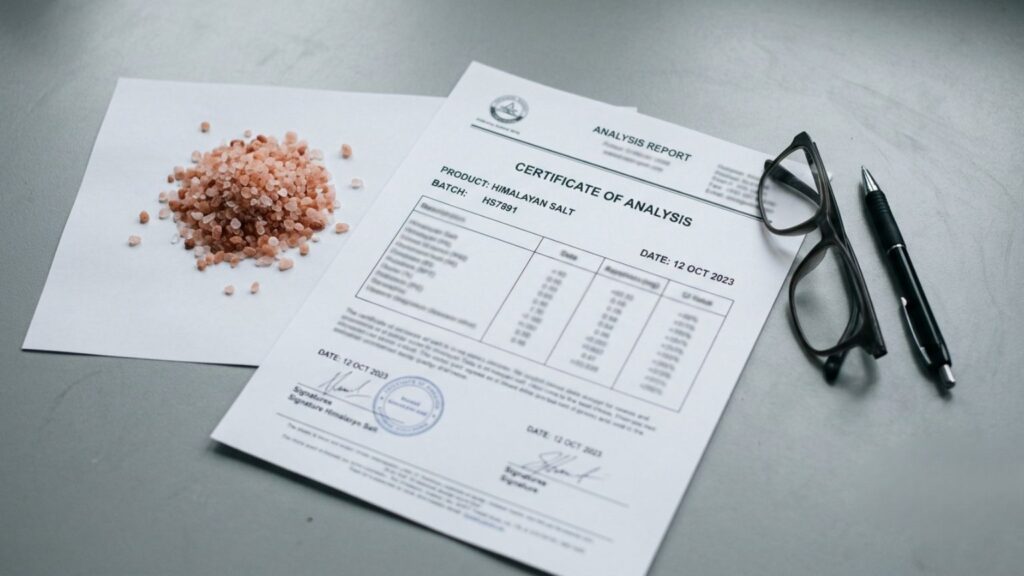
A Certificate of Analysis, or COA, is a laboratory-issued document reporting the measured test results for one specific batch of salt. It states what the salt actually contains purity, moisture, impurities, and heavy metals, against the limits it is meant to meet. A genuine COA describes a single production lot, not the product in general.
That distinction is the whole point. A supplier can describe its salt in glowing terms on a website, a COA is where those claims become numbers a laboratory has signed its name to. It is the difference between being told the salt is pure and being shown the measurement.
COA Vs Specification Sheet, What is the Difference?
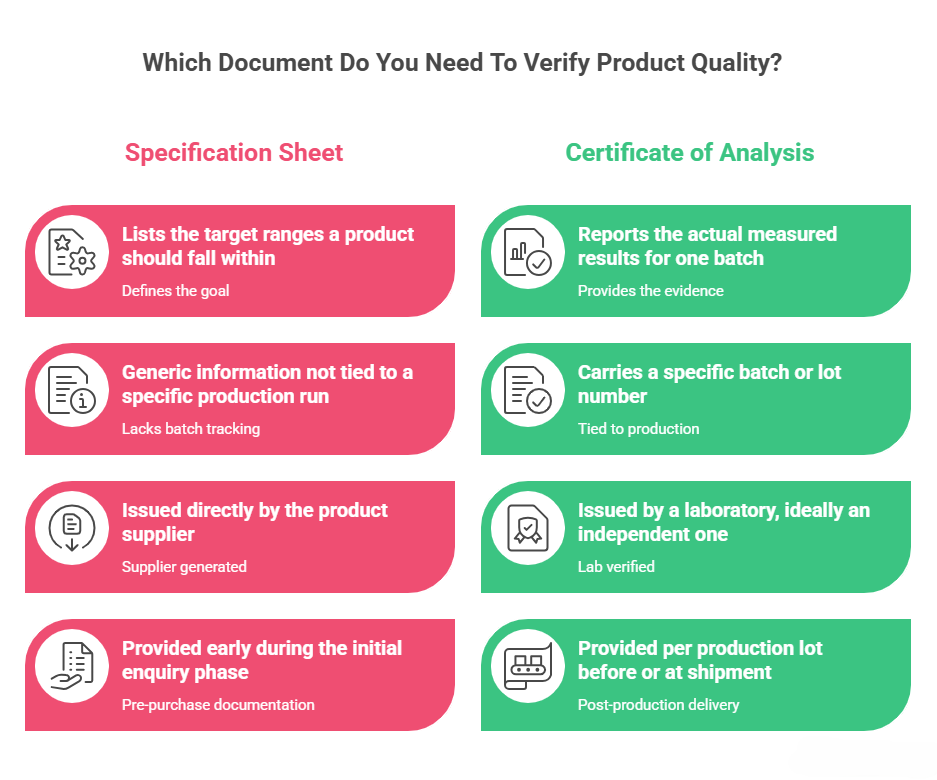
A specification is the promise, a COA is the proof. A specification sheet lists the target ranges a product should fall within. A COA reports the actual measured results for one batch. If a supplier sends only a specification, they have shown you the goal, not the evidence that this shipment meets it.
| Specification sheet | Certificate of Analysis |
What it shows | Target ranges the product should meet | Measured results for one real batch |
Tied to a batch | No, it is generic | Yes, carries a batch or lot number |
Issued by | The supplier | A laboratory (ideally independent) |
Proves your order | No | Yes, when the batch matches your shipment |
When you get it | Early, during enquiry | Per production lot, before or at shipment |
What Should a Himalayan Salt COA Actually Contain?
Every credible salt COA carries the same core fields: product identity, a batch number, the test date, the parameters measured, the results, the limits, and the issuing laboratory. Missing any of these is a warning sign. The batch number matters most, it is what ties the certificate to the salt actually loaded into your container.
Field | What it should show | Why it matters |
Product & grade | Exact product name and grade tested | Confirms the COA covers your salt, not another line |
Batch / lot number | A unique code for the tested lot | Ties the certificate to your physical shipment |
Test date | When the analysis was run | A stale COA may not reflect your batch |
Parameters & results | Each measured value, with units | The actual evidence of quality |
Limits / spec | The threshold each result is judged against | Lets you see pass or fail at a glance |
Laboratory | Named lab, method, signature or stamp | Shows who is accountable for the numbers |
How Do You Read the Purity and Composition Values?
Start with sodium chloride content, the core purity measure. Under the Codex food-grade salt standard, food-grade salt must contain at least 97% NaCl on a dry basis, exclusive of additives, premium Himalayan salt often exceeds 98%. Then read moisture, water-insoluble matter, and the calcium, magnesium, and sulphate figures that make up the natural remainder.
- Sodium chloride (NaCl %): the purity headline. Compare it to the 97% Codex floor, higher is purer.
- Moisture (%): high moisture risks caking and means you are paying salt price for water weight.
- Water-insoluble matter (%): sand, clay, or grit that will not dissolve. Lower is cleaner.
- Calcium, magnesium, sulphate: naturally present secondary compounds; unusually high figures can affect taste and clumping.
A Verified Benchmark, Not An Invented One
Do not trust a COA that reports a suspiciously perfect 100% NaCl, natural rock salt always contains a small natural remainder, which is why the Codex minimum is 97%, not 100%.
As a real reference point: a recent PCSIR laboratory report for Sobaan Salts’ fine edible salt recorded 98.1% sodium chloride, above the Codex floor, with a small natural remainder, exactly as a genuine result should look.
How Do You Read the Heavy-Metal Results?
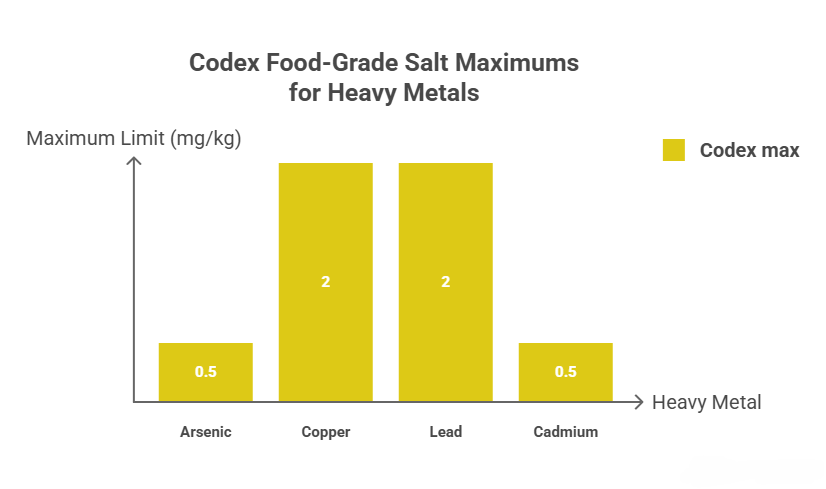
Natural rock salt can carry trace heavy metals, so a credible COA screens for them and reports each below a recognised limit. The Codex food-grade salt standard sets maximums you can check against directly. A result at or above any limit or a missing heavy-metal section entirely should stop the order until it is explained.
Heavy metal | Codex food-grade salt maximum | Reported as |
Arsenic | 0.5 mg/kg | As |
Copper | 2 mg/kg | Cu |
Lead | 2 mg/kg | Pb |
Cadmium | 0.5 mg/kg | Cd |
Two reading notes. “mg/kg” and “ppm” mean the same thing on a salt COA, so do not be thrown by the unit. And mercury and other contaminants are further governed by the Codex General Standard for Contaminants (CXS 193-1995), a thorough COA screens for mercury too.
How Do You Verify a COA is Genuine and Not Fabricated?
Treat the certificate as a claim until you can confirm its source. A fabricated or template COA usually fails on the specifics: no accredited laboratory, no batch number, no test methods, and suspiciously round or identical numbers. A real COA names the laboratory and the standard methods it uses and it ties to your batch.
- Independent, accredited lab: look for a third-party laboratory, ideally accredited to ISO/IEC 17025, not the supplier’s own letterhead.
- Batch match: the lot number on the COA should match the salt in your shipment documents.
- Named test methods: credible COAs cite recognised methods, such as those in the Codex methods standard (CXS 234-1999).
- Recent date: the analysis should relate to your production run, not one from years earlier.
- Both results and limits shown: a value with no threshold beside it is hard to judge and easy to fake.
- Lab identity: a real laboratory name, signature or stamp, and contact details you can reach.
Why An In-House COA is Not Enough?
An in-house result is the supplier grading its own work. It can be perfectly accurate but you cannot independently verify it, and a supplier confident in its salt will provide third-party testing. Ask for a COA from an independent, accredited laboratory rather than a sheet printed on the supplier’s own letterhead.
This is one of the clearest signals separating a serious manufacturer from a reseller. Reluctance to provide independent testing, or an insistence that the in-house sheet is sufficient, belongs on your list of supplier red flags, not in your purchase decision.
What a COA Does Not Tell You?
A COA proves what one batch contained on one day. It does not, on its own, guarantee the next batch, confirm where the salt was mined, or tell you whether the grade suits your product. It is a powerful verification tool, not a complete one, read it alongside other evidence.
- Consistency: one clean COA does not prove every future lot will match. Batch-to-batch reliability comes from history.
- Origin: a COA reports composition, not provenance. Traceability needs separate documentation.
- Fit for purpose: a result can pass every limit and still be the wrong grain size or grade for your application.
- Handling after testing: transport and storage can affect moisture and caking after the analysis was run.
How Sobaan Salts Handles Certificates of Analysis (COA)?
Run this same scrutiny on us. Sobaan Salts, the top himalayan salt exporter, provides an independent Certificate of Analysis, tied to your batch, from accredited laboratory testing, not an in-house sheet. A recent PCSIR report for our fine edible salt recorded 98.1% sodium chloride, above the 97% Codex floor, with heavy metals screened against recognised limits.
We share the report, the batch reference, and physical samples on request, because a quality claim you cannot verify should not shape your decision. You can review our certifications directly and ask for the COA that matches the exact grade you intend to order.
Verify Before You Commit
Ask us for the independent COA and a sample of the grade you need, then read it against every check in this guide.
Request a COA and samples, we reply within 24 hours, and we would rather you verify than take our word for it.
Frequently Asked Questions
What is the difference between a Certificate of Analysis and a specification sheet?
A specification lists the target ranges a product should meet; a Certificate of Analysis reports the actual measured results for one real batch. The specification is the promise, the COA is the proof. If a supplier sends only a specification, ask for the COA tied to the batch you are buying.
What NaCl purity should food-grade Himalayan salt have?
Under the Codex food-grade salt standard, the minimum is 97% sodium chloride on a dry basis, exclusive of additives. Premium Himalayan salt commonly tests above 98%. Be sceptical of any COA claiming a perfect 100%, natural rock salt always contains a small natural remainder.
What heavy metals should a Himalayan salt COA test for?
A credible COA screens for arsenic, copper, lead, and cadmium against the Codex food-grade salt maximums, and mercury under the Codex contaminants standard. Each result should sit below its limit. On a salt COA, mg/kg and ppm mean the same thing, so do not be confused by the unit.
How do I know a COA is from an independent lab and not made up?
Check for a named, accredited laboratory — ideally ISO/IEC 17025 — a batch number that matches your shipment, cited test methods, a recent date, and both results and limits shown. A fabricated COA usually lacks these specifics and shows suspiciously round or repeated numbers.
Should the COA match my specific shipment?
Yes. The batch or lot number on the COA should match the salt in your shipping documents. A COA for a different batch, or a generic one with no lot number, does not prove anything about the salt actually arriving in your container. The batch link is what makes it evidence.
Sources:
- Codex Alimentarius Commission (FAO/WHO): Standard for Food-Grade Salt, CXS 150-1985 (minimum 97% NaCl on a dry basis; maximum limits for arsenic, copper, lead, and cadmium). https://www.fao.org/input/download/standards/3/CXS_150e.pdf
- Codex Alimentarius Commission (FAO/WHO): General Standard for Contaminants and Toxins in Food and Feed, CXS 193-1995 (mercury and other contaminants).
https://www.fao.org/input/download/standards/17/CXS_193e_2015.pdf - Codex Alimentarius Commission (FAO/WHO): Recommended Methods of Analysis and Sampling, CXS 234-1999.
https://www.fao.org/input/download/standards/388/CXS_234e_2015.pdf - International Organization for Standardization / IEC: ISO/IEC 17025, General requirements for the competence of testing and calibration laboratories.
https://www.iso.org/standard/66912.html
Share This Post
Article By

Zainab Abid is the Sales and Content Manager at Sobaan Salts, where she works with international buyers and businesses sourcing premium Himalayan salt products. She writes about Himalayan salt, its applications, export processes, and industry best practices, combining practical experience with insights gained from working closely with manufacturers and global customers. Her goal is to make technical topics easy to understand while helping readers make informed decisions about Himalayan salt products.
our latest posts
Table of Contents
From Checking Documents to Placing Orders
Send us your grade and volume, and we’ll return an independent COA, a sample, and a quote.


