
Packaging Requirements for International Salt Export: Standards & Best Practices
- Zayan Rauf
Key takeaways
- ISO 22000 and ISO/TS 22002-4 set international standards for food packaging manufacturing
- FDA requires food-grade materials and proper labeling for all salt products entering the USA market
- EU Regulation EC 1935/2004 governs food contact materials across European markets
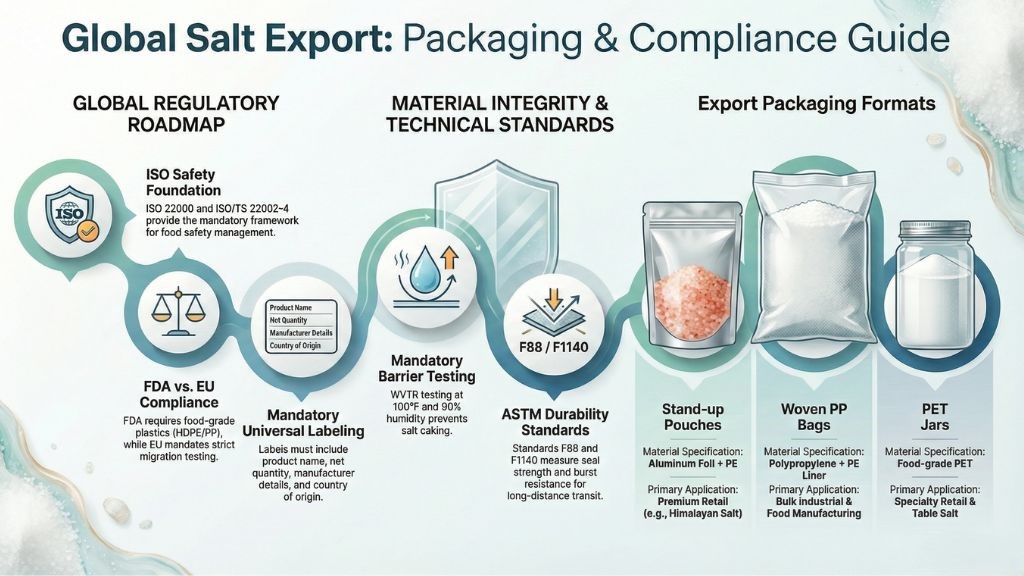
- Moisture-proof packaging is mandatory with WVTR testing at 100°F (37.8°C) and 90% RH conditions
- Private label packaging requires compliance with both origin and destination country regulations
- Proper documentation including Declaration of Compliance is essential for customs clearance
- ASTM testing standards measure barrier properties critical for long-distance salt transportation
International salt exports require strict adherence to packaging standards that ensure product safety, quality preservation, and regulatory compliance across global markets. For B2B salt exporters and manufacturers, understanding these requirements is critical for successful market entry and maintaining long-term business relationships with international buyers.
The global food packaging market reached $405.44 billion in 2024 and is projected to grow to $651.66 billion by 2033. Proper packaging protects salt from moisture, contamination, and quality degradation during transit while meeting the specific regulatory requirements of destination countries. This guide covers essential packaging standards and best practices for Himalayan salt and other specialty salt products in international trade.
International Packaging Standards for Salt Export
ISO Standards for Food Packaging
ISO 22000 provides the framework for food safety management systems applicable to any organization in the food chain, including salt manufacturers and packaging suppliers. The standard integrates HACCP principles with Good Manufacturing Practices to ensure food safety throughout production and packaging [2].
For salt packaging specifically, ISO/TS 22002-4 establishes prerequisite programs for food packaging manufacturing. This technical specification assists organizations in controlling food safety hazards during the manufacture of packaging materials including plastics, paper, glass, and metal containers that come into direct contact with salt products.
Key ISO Certification Benefits:
- Demonstrates commitment to international food safety standards
- Opens access to quality-conscious developed markets
- Provides competitive advantage in B2B negotiations
- Ensures consistent quality control throughout packaging process
- Builds buyer confidence through third-party verification
Salt exporters working with certified packaging suppliers gain significant advantages when exporting globally. Suppliers engaged in bulk Himalayan salt procurement benefit from understanding these international packaging requirements.
FDA Packaging Requirements for USA Market
The United States Food and Drug Administration enforces strict regulations for food packaging materials through the Federal Food, Drug, and Cosmetic Act and the Fair Packaging and Labeling Act. Any packaging material intended to contact food must be authorized by FDA before entering the USA market.
Did You Know?
The Fair Packaging and Labeling Act requires all consumer packages entering the USA to display accurate product name, net quantity in both metric and US customary units, and complete manufacturer information [3]. Exporters must ensure packaging compliance before shipment to avoid customs delays.
FDA requirements for salt export to the USA include several critical elements:
Essential FDA Compliance Requirements:
- Food-Grade Certification – All materials must be FDA-approved for direct food contact
- Migration Testing – Packaging must not transfer harmful substances to salt
- Accurate Labeling – Product name, net quantity (metric + US units), manufacturer details
- Approved Materials – HDPE and PP plastics with proper safety documentation
- Traceability Records – Complete documentation for supply chain verification
Food-grade plastics commonly used for salt packaging include high-density polyethylene (HDPE) and polypropylene (PP), both approved for direct food contact with proper migration testing.
EU Food Contact Material Regulations
European Union food packaging regulations operate under Regulation EC 1935/2004, which establishes a harmonized legal framework for all food contact materials across member states. This framework requires that packaging materials do not release constituents into food at levels harmful to human health and do not bring unacceptable changes in food composition [4].
EU-Regulated Material Categories (17 Groups):
- Plastics and polymers
- Metals and alloys
- Paper and board products
- Glass and ceramics
- Regenerated cellulose
- Rubber and elastomers
- Printing inks and coatings
The EU regulation applies comprehensive standards across these material categories. Salt exporters targeting European markets must ensure packaging complies with both the framework regulation and specific measures like Regulation EU 10/2011 for plastics.
Required EU Compliance Documentation:
- Declaration of Compliance from packaging manufacturer
- Material composition and safety data sheets
- Migration test certificates for food contact materials
- Traceability documentation throughout supply chain
- Technical dossier proving regulatory conformity
All food contact materials must be accompanied by a Declaration of Compliance proving they meet applicable requirements. This documentation proves essential during customs clearance and provides traceability throughout the supply chain.
Material Requirements and Barrier Properties
Moisture Barrier Testing Standards
Salt’s hygroscopic nature demands packaging with superior moisture barrier properties. Packaging materials must prevent moisture absorption that causes caking, clumping, and quality degradation. The standard test condition for Moisture Vapor Transmission Rate (MVTR) testing is 100°F (37.8°C) and 90% relative humidity, with results expressed in g/100in²/24hr [5].
Critical MVTR Testing Parameters:
- Test Temperature: 100°F (37.8°C)
- Humidity Level: 90% relative humidity
- Measurement Standard: ASTM F1249 (infrared sensor method)
- Result Format: g/100in²/24hr
- Target Values: Low MVTR for 25-35 day shipping periods
ASTM F1249 measures water vapor transmission rate through flexible barrier materials using infrared sensor methods. For salt packaging, MVTR values must remain low enough to prevent moisture penetration during typical international shipping durations.
Recommended Packaging Solutions by Application:
Package Type | Material | Application | GSM Weight |
Multi-layer Films | PE + Metallized Layers | Premium Retail | 80-120 GSM |
Woven PP Bags | PP + PE Liner | Bulk Industrial | 60-90 GSM |
Stand-up Pouches | Aluminum Foil + PE | Premium Retail | 100-150 GSM |
Heavy-Duty Bags | Reinforced PP | Industrial Export | 90-120 GSM |
Multi-layer laminated films combining polyethylene and metallized layers offer excellent protection for long-distance international shipments. For bulk industrial salt, moisture-resistant woven polypropylene bags with polyethylene liners provide cost-effective protection for sourcing Himalayan pink salt in bulk.
Food-Grade Certification and Testing
All packaging materials contacting salt must carry food-grade certification from recognized testing laboratories. ASTM standards define comprehensive testing methods to ensure packaging integrity during distribution [6].
Essential ASTM Testing Standards for Salt Packaging:
- Seal Strength Testing (ASTM F88)
- Measures adhesive bond strength between sealed layers
- Prevents package opening during handling and transit
- Critical for maintaining moisture barriers
- Burst Testing (ASTM F1140)
- Evaluates package resistance to internal pressure
- Tests for structural integrity under stress conditions
- Ensures packages withstand stacking and compression
- Leak Detection (ASTM F2338)
- Identifies microscopic holes or seal failures
- Prevents moisture infiltration and contamination
- Validates barrier performance before shipment
Package integrity testing becomes especially important for salt products shipped in containers across oceans. Temperature fluctuations, humidity changes, and physical handling stress require packaging that maintains protective barriers throughout the journey. Regular testing validates that materials meet performance specifications under real-world export conditions.
Labeling Requirements for Global Markets
Mandatory Label Elements
International salt packaging must include specific label elements regardless of destination country. These baseline requirements ensure consumer safety and regulatory compliance across all markets.
Universal Label Requirements (All Markets):
- Product name clearly identifying salt type (Himalayan pink salt, sea salt, rock salt)
- Net quantity in appropriate measurement units
- Manufacturer name and complete address
- Country of origin declaration
- Production date and expiry/best-before date
- Batch or lot number for traceability
Different markets impose additional labeling requirements based on local regulations.
Market-Specific Labeling Requirements:
Market | Additional Requirements |
USA | Nutrition facts panel, sodium content per serving, FDA facility number |
European Union | Allergen warnings, multi-language labels, nutritional analysis format |
Middle East | Halal certification symbols, Arabic language text, origin verification |
Asia-Pacific | Local language translations, specific nutritional formats, import codes |
Latin America | Spanish/Portuguese text, local health authority codes, importer details |
Private Label Packaging Compliance
Private label packaging for B2B clients requires careful coordination between exporter and importer. The private labeling process involves designing custom packaging that meets both the exporter’s quality standards and the destination country’s regulatory requirements.
Did You Know?
The global food packaging market’s 44.5% share comes from flexible packaging, which dominates due to its cost-effectiveness, lightweight properties, and ability to incorporate advanced barrier technologies [1]. Private label salt brands increasingly choose flexible packaging for retail distribution.
Private Label Packaging Checklist:
Design & Branding Phase:
- Custom graphics and brand identity development
- Color scheme selection for market appeal
- Product photography and lifestyle imagery
- Logo placement and sizing specifications
- Barcode and QR code integration
Compliance Documentation:
- Material safety data sheets (MSDS)
- Migration test certificates from accredited laboratories
- Regulatory compliance declarations for target markets
- Food contact material certificates
- Quality control inspection reports
Production Specifications:
- Minimum order quantities (MOQ) per design
- Printing technology selection (flexographic, digital, rotogravure)
- Color matching and proof approval process
- Lead times from design to finished goods
- Storage and shelf life specifications
Exporters offering private label services must maintain comprehensive documentation proving packaging materials comply with food contact regulations in target markets. Successful private label partnerships depend on clear communication about packaging specifications, printing requirements, and quality control procedures.
Packaging Types for Different Export Segments
Consumer Retail Packaging
Retail salt packaging ranges from 250g to 2kg formats designed for supermarket distribution. These packages require attractive graphics, resealable closures, and clear product information.
Popular Retail Packaging Formats:
Stand-Up Pouches:
- Sizes: 250g, 500g, 1kg
- Features: Resealable zipper, transparent window
- Materials: Laminated film with aluminum barrier
- Best for: Premium Himalayan pink salt retail
PET Jars:
- Sizes: 350g, 500g, 750g
- Features: Built-in grinder option, moisture-proof seal
- Materials: Food-grade PET plastic
- Best for: Table salt and specialty blends
Cardboard Cylinders:
- Sizes: 250g, 500g
- Features: Pour spout, recyclable material
- Materials: Paperboard with inner liner
- Best for: Traditional table salt presentation
Flexible Bags:
- Sizes: 500g, 1kg, 2kg
- Features: Tear notch, easy-pour design
- Materials: Multi-layer plastic film
- Best for: Economy retail segments
Growing pink salt demand in global market drives innovation in premium retail packaging. Consumers increasingly expect transparent windows showing product color, ergonomic grinders built into packaging, and sustainable materials like recycled paperboard.
Industrial Bulk Packaging
Industrial buyers importing salt for food manufacturing, water treatment, or chemical processing require different packaging solutions optimized for high-volume handling and storage.
Industrial Packaging Options:
Package Type | Capacity | Material | Best Application |
Woven PP Bags | 25kg – 50kg | Polypropylene + PE liner | Food manufacturing |
FIBC Bags | 500kg – 1000kg | Woven PP with liner | Chemical processing |
Bulk Containers | 1000kg+ | Steel or plastic | Water treatment |
Paper Bags | 25kg | Multi-wall kraft paper | Specialty industrial |
Bulk Packaging Requirements:
- Durable construction for multi-tier pallet stacking
- Moisture-proof inner liners for product protection
- Reinforced stitching for handling and transport
- UV-resistant outer layers for outdoor storage
- Standard pallet dimensions (1200mm x 1000mm or 1200mm x 800mm)
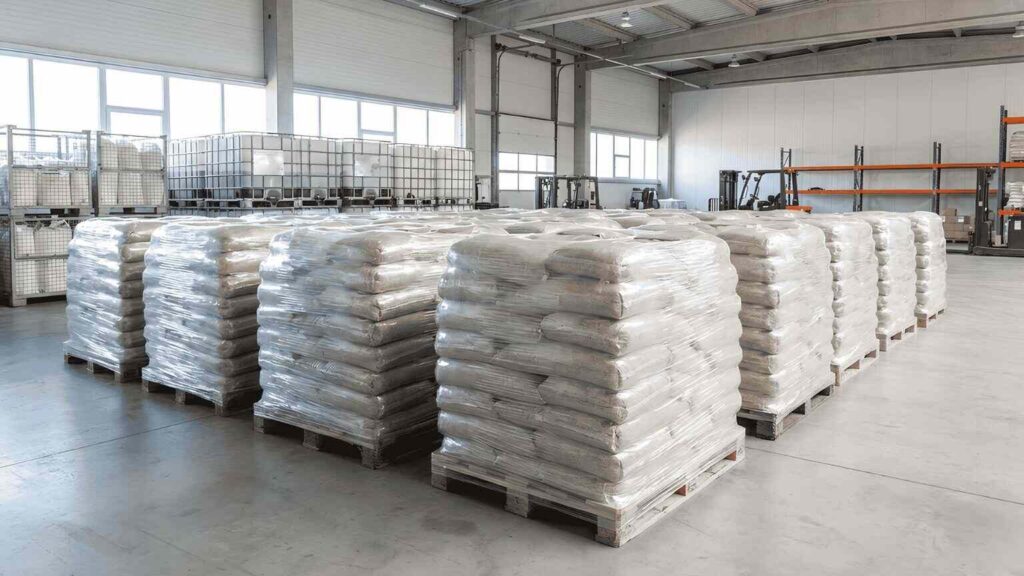
Bulk packaging prioritizes durability, moisture protection, and efficient palletization. Proper stacking strength prevents package collapse during multi-tier storage in warehouses. Standard pallet dimensions enable optimal container loading with typical configurations fitting 20-25 metric tons per 20-foot container.
Foodservice Packaging
Restaurants, hotels, and catering operations purchase salt in 5kg-25kg formats designed for professional kitchen environments.
Foodservice Packaging Features:
- Resealable bucket-style containers with ergonomic handle grips
- Moisture-resistant paper bags with reinforced inner liners
- Batch codes and traceability information for HACCP compliance
- Large-format labels for quick identification during service
- Portion control markings for recipe standardization
- Durable construction for daily professional use
These packages balance convenience for professional kitchens with practical portion control. Clear labeling helps kitchen staff identify salt types quickly during busy service periods, while batch codes support food safety management systems required by health authorities.
Cost Considerations and ROI
Packaging Cost Structure
Packaging costs typically represent 8-15% of total FOB pricing for salt exports. Understanding cost breakdowns helps B2B buyers make informed decisions about packaging quality and market positioning.
Retail Packaging Cost Comparison:
Package Type | Capacity | Unit Cost | Cost per KG |
Basic PP Bag | 1kg | $0.15 – $0.30 | $0.15 – $0.30 |
Premium Pouch | 1kg | $0.45 – $0.80 | $0.45 – $0.80 |
PET Jar | 500g | $0.35 – $0.60 | $0.70 – $1.20 |
Stand-Up Pouch | 1kg | $0.40 – $0.75 | $0.40 – $0.75 |
Bulk Packaging Economics:
Package Type | Capacity | Unit Cost | Cost per KG |
PP Woven Bag | 50kg | $1.50 – $2.50 | $0.03 – $0.05 |
FIBC Bag | 1000kg | $15.00 – $25.00 | $0.015 – $0.025 |
Multi-wall Paper | 25kg | $0.80 – $1.20 | $0.032 – $0.048 |
Additional Cost Factors:
- Private label printing: $0.05 – $0.15 per unit (varies with design complexity)
- Setup fees for new designs: $500 – $2,000 per SKU
- Volume discounts: 10-25% reduction for orders above 50,000 units
- Rush orders: 15-30% premium for expedited production
Bulk industrial packaging proves more economical per kilogram. However, retail packaging’s higher per-unit cost enables premium pricing that often justifies the investment for brand-focused importers.
Quality Control Investment
Implementing comprehensive quality control for packaging requires upfront investment but prevents costly product losses and protects brand reputation.
Quality Control Cost Breakdown:
Pre-Shipment Testing:
- Seal integrity testing: $50 – $100 per batch
- Drop resistance testing: $75 – $150 per batch
- Moisture barrier performance: $100 – $200 per batch
- Total per batch: $200 – $500
Third-Party Certification:
- SGS certification: $1,000 – $1,500 annually
- Bureau Veritas certification: $1,200 – $1,800 annually
- Intertek certification: $1,000 – $1,500 annually
- Annual investment: $1,000 – $3,000
ROI on Quality Investment:
- Prevents product losses from damaged goods (typically 2-5% of shipment value)
- Reduces customer returns and replacements (saves 3-8% annually)
- Builds buyer confidence for repeat business
- Streamlines customs clearance with proper documentation
- Protects brand reputation in competitive markets
This investment protects against much larger losses from damaged goods, customer returns, and reputation damage. For exporters serving multiple markets, certification streamlines compliance verification and builds buyer confidence.
Working with Experienced Salt Exporters
Professional salt manufacturers understand that packaging quality directly impacts customer satisfaction and repeat business. Experienced exporters maintain relationships with certified packaging suppliers, invest in quality testing equipment, and stay updated on evolving international regulations.
Himalayan salt exporters offering comprehensive export services provide valuable support including packaging material sourcing, custom label design, compliance documentation, and quality assurance testing. This end-to-end approach ensures packaging meets technical specifications while reflecting the importer’s brand identity.
For importers new to salt trade, partnering with established exporters reduces risks associated with packaging failures. Experienced suppliers navigate complex requirements like how to import Himalayan salt from Pakistan while ensuring packaging standards support successful market entry.
Conclusion
Packaging requirements for international salt export encompass regulatory compliance, material specifications, barrier properties, and labeling standards that vary across global markets. Success requires understanding ISO food safety standards, FDA and EU regulations, moisture barrier testing protocols, and market-specific labeling requirements.
For B2B salt buyers and exporters, proper packaging protects product quality, ensures regulatory compliance, and supports brand positioning in competitive markets. Investing in quality packaging materials, comprehensive testing, and expert guidance from experienced manufacturers creates long-term value through reduced losses, improved customer satisfaction, and sustained market access.
Ready to streamline your salt export packaging? Contact Sobaan Salts for comprehensive private labeling solutions that meet international packaging standards. Our experienced team provides end-to-end support from packaging design to compliance documentation, ensuring your products reach global markets with quality and confidence.
References
[1]: IMARC Group. (2025). Food Packaging Market Size, Share & Growth Report 2033. Global food packaging market valued at $405.44 billion in 2024, projected to reach $651.66 billion by 2033. https://www.imarcgroup.com/food-packaging-market
[2]: International Organization for Standardization. (2024). ISO 22000:2018 – Food Safety Management Systems. Framework integrating HACCP principles with GMP for comprehensive food safety.
https://www.iso.org/standard/65464.html
[3]: U.S. Food and Drug Administration. (2024). Fair Packaging and Labeling Act Requirements. Mandates accurate product information including net quantity in metric and US customary units.
https://www.ftc.gov/legal-library/browse/rules/fair-packaging-labeling-act-regulations-under-section-4-fair-packaging-labeling-act
[4]: European Commission. (2004). Regulation (EC) No 1935/2004 on Food Contact Materials. Framework regulation for materials and articles intended to come into contact with food. https://eur-lex.europa.eu/legal-content/EN/TXT/?uri=CELEX:32004R1935
[5]: ICPG Packaging Solutions. (2025). Understanding OTR & MVTR Specifications for Barrier Food Packaging. MVTR testing at 100°F (37.8°C) and 90% RH conditions for moisture barrier measurement. https://blog.icpg.co/understanding-otr-mvtr-specifications-for-barrier-food-packaging
[6]: ASTM International. (2024). Paper Standards and Packaging Standards. Comprehensive testing methods including F88 (seal strength), F1140 (burst testing), F2338 (leak detection). https://store.astm.org/products-services/standards-and-publications/standards/paper-standards-and-packaging-standards.html
Share This Post
Article By