
How to Import Himalayan Salt from Pakistan: Complete B2B Guide for Global Buyers
- Zayan Rauf
Key takeaways
- Pakistan exported 3,789 shipments of Himalayan salt between Nov 2023-Oct 2024, marking 10% growth
- USA receives 46% of Pakistan’s total Himalayan salt exports with 24% year-over-year growth
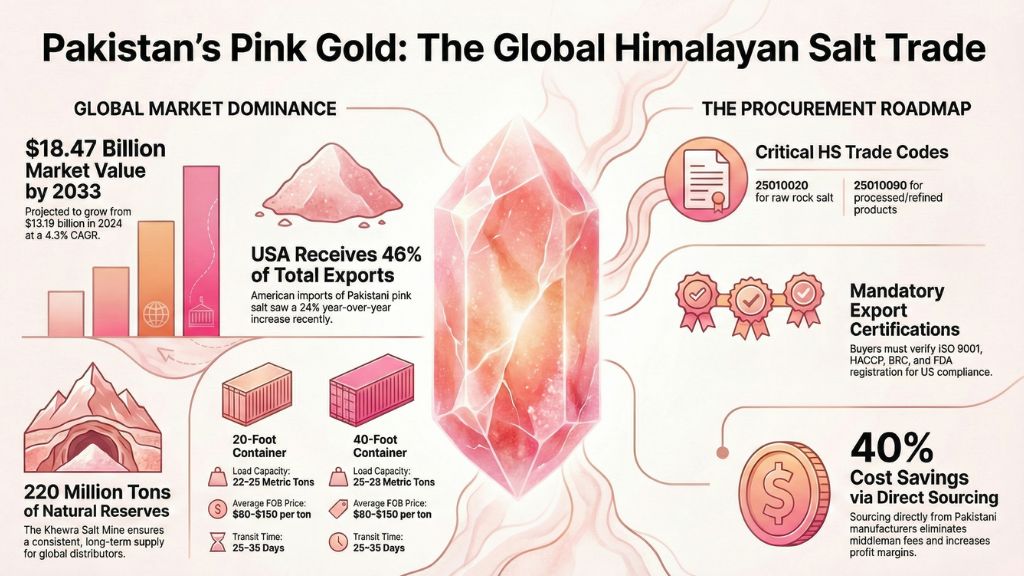
- Rock salt exports use HS Code 25010020, processed salt uses HS Code 25010090
- Global pink Himalayan salt market valued at $13.19 billion in 2024, expected to reach $18.47 billion by 2033
- Average FOB price ranges from $80-$150 per metric ton depending on grade and packaging
- Khewra mine holds estimated reserves of 220 million tons with consistent quality standards
- Essential certifications include ISO 9001, HACCP, BRC, and FDA registration for USA exports
The global demand for authentic Himalayan pink salt continues to rise, making Pakistan the world’s leading supplier of this premium mineral. For B2B buyers looking to import Himalayan salt from Pakistan, understanding the complete procurement process is critical for successful international trade operations.
Pakistan’s Khewra Salt Mine, the world’s second-largest salt deposit, produces over 385,000 tons of pure Himalayan salt annually [1]. This guide provides wholesale buyers, distributors, and retailers with a clear roadmap on how to import Himalayan pink salt from Pakistan while meeting quality standards and compliance requirements.
Why Import Himalayan Salt From Pakistan?
Pakistan dominates the global Himalayan salt market with over 90% of exporters declaring shipments under HS Code 25010020 for rock salt. The Salt Range in Punjab province contains the planet’s purest salt deposits, formed over 250 million years ago.
Several factors make Pakistan the preferred source for authentic Himalayan salt:
- Geological Authenticity: Only salt mined from Pakistan’s Khewra, Warcha, and Kalabagh mines qualifies as genuine Himalayan pink salt. The unique geological conditions create salt with distinctive mineral composition and natural pink coloration from iron oxide traces.
- Cost Effectiveness: Direct sourcing from pink salt manufacturers in Pakistan eliminates intermediaries, reducing per-ton costs by 30-40% compared to buying from secondary distributors. This pricing advantage translates to better profit margins for wholesale buyers.
- Product Diversity: Pakistani exporters offer Himalayan salt in multiple grades including edible fine and coarse grains, decorative salt lamps, bath salts, salt tiles, cooking blocks, and industrial-grade salt for various applications. This variety allows importers to serve diverse market segments.
Did You Know?
From November 2023 to October 2024, Pakistan exported 1,121 shipments of Himalayan salt to the United States alone, showing a remarkable 24% growth compared to the previous year [3].
Understanding Pink Salt HS Code in Pakistan
The pink salt HS code in Pakistan determines customs duties, export documentation, and trade regulations. Pakistani exporters primarily use two classifications:
- HS Code 25010020 – Rock Salt: This covers raw Himalayan salt chunks, boulders, and minimally processed rock salt. Over 90% of Pakistani salt exports fall under this category [4]. Importers can clear these products with standard customs procedures and basic documentation.
- HS Code 25010090 – Other Salt: This applies to refined, ground, and value-added salt products including edible table salt, iodized salt, and specialty gourmet salts. Additional food safety certifications may be required depending on destination country regulations.
Using the correct pink salt HS code in Pakistan ensures accurate customs declarations and prevents shipment delays at international borders.
Step-by-Step Import Process
1. Identify Certified Suppliers
Success in bulk Himalayan salt procurement starts with selecting experienced manufacturers. Look for suppliers with direct mining operations, comprehensive certifications (ISO, HACCP, BRC, FDA), and proven export track records. Reputable Himalayan salt exporters maintain quality assurance systems and provide transparent sourcing documentation.
2. Request Product Specifications
Before placing bulk orders, obtain detailed specifications including sodium chloride percentage (typically 95-98% for food grade), trace mineral composition, moisture content, grain size distribution, and microbiological test results. Many suppliers provide free samples for laboratory verification.
3. Understand Import Regulations
Each country maintains specific import requirements. USA buyers must ensure suppliers follow FDA requirements for salt export to the USA, including facility registration and Prior Notice submission. The European Union requires EFSA compliance and proper CE marking. Middle East markets need Halal certification for food products.
4. Negotiate Commercial Terms
Standard terms for bulk salt imports include FOB (Free On Board) Karachi Port or CIF (Cost, Insurance, Freight) pricing. Payment methods typically involve 30% advance with 70% against shipping documents, Letter of Credit for new relationships, or cash against documents for established partnerships. The benefits of sourcing Himalayan pink salt in bulk include volume discounts and guaranteed supply consistency.
5. Arrange Logistics and Shipping
For bulk orders, sea freight from Karachi Port offers cost-effective solutions. A 20-foot container holds 22-25 metric tons while 40-foot containers accommodate 25-28 metric tons. Transit times to major ports range from 25-35 days. Leading shipping lines include Maersk, MSC, and CMA CGM.
6. Prepare Import Documentation
Essential documents include commercial invoice with detailed product descriptions, packing list with container-wise breakdown, Certificate of Origin from Pakistani authorities, Bill of Lading from shipping line, laboratory test certificates for quality verification, and health certificates as required by destination country.
7. Clear Customs and Receive Shipment
Upon arrival, customs authorities review documentation and may inspect cargo. Working with licensed customs brokers streamlines clearance and ensures proper duty calculation. Import duties typically range from 0-10% for raw salt and 5-15% for processed products.
Quality Verification Standards
Implementing quality control protects investments and ensures consistent standards. Pre-shipment inspection through SGS, Bureau Veritas, or Intertek verifies product quality, quantities, and packaging before departure. Laboratory testing confirms sodium chloride content, heavy metal levels, microbiological safety, and moisture content for each shipment.
Did You Know?
The Khewra Salt Mine alone holds estimated reserves exceeding 220 million tons, with annual extraction averaging 385,000 tons. This massive reserve ensures consistent supply for decades, making Pakistan a reliable long-term source for global importers [6].
Working With Reliable Pakistani Exporters
The global market size for pink Himalayan salt reached $13.19 billion in 2024 and is projected to grow at 4.30% CAGR, reaching $18.47 billion by 2033 [5]. This growth reflects increasing consumer preference for natural food additives and wellness products.
Sobaan Salt Manufacturer offers comprehensive export services including direct mine-to-market operations, complete certification portfolio, custom packaging and private labeling, flexible order quantities, quality assurance with independent testing, and export documentation support. Their experience with international compliance requirements simplifies the import process for B2B buyers.
Pakistan’s competitive advantages in salt production include lower mining costs due to abundant reserves, established infrastructure for processing and export, government support for small-scale miners, and quality certification systems meeting international standards [7]. These factors combine to make Pakistani Himalayan salt the most cost-effective and reliable option for global importers.
Cost Analysis for Bulk Import
Understanding complete cost structure helps calculate landed cost and profit margins. FOB prices from Pakistan range from $80-$150 per metric ton depending on grade and packaging. Ocean freight to major ports costs $30-$60 per ton. Marine insurance typically runs 0.3-0.5% of cargo value. Add customs duties (varies by country), port handling charges, customs broker fees, and inland transportation to determine total landed cost.
For example, importing 25 metric tons of food-grade Himalayan salt to Los Angeles typically involves product cost (FOB) of $3,000, freight of $1,250, insurance of $15, customs duty of $60, port charges of $400, and broker fees of $200, resulting in total landed cost of approximately $197 per ton.
Market Opportunities and Growth
Pakistan’s salt exports to China increased by 38% in early 2025, demonstrating expanding market opportunities beyond traditional destinations [8]. The USA market shows particularly strong growth, with imports from Pakistan increasing 24% year-over-year. This growth reflects rising consumer awareness of Himalayan salt’s mineral content and perceived health benefits.
The Asia-Pacific region leads the global market due to abundant natural reserves, low production costs, growing regional consumption, and rising exports. Pakistan’s position as the primary source gives it a natural advantage in meeting worldwide demand for authentic Himalayan salt products.
Conclusion
Learning how to import Himalayan salt from Pakistan requires understanding sourcing, quality standards, proper pink salt HS codes, logistics coordination, and compliance requirements. Pakistan’s dominance as the world’s leading Himalayan pink salt supplier Pakistan offers B2B buyers access to authentic products at competitive prices with reliable supply chains. Working with certified exporters who understand international regulations ensures smooth import operations and long-term business success.
References
[1]: Geological Survey of Pakistan. (2024). Khewra Salt Mine Production Data. Ministry of Energy, Government of Pakistan. Annual extraction averages 385,000 tons.
https://gsp.gov.pk/
[2]: The Express Tribune. (2025). Pink Salt Export Analysis. Pakistan exported 3,789 shipments of Himalayan salt from Nov 2023-Oct 2024, marking 10% increase.
https://tribune.com.pk/story/2515515/pink-salt-export-rises
[3]: Volza Trade Intelligence. (2024). Himalayan Salt Exports from Pakistan to the United States. USA received 1,121 shipments with 24% growth rate (Nov 2023-Oct 2024).
https://www.volza.com/p/himalayan-salt/export/export-from-pakistan/cod-united-states/
[4]: Trade Development Authority of Pakistan. (2022). Product Report: Salt (HS 250100). Over 90% of Pakistani salt exporters use HS Code 25010020 for rock salt.
https://tdap.gov.pk/wp-content/uploads/2022/03/Report-on-Salt.pdf
[5]: Market Data Forecast. (2025). Pink Himalayan Salt Market Analysis 2024-2033. Market valued at $13.19 billion in 2024, projected $18.47 billion by 2033.
https://www.marketdataforecast.com/market-reports/pink-himalayan-salt-market
[6]: Market Data Forecast. (2024). Geological Survey – Khewra Mine Reserves. Estimated reserves exceed 220 million tons with 385,000 tons annual extraction.
https://www.marketdataforecast.com/market-reports/pink-himalayan-salt-market
[7]: SkyQuest Technology. (2024). Pakistan Pink Himalayan Salt Market Report. Pakistan leads as the world’s primary producer and exporter with massive Punjab reserves.
https://www.skyquestt.com/report/pink-himalayan-salt-market
[8]: The Express Tribune. (2025). Pakistan Salt Export Growth. Salt exports to China increased by 38% during the first five months of 2025.
https://tribune.com.pk/story/2541312/pakistans-salt-exports-to-china-surge-40-in-q1-2025
Share This Post
Article By