
How to Build a Salt Cave: A Himalayan Salt Manufacturer's Complete Guide
Key takeaways
- The minimum tile thickness for wall installation is 2 inches, thinner tiles are decorative only and will crack under load.
- A 6×8 ft. room with three tiled walls requires approximately 1,000 tiles and 80 lbs of floor granules, roughly 2,700 lbs of Himalayan salt material total.
- Sourcing tiles at wholesale directly from a manufacturer reduces material cost by 60–80% compared to retail purchasing.
- Halogenerators require pharmaceutical-grade NaCl, Himalayan salt damages the grinding mechanism.
- A vapor barrier on the floor and a 1-inch air gap behind wall tiles are the two structural elements that determine long-term durability.
- Salt cave sessions retail for $25–$60 per person, a complete home or commercial build can generate income through private bookings.
Quick Answer: Building a salt cave requires salt tiles or bricks for the walls, loose salt granules for the floor, proper ventilation, and ambient lighting. A small home salt room (6×8 ft.) uses approximately 200–250 lbs of Himalayan salt tiles and costs between $1,500 and $4,000 in materials. The critical variable is salt quality: construction-grade Himalayan salt tiles should be 2 inches thick, hand-finished, and sourced from verified Khewra Mine deposits not industrial or food-grade salt, which lacks the structural integrity required for wall installation.
Most guides on how to build a salt cave cover the basic steps: choose a room, put up salt walls, add lighting. What they rarely cover is the material science behind it, how thick salt tiles need to be to hold without cracking, how much salt a 100-square-foot room actually requires, or what separates authentic Himalayan salt from the lower-grade alternatives flooding the market.
Sobaan Salts has manufactured and exported Himalayan salt products from Pakistan since 2001, supplying salt tile and brick materials to wellness centers, spa operators, and commercial salt room builders across more than 70 countries. This guide brings that manufacturing knowledge directly into the construction planning process.
What Is a Salt Cave, and What Makes One Actually Work?
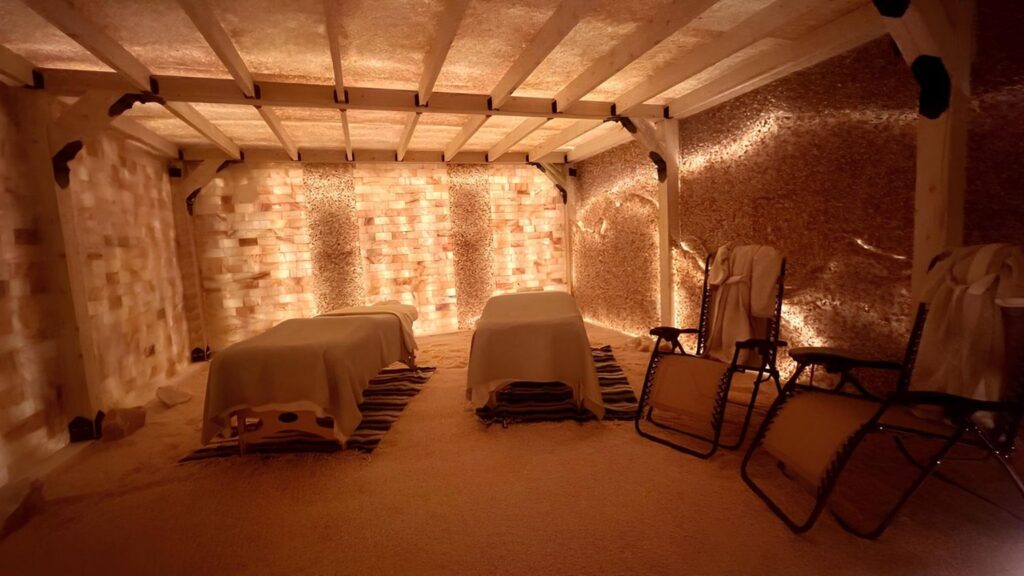
A salt cave also called a salt room or halotherapy room is a controlled wellness environment where walls, floors, and sometimes the ceiling are lined with Himalayan pink salt. The goal is to replicate the microclimate of underground salt mines in Eastern Europe, particularly in Poland and Ukraine, where miners historically reported unusually low rates of respiratory illness.[1]
Two elements determine whether a salt cave genuinely delivers that microclimate or just looks like one:
- Salt surface coverage: The more exposed salt surface area, the higher the ambient ionic effect. A room where only one accent wall has salt tiles will not perform the same as a room fully lined with 2-inch salt bricks on all four walls and the floor.
- Air circulation with salt particles: Passive exposure from salt walls provides some effect. Active halotherapy, where a halogenerator disperses micronized dry salt into the air, is what clinical halotherapy practitioners use in professional settings.
Did You Know?
Halotherapy is used as a complementary wellness practice. Peer-reviewed evidence supports potential benefits for respiratory comfort and relaxation. [2][3] Salt caves are not a substitute for medical treatment. Consult a qualified healthcare professional if you have a diagnosed respiratory condition.
For home builders, a passive salt cave with quality salt walls and proper air circulation creates a genuinely calming, humidity-balanced environment. For commercial wellness operators, an active setup with a halogenerator is the professional standard.
Salt Cave Materials: Specifications and Quantities
This is where most DIY guides fall short. Knowing what to buy matters less than knowing what specifications to buy it to. Here is what professional salt cave builders use and why.
Himalayan Salt Tiles (Walls and Ceiling)
Salt tiles are the primary structural material for salt cave walls. They are cut from Himalayan pink salt blocks mined in the Khewra Salt Mine in Pakistan, the second-largest salt mine in the world.
Specification | Requirement | Why It Matters |
Thickness | 2 inches (50 mm) minimum | Thinner tiles crack under their own weight and the adhesive load. 1-inch tiles are decorative, not structural. |
Standard tile size | 8×4 inches or 12×6 inches | These sizes maintain structural integrity. Larger formats increase cracking risk from thermal expansion. |
Surface finish | Hand-finished, not machine-cut | Machine-cut tiles have micro-fractures from saw heat. Hand-finishing preserves natural crystal structure. |
Salt grade | NaCl 98%+ purity | Higher purity = fewer trace mineral impurities = better structural stability and consistent color. |
Color | Pink to deep rose | Color indicates iron oxide content from Khewra deposits. Uniform color signals consistent mining depth and quality. |
Weight per tile (8×4 in.) | Approx. 2.5–3 lbs per tile | Used for wall load calculations important for mounting system selection. |
Coverage calculation: For a 6×8 ft. room with 8 ft. ceilings, the total wall surface is approximately 224 sq. ft. At roughly 1 tile per 0.22 sq. ft. for 8×4-inch tiles, that is approximately 1,020 tiles or about 510 lbs of salt tile material. Most home builders cover three walls rather than all four, which brings the requirement down to around 650–720 tiles.
Himalayan Salt Bricks (Alternative to Tiles)
Salt bricks are larger and thicker than tiles, making them better suited for standalone salt walls and free-standing salt panels. They are commonly used in larger commercial installations and backlit salt wall features.
Brick Type | Dimensions | Coverage per Brick | Best Application |
Standard salt brick | 8×4×2 inches | 0.22 sq. ft. | Solid salt walls, cave-style construction |
Large format brick | 12×6×2 inches | 0.50 sq. ft. | Feature walls, panel systems |
Backlit brick panel | 10×5×1.5 inches | 0.35 sq. ft. | Illuminated accent walls, aesthetic installs |
Corner brick | 4×4×4 inches (L-shape) | N/A | Wall corners, edge finishing |
Himalayan Salt Granules (Floor Coverage)
The floor of a traditional salt cave is covered with loose Himalayan salt granules, typically 2–4 inches deep. This provides the underfoot texture associated with natural salt mines and contributes to the room’s overall salt surface area.
- Granule size for floors: Medium grain (2–5 mm) coarse enough to walk on without becoming powdery, fine enough to feel natural underfoot.
- Coverage rate: At 2 inches deep, 50 lbs of salt granules covers approximately 30 sq. ft.
- Sealing the floor first: Seal the subfloor with a moisture barrier before laying granules. Salt draws moisture unsealed concrete or wood will absorb and expand over time.
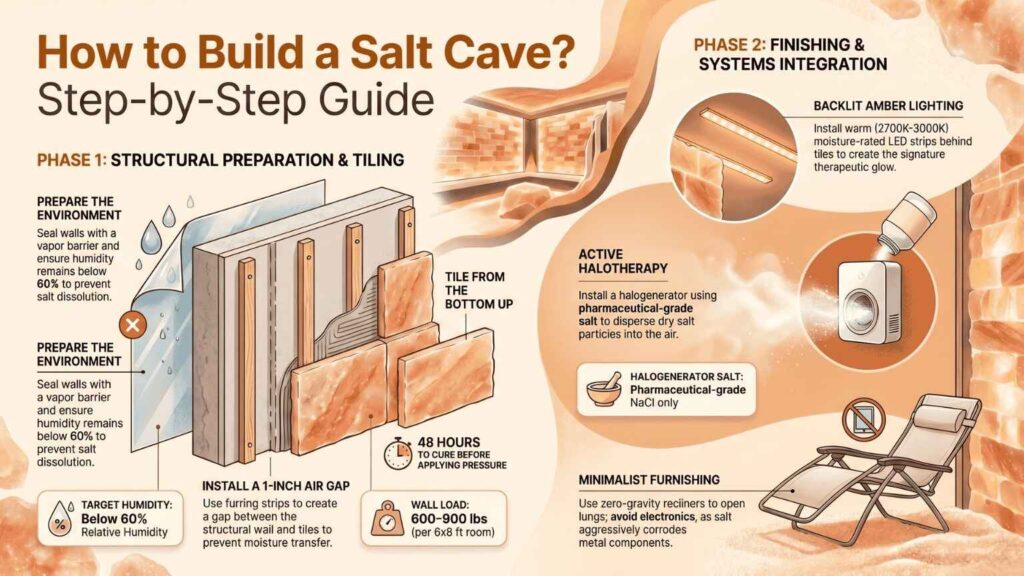
How to Build a Salt Cave? Step-by-Step Guide
These steps apply to a home salt room build using Himalayan salt tiles and bricks. Commercial builds follow the same sequence but require structural engineering consultation for load-bearing wall modifications.
Step 1: Select and Prepare the Room
Choose a small, enclosed room, basements and interior rooms work best because they have stable temperature and minimal humidity fluctuation. Salt is hygroscopic: it draws moisture from the air. Rooms with high ambient humidity will accelerate surface dissolution on the salt walls.
- Target room humidity: below 60% relative humidity during use
- Install a dehumidifier: if baseline humidity in the room exceeds 65%
- Seal all existing wall surfaces with a vapor barrier before tile installation
- Minimum ceiling height: 7.5 feet, lower ceilings create a claustrophobic atmosphere
Step 2: Install the Mounting System
Salt tiles cannot be applied directly with standard tile adhesive. The weight and the hygroscopic nature of salt require a specific installation approach.
- Metal furring strips or wooden battens: Create a 1-inch air gap between the structural wall and the salt tiles. This prevents moisture from the building envelope from reaching the salt directly.
- Adhesive: Use a high-strength construction adhesive rated for heavy tile. Standard ceramic tile adhesive is not formulated for the weight of 2-inch salt tiles.
- Load check: A fully tiled 6×8 ft. room can add 600–900 lbs to the wall structure. For interior partition walls, consult a builder about load distribution before mounting.
Step 3: Tile the Walls
Work from the bottom up. Start at floor level and build upward in rows, checking level every three rows. Salt tiles are naturally irregular, minor variation in thickness (±0.1 inch) is expected and part of the handmade character.
- Apply adhesive to the back of each tile, not the wall, for better control of placement
- Leave 1/8-inch gaps between tiles to allow for natural expansion
- Grout gaps with a salt-based grout or leave as natural gaps for the traditional cave aesthetic
- Allow adhesive to cure for 48 hours before applying weight or pressure to tiled sections
Step 4: Prepare and Seal the Floor
Before adding granules, apply a self-leveling epoxy floor coating or heavy-duty polyurethane sealant to the subfloor. This creates the moisture barrier that prevents structural damage from salt-to-floor contact.
Once cured, spread a 2-inch layer of medium-grain Himalayan salt granules evenly across the floor. For a finished edge, use salt brick edging around the perimeter to contain the granule layer.
Step 5: Install Lighting
Lighting in a salt cave serves two functions: creating the therapeutic ambiance and illuminating the natural translucency of the salt. Himalayan salt is naturally translucent, backlighting it from behind the tile layer produces the signature warm amber glow associated with salt caves.
- Backlit panels: Install LED strip lighting behind salt brick panels before final wall installation. Use warm white (2700K–3000K) LEDs, never cool white.
- Recessed ceiling lighting: Use sealed, moisture-rated recessed fixtures. Exposed wiring connections in a salt environment will corrode significantly faster than in standard rooms.
- Salt lamps as accent: Place 2–4 Himalayan salt lamps at floor level for supplementary ambient light and the visual texture of naturally carved salt forms.
Step 6: Ventilation and Air Circulation
A passive salt room can use a standard HVAC vent for air circulation. Keep airflow low and non-turbulent, you want gentle circulation, not a breeze that picks up floor granules.
For active halotherapy, install a halogenerator. This is a medical-grade device that grinds pharmaceutical-grade dry salt into particles of 1–5 microns and disperses them into the room at controlled concentrations.[2]
- Halogenerator sizing: A 1–1.5 kg/hour output unit is standard for rooms up to 200 sq. ft. Overspeccing creates excessive salt concentration that is uncomfortable and accelerates tile surface erosion.
- Placement: Mount the halogenerator on the wall at shoulder height, positioned to distribute particles across the full room volume before air reaches the occupants.
- Salt cartridge type: Halogenerators use pharmaceutical-grade sodium chloride, not Himalayan pink salt. Himalayan salt granules contain trace minerals that clog halogenerator grinding mechanisms.
Step 7: Furnish for the Intended Use
Keep furnishings minimal. The material goal of a salt cave is exposed salt surface area furniture reduces the effective cave volume. Standard setups for home use:
- 2–4 zero-gravity recliners or flat loungers (zero-gravity position opens the lungs fully)
- A low side table for water, hydration during sessions matters
- Removable floor cushions if yoga or meditation is the primary use
- No electronics inside the salt room beyond the halogenerator and lighting system, salt is aggressively corrosive to electronic components
How Much Salt Does a Salt Cave Require? The Numbers
This is the most frequently unanswered question in salt cave guides. Here are the actual material quantities for three standard room sizes:
Room Size | Wall Coverage (3 walls) | Salt Tiles Needed | Floor Granules | Total Salt Weight |
6×6 ft. (36 sq. ft.) | ~168 sq. ft. | ~765 tiles | ~60 lbs | ~1,980 lbs + 60 lbs |
6×8 ft. (48 sq. ft.) | ~224 sq. ft. | ~1,020 tiles | ~80 lbs | ~2,550 lbs + 80 lbs |
10×12 ft. (120 sq. ft.) | ~432 sq. ft. | ~1,965 tiles | ~200 lbs | ~4,912 lbs + 200 lbs |
Sourcing Note:
At these quantities, sourcing from a retail salt supplier will cost 3–5x more than importing directly from a Himalayan salt manufacturer at wholesale. A 6×8 ft. build requires close to one metric ton of salt material. That is a B2B procurement quantity priced accordingly when bought through the right channel.
Cost to Build a Salt Cave: Realistic Material Budgets
The cost range in most DIY guides ($1,000–$15,000) is accurate but not useful without understanding what drives the variance. Here is what the budget actually covers:
Budget Level | Total Spend | What It Covers | Salt Source |
Entry-level DIY | $1,200–$2,500 | Partial wall coverage, accent tiles, salt lamps, no halogenerator | Retail / online marketplace |
Mid-range home build | $4,000–$8,000 | 3 full walls tiled, granule floor, LED backlighting, basic ventilation | Specialty supplier or direct import |
Full home salt cave | $10,000–$18,000 | 4 walls + ceiling tiled, halogenerator, professional lighting system, sealed floor | Direct manufacturer import |
Commercial installation | $25,000–$80,000+ | Full structural modifications, professional build, commercial halogenerator, compliance inspection | Wholesale manufacturer, container quantity |
The single largest cost variable is salt sourcing. Retail Himalayan salt tiles in the US, UK, and EU are priced at $8–$22 per tile. The same tile sourced directly from a Pakistani Himalayan salt manufacturer costs $1.50–$4.00 per tile at wholesale, with a minimum order quantity typically starting at 500–1,000 tiles (approximately half a metric ton).
For a full home build requiring 1,000+ tiles, the sourcing decision alone creates a $7,000–$18,000 difference in material cost.
How to Source Authentic Himalayan Salt for Construction
Authentic Himalayan salt for cave construction comes from one place: the Khewra Salt Mine in the Punjab region of Pakistan. It is the world’s second-largest salt deposit, formed approximately 800 million years ago.[5] Salt sold as ‘Himalayan’ from other sources is not geologically Himalayan salt.
When evaluating a supplier, ask for these verifications:
- Mining origin certificate: Should specify Khewra Mine, Punjab, Pakistan issued by the Pakistan Mineral Development Corporation (PMDC).
- Purity analysis: SGS or Bureau Veritas lab analysis showing NaCl content of 97–99%. Reputable manufacturers provide this on request for B2B orders.
- FDA food facility registration (for edible-grade suppliers): Indicates the facility operates to a manufacturing standard consistent with regulated export markets.
- Export documentation: Certificate of Origin (Pakistan), phytosanitary certificate, and commercial invoice with HS code 2501.00, the correct customs classification for unprocessed Himalayan salt.
From Sobaan Salts: We have supplied Himalayan salt tiles, bricks, and construction granules to salt room builders and spa operators since 2001. All materials ship from our facility in Lahore, Pakistan, with full export documentation including PMDC origin certification, SGS purity analysis, and halal certification. Minimum order for construction tile: 500 units. Request a product specification sheet and quote at info@sobaansalts.com.
DIY vs. Professional Salt Cave Construction: A Realistic Comparison
Factor | DIY Build | Professional Build |
Upfront cost | $1,500–$10,000 (materials only) | $15,000–$80,000+ (materials + labor + design) |
Timeline | 3–12 weeks (weekend project pace) | 2–6 weeks (professional crew) |
Salt material sourcing | Retail, higher per-unit cost, wider availability | Wholesale, lower per-unit cost, requires import logistics |
Risk of installation error | Moderate, incorrect adhesive or load distribution is the most common failure point | Low, professional contractors have salt cave installation experience |
Halogenerator setup | Typically excluded, self-installed if desired | Included, professionally commissioned and tested |
Best suited for | Home personal use, wellness corner, meditation room | Commercial spa, wellness center, clinical halotherapy room |
Resale / income potential | Adds property appeal, not directly monetizable | Directly monetizable, salt cave sessions sell for $25–$60/session |
Common Salt Cave Construction Mistakes
These are the mistakes that result in early tile failure, structural damage, or a room that does not perform the way it should:
- Using 1-inch decorative tiles as structural wall tiles. Decorative salt tiles are finished for display, not load-bearing wall installation. They crack at grout joints within 6–12 months under wall pressure. Specify a minimum 2-inch thickness for all wall tile.
- Skipping the vapor barrier. Salt draws moisture through concrete and wood. Without a sealed floor and a wall air gap, moisture migrates into the substrate and compromises adhesive bonds. This is the most common structural failure in DIY builds.
- Installing halogenerators at floor level. Salt particles are denser than air and settle not rise. A floor-level halogenerator fills the lower third of the room, not the full breathing zone. Mount at shoulder height or above.
- Using Himalayan salt granules in the halogenerator. Himalayan salt’s trace minerals clog halogenerator grinding mechanisms. These units require pharmaceutical-grade NaCl. Using the wrong salt type voids most halogenerator warranties and damages the grinding disc within weeks.
- Overcrowding the room with furniture. Every piece of furniture reduces exposed salt surface area and disrupts airflow. A simple, minimal layout with 1–4 loungers is optimal.
Frequently Asked Questions
How long does it take to build a salt cave at home?
A small DIY salt cave covering three walls in a 6×6 ft. room takes 4–8 weekends for a person with basic tile installation experience. The largest time commitment is waiting for adhesive cure cycles: each tiled section requires 48 hours before you can tile adjacent sections. A professional crew working full-time completes the same scope in 5–7 business days.
What thickness of Himalayan salt tiles do I need for a salt cave?
Use a minimum of 2 inches (50 mm) for any tile installed on a vertical wall surface. Thinner tiles lack the structural strength to hold their own weight when adhered vertically and will crack at grout joints within 12–18 months. 1-inch tiles are appropriate only for horizontal surface decoration or display, not load-bearing wall coverage.
Do I need a halogenerator to get benefits from a salt cave?
No. A passive salt cave with walls fully lined in Himalayan salt tiles creates a naturally salt-rich ambient environment without active salt dispersal. Many home builders find a passive setup sufficient for relaxation and wellness use. A halogenerator is the professional standard for clinical halotherapy because it delivers a measured, consistent dose of 1–5 micron salt particles into the breathing zone.[2][3] If respiratory health support is a specific goal, a halogenerator adds meaningful function. If the goal is relaxation and atmosphere, it is optional.
How do I maintain a salt cave?
Salt tiles require minimal maintenance. Avoid introducing liquid water into the room, wipe down surfaces with a dry cloth only. Vacuum the floor granule layer every 2–3 weeks to remove dust accumulation. Replace cracked or structurally compromised tiles as they appear, leaving a cracked tile accelerates moisture ingress at that point. A properly installed salt cave with quality materials requires no other active maintenance for 5–10 years.
Can I use Himalayan salt granules in a halogenerator?
No. Halogenerators are designed for pharmaceutical-grade sodium chloride pure NaCl with no trace minerals. Himalayan pink salt contains iron oxide and up to 84 trace minerals. These minerals accumulate in the halogenerator’s grinding disc and dispersal mechanism, causing early failure and voiding the manufacturer warranty. Use pharmaceutical-grade NaCl in the halogenerator, and reserve Himalayan salt for floor coverage and wall tiles.
How many salt tiles does a 10×10 ft. salt cave room require?
For a 10×10 ft. room with 8 ft. ceilings, tiling three walls at full height gives approximately 240 sq. ft. of wall surface. Using standard 8×4-inch tiles at 2 inches thick, you need approximately 1,090 tiles or about 2,725 lbs of tile material. For full room coverage (four walls and ceiling), multiply the tile count by approximately 1.75.
References
[1] Sala, E. & Horowitz, S. (2010). Salt Cave Therapy: An Overview of Clinical Research. Alternative Therapies in Health and Medicine, 16(3).
https://saltcavenz.co.nz/assets/public/images/uploaded/1551934174/sala-horowitz-salt-cave-therapy-2010.pdf
[2] Zajac, J. et al. (2022). Effectiveness of Halotherapy in Health and Wellness. Journal of Education, Health and Sport, 12(9).
https://apcz.umk.pl/JEHS/article/view/40108
[3] Inhaleum Research Group (2023). A Review of Salt Therapy as a Complementary Treatment for Enhancing Respiratory Wellness and Skin Ailments.
https://inhaleum.cz/wp-content/uploads/2023/10/A-review-of-salt-therapy-as-a-complementary-treatment-for-enhancing-respiratory-wellness-and-skin-ailment.pdf
[4] Hedman, L. et al. (2010). Clinical Review of Salt Cave Therapy. Alternative Therapies in Health and Medicine.
https://www.alternative-therapies.com/abstract/pdf/6413.pdf
[5] Pakistan Mineral Development Corporation (PMDC). Khewra Salt Mine, Official Mine Profile and Export Documentation.
https://www.pmdc.gov.pk
Share This Post
Article By