
Epsom Salt vs Himalayan Salt: Differences, Uses, and Which One to Buy
- Zayan Rauf
Key takeaways
- Epsom salt is magnesium sulfate, it is not actually salt; you cannot eat it
- Himalayan salt is sodium chloride, a regular edible salt with trace minerals
- Use Epsom salt for baths, foot soaks, and easing sore muscles; use Himalayan salt for cooking and seasoning
- They are not interchangeable, never substitute one for the other in any use
- Epsom salt is much cheaper and widely available in pharmacies; Himalayan salt is sold as a culinary specialty salt
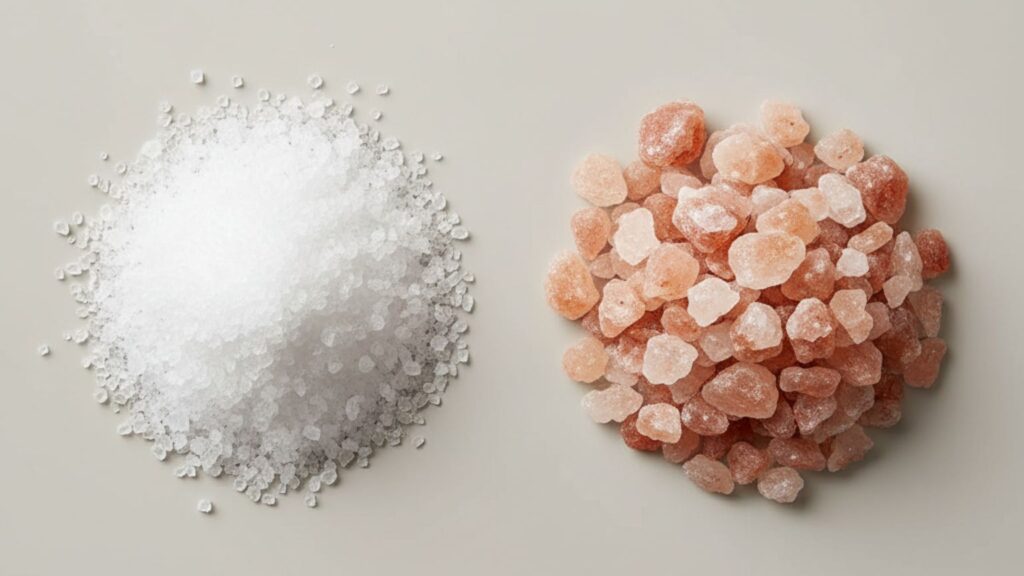
Epsom salt and Himalayan salt have one thing in common, the word “salt” in the name. Beyond that, they are completely different substances with different chemistry, different uses, and different price tags. Epsom salt is not edible. Himalayan salt is. If you are wondering which one to buy for a bath, a foot soak, your garden, or your kitchen, this guide gives you a clear answer.
What Is Epsom Salt?
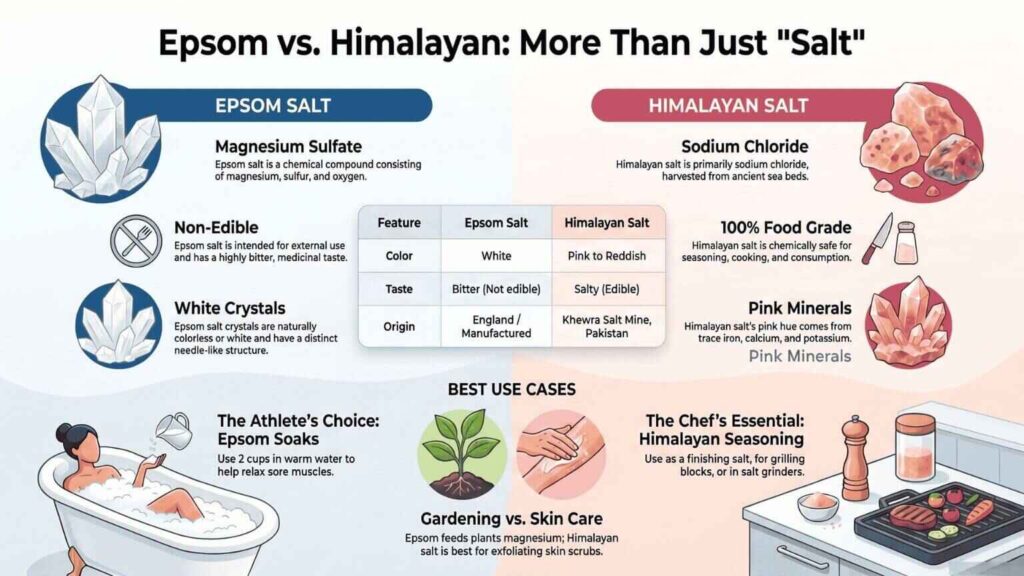
Epsom salt is the common name for magnesium sulfate (MgSO₄). It is not technically a salt in the kitchen sense, it does not contain sodium and does not taste salty. The name comes from a bitter spring in Epsom, England, where the compound was first identified in the 1600s.
Epsom salt looks like coarse white crystals that dissolve quickly in warm water. It is sold in pharmacies, supermarkets, and garden centers. The most common forms are USP-grade for personal care and agricultural-grade for gardening. It is widely used because magnesium is poorly absorbed through diet, and warm water soaks are believed to help with muscle relaxation.
Quick facts
- Chemistry: magnesium sulfate (MgSO₄·7H₂O)
- Taste: bitter, not edible, never used in cooking
- Texture: large white crystals, dissolves easily in warm water
- Common uses: bath soaks, foot soaks, garden fertilizer, plant supplements
What Is Himalayan Salt?
Himalayan salt is rock salt mined from the Khewra Salt Mine in Punjab, Pakistan. Chemically it is sodium chloride (NaCl), the same compound as ordinary table salt, with small traces of iron, calcium, magnesium, and potassium that give it a pink color. It is fully edible and used as a culinary salt around the world. Sobaan Salts is a Himalayan salt manufacturer supplying food-grade pink salt directly from the source.
Quick facts
- Chemistry: sodium chloride (NaCl), about 97–99% pure with trace minerals
- Taste: regular salty taste with a faint mineral note
- Texture: dense, hard pink crystals, sold as fine, coarse, or chunks
- Common uses: cooking, seasoning, finishing salt, salt grinders, decorative salt blocks
What Are the Key Differences Between Epsom Salt and Himalayan Salt?
They are different substances entirely. Here is a side-by-side comparison:
|
Feature |
Epsom Salt |
Himalayan Salt |
|
Chemistry |
Magnesium sulfate (MgSO₄) |
Sodium chloride (NaCl) |
|
Is it actually salt? |
No, it is a magnesium compound |
Yes, it is a true salt |
|
Edible? |
No, bitter and used externally |
Yes, used in cooking |
|
Color |
White |
Pink to reddish |
|
Where it’s from |
Manufactured or mined as magnesium sulfate |
Khewra Salt Mine, Pakistan |
|
Main use |
Bath soaks, foot soaks, gardening |
Cooking, seasoning, finishing |
|
Sold by |
Pharmacies, supermarkets, garden stores |
Grocery stores, specialty food shops |
|
Price |
Inexpensive, widely available |
More expensive, specialty salt |
Did You Know?
Epsom Salt and Himalayan Salt are not substitutes for each other. You cannot cook with Epsom salt, and you should not soak in Himalayan salt expecting muscle-relaxation effects. They serve different purposes.
Is Himalayan Salt the Same as Epsom Salt?
No. Even though both are sold as crystals and both are called “salt” in everyday language, they are different compounds. Himalayan salt is sodium chloride, the same chemical family as the table salt in your kitchen. Epsom salt is magnesium sulfate, a completely different substance that just happens to look similar.
The confusion exists because both are used in baths sometimes. But they do different things: Himalayan salt baths are mostly for skin cleansing and relaxation through warm water; Epsom salt baths are used because the magnesium and sulfate are believed to help muscles relax.
When Should You Use Epsom Salt vs Himalayan Salt?
Each one has specific uses where it works best. Here is a practical guide:
|
Use Case |
Better Choice |
Why |
|
Bath for sore muscles |
Epsom salt |
Magnesium and sulfate are believed to ease muscle aches; standard recommendation is 2 cups in a warm bath |
|
Foot soak after long day |
Epsom salt |
Same reason, magnesium-sulfate soak is the traditional choice |
|
Cooking and seasoning food |
Himalayan salt |
Edible, food-grade, Epsom salt is bitter and not safe to eat |
|
Salt scrub for skin |
Himalayan salt |
Sodium chloride is the standard skincare salt; Epsom salt is harsher on the skin |
|
Gardening and plant fertilizer |
Epsom salt |
Magnesium and sulfur are nutrients many plants need |
|
Finishing salt for cooking |
Himalayan salt |
Pink color and crystal texture work as a finishing salt |
|
Salt block for grilling |
Himalayan salt |
Sold in solid block form, Epsom salt cannot be used this way |
|
Constipation relief (oral, with doctor advice) |
Epsom salt |
FDA-approved as a saline laxative but only under medical supervision |
Important Safety Note
Never take Epsom salt internally without consulting a doctor. While it is FDA-approved as a saline laxative, it can cause serious side effects including dehydration and electrolyte imbalance if used incorrectly.
Can You Substitute Epsom Salt for Himalayan Salt (or Vice Versa)?
No. They are different chemicals with different effects. Here is what happens if you try:
- Cooking with Epsom salt: it tastes bitter and is not safe to use as table salt, your food will be inedible
- Bathing in Himalayan salt instead of Epsom salt: you get a pleasant warm-water soak, but you will not get the magnesium-sulfate benefits people associate with Epsom soaks
- Using Himalayan salt as garden fertilizer: it adds sodium to soil, which is harmful to most plants, Epsom salt provides magnesium that plants actually need
Buy each one for its intended purpose. Both are inexpensive enough that there is no reason to compromise.
Which One Is Better for Your Health?
Each one has a different role in personal care. Both can be part of a healthy routine when used correctly:
Epsom salt: used externally
A warm Epsom salt bath is widely used for muscle relaxation and stress relief. The standard recipe is around 2 cups of Epsom salt in a full bathtub of warm water for 12–15 minutes. The Mayo Clinic notes that while many people report benefits, the scientific evidence for magnesium absorption through skin is limited. Still, the warm soak itself helps muscles relax.
Himalayan salt: used in food
Himalayan salt is a regular dietary salt. It contains the same amount of sodium as table salt, about 2,300 mg per teaspoon for fine grind so the same general advice applies: most adults should keep total daily sodium under 2,300 mg. The trace minerals in Himalayan salt are real but in such small amounts they have no measurable nutritional benefit beyond what regular table salt provides.
Cost and How to Buy
Epsom salt is among the cheapest products on the shelf, typically USD 5–10 for a 4 to 5-pound bag at any pharmacy or supermarket. Look for USP-grade if you plan to use it on your skin.
Himalayan salt costs more because it is mined in only one region of Pakistan and shipped globally. A 1-pound retail container of food-grade pink salt usually sells for USD 5–15. Authentic Himalayan salt is naturally pink, never bright magenta or artificial-looking. For verified, food-grade Himalayan salt sourced directly from the Khewra mine, see our Himalayan edible salt range.
Frequently Asked Questions
Is Himalayan salt the same as Epsom salt?
No. Himalayan salt is sodium chloride (a regular salt, edible). Epsom salt is magnesium sulfate (not edible, used for baths and gardening). They are completely different substances.
Can you cook with Epsom salt?
No. Epsom salt is bitter and is not classified as a food-grade salt. It is sold as a personal care product or garden supplement, not for eating. Use Himalayan salt or table salt for cooking.
Can I take a bath in Himalayan salt instead of Epsom salt?
You can, but the effect is different. A Himalayan salt bath is a warm-water soak with mineral content; an Epsom salt bath delivers magnesium and sulfate that are believed to help muscles relax. Use Epsom salt if your goal is muscle recovery.
What’s the difference between Epsom salt and pink Himalayan salt?
The main difference is chemistry. Epsom salt is magnesium sulfate (MgSO₄), used for bath soaks and gardening. Pink Himalayan salt is sodium chloride (NaCl), used in cooking. They look similar but serve completely different purposes.
Is Epsom salt safer than Himalayan salt?
Both are safe when used correctly. Epsom salt is safe in baths and as a garden additive but should not be eaten without medical advice. Himalayan salt is safe to eat in normal cooking amounts but, like all salt, should be limited to about 2,300 mg of sodium per day for most adults.
- U.S. Food and Drug Administration — Magnesium Sulfate Drug Information: https://www.accessdata.fda.gov/drugsatfda_docs/label/2018/019316s024lbl.pdf
- Mayo Clinic — Magnesium Sulfate (Epsom Salt) Topical Use: https://www.mayoclinic.org/drugs-supplements/magnesium-sulfate-oral-route-topical-application-route-route-not-applicable/description/drg-20088513
- Cleveland Clinic Health Essentials — “Are Epsom Salt Baths Actually Good for You?”: https://health.clevelandclinic.org/7-things-you-probably-didnt-know-about-epsom-salt
- National Institutes of Health (NIH) — Magnesium Fact Sheet for Health Professionals: https://ods.od.nih.gov/factsheets/Magnesium-HealthProfessional/
- Harvard T.H. Chan School of Public Health — The Nutrition Source: Salt and Sodium: https://nutritionsource.hsph.harvard.edu/salt-and-sodium/
- McGill University Office for Science and Society — “Table Salt, Kosher Salt, Sea Salt, Himalayan Salt: Which One Should I Buy?”: https://www.mcgill.ca/oss/article/health-nutrition-you-asked/table-salt-kosher-salt-sea-salt-himalayan-salt-which-one-should-i-buy
Share This Post
Article By