
Chinen Salt vs Himalayan Salt: Differences, Uses & The Truth
- Zayan Rauf
Key takeaways
- Chinen salt is not actually a salt, it is a herbal supplement based on the plant compound berberine
- Himalayan salt is a true rock salt, about 97-99% sodium chloride with trace minerals like iron, calcium, and potassium
- You cannot cook with Chinen salt, it is sold as a supplement in capsules, powders, or extracts, not as a kitchen seasoning
- The two are not interchangeable, confusing them can lead to misuse and missed medical guidance
- If you are considering berberine for blood sugar or metabolic support, consult a doctor first, it can interact with medications
Chinen salt and Himalayan salt are often confused because both have “salt” in the name and both have a pinkish color. But they are completely different things. Himalayan salt is a true rock salt used for cooking. Chinen salt is not actually salt at all, it is a herbal supplement derived from a Chinese plant. You cannot use them for the same purpose. This guide explains exactly what each one is, what they are used for, and why mistaking one for the other can be a costly mistake.
What Is Chinen Salt?
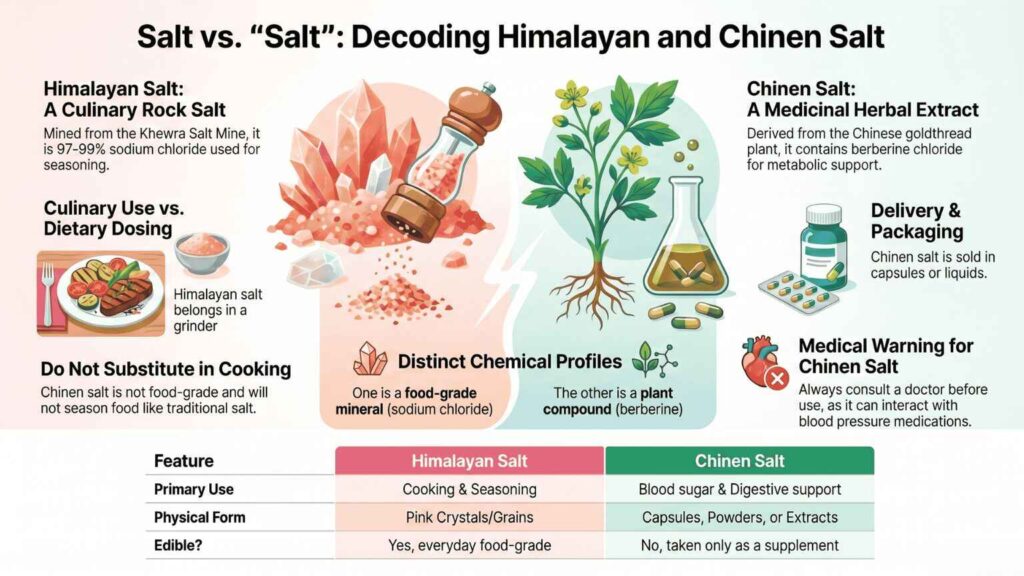
Chinen salt is a herbal supplement, not a culinary salt. It is derived from a plant called Chinese goldthread (Coptis chinensis) and contains a compound called berberine chloride. The name “salt” refers to the chemical structure of berberine chloride, which is technically a salt compound in the chemistry sense but it is not the kind of salt you season food with.
Chinen salt has been used in Traditional Chinese Medicine for centuries, primarily for blood sugar and digestive concerns. It is sold today in three forms: capsules, powders, and liquid extracts. None of these are used in cooking.
Quick facts about Chinen salt
- Source: Chinese goldthread (Coptis chinensis) plant
- Active compound: berberine chloride
- Form: capsules, powders, or liquid extract not crystals or grains
- Use: herbal supplement for metabolic and digestive concerns
- Other names: Huang Lian, Chinese Coptis, Coptidis Rhizoma
What Is Himalayan Salt?
Himalayan salt is a true rock salt mined from the Khewra Salt Mine in Punjab, Pakistan. It formed around 600 million years ago when an ancient inland sea evaporated, leaving deposits of salt that were later pushed up by tectonic activity. Its pink color comes from trace amounts of iron oxide trapped in the crystals.
Chemically, Himalayan salt is about 97-99% sodium chloride, the same compound as ordinary table salt with small amounts of iron, calcium, magnesium, and potassium. It is fully edible and used worldwide for cooking, seasoning, and as a finishing salt. Sobaan Salts is a certified Himalayan salt manufacturer supplying food-grade pink salt directly from the source.
Quick facts about Himalayan salt
- Source: Khewra Salt Mine, Punjab, Pakistan
- Chemistry: sodium chloride (NaCl), 97-99% pure with trace minerals
- Form: pink crystals, fine, coarse, or chunks
- Use: cooking, seasoning, finishing salt, salt grinders, decorative blocks
- Taste: regular salty taste with a faint mineral note
What Are the Key Differences Between Chinen Salt and Himalayan Salt?
Despite sharing a name and a pink color, the two are different products with different purposes. Here is a side-by-side comparison:
Feature | Chinen Salt | Himalayan Salt |
What it is | Herbal supplement | Rock salt |
Source | Chinese goldthread plant (Coptis chinensis) | Khewra Salt Mine, Pakistan |
Main compound | Berberine chloride | Sodium chloride (NaCl) |
Edible? | No, taken as a supplement, not a seasoning | Yes, used in everyday cooking |
Form sold in | Capsules, powders, liquid extracts | Crystals: fine, coarse, or chunks |
Color | Light pink to yellowish (from berberine) | Pink to reddish (from iron oxide) |
Common use | Blood sugar and digestive support | Cooking, seasoning, salt grinders |
Regulation | Sold as a dietary supplement | Food-grade salt |
Is Chinen Salt the Same as Himalayan Salt?
No. They are not the same and they should not be used as substitutes for each other. The confusion exists for three reasons: both have the word “salt” in the name, both can have a pinkish color, and some product labels add to the confusion by listing them on shelves near each other in wellness stores.
But the chemistry is completely different. Himalayan salt is sodium chloride, the same chemical family as table salt. Chinen salt is berberine chloride, a plant-derived compound that is technically a chemistry-class salt but is not a culinary salt. The two cannot replace one another in any use.
Can You Cook With Chinen Salt?
No. Chinen salt is not classified as a food-grade salt and is not sold for cooking. It is taken as a herbal supplement in pre-measured doses typically capsules or powdered extracts under guidance for specific health concerns. Adding it to food would change neither flavor nor saltiness in a useful way, and it could deliver an unintentional dose of berberine.
For seasoning, you should use a true culinary salt such as Himalayan salt, sea salt, kosher salt, or table salt. These are sodium chloride based and are designed for food use.
Does Chinen Salt Help With Diabetes?
This is the most common reason people search for Chinen salt. The honest answer requires care, because diabetes is a YMYL (Your Money Your Life) topic where claims need to be supported and balanced.
Berberine, the active compound in Chinen salt, has been studied for its possible effects on blood sugar and metabolic health. Some research suggests it may help lower blood glucose levels in people with type 2 diabetes, though studies are limited in size and quality. The FDA has not approved Chinen salt or berberine to treat, cure, or prevent diabetes or any other medical condition.
If you are considering berberine or Chinen salt for diabetes or any other health concern, talk to your doctor first. Berberine can interact with several common medications, including blood pressure medications, blood thinners, and some diabetes drugs. It is not a replacement for prescribed treatment.
Which One Should You Choose?
The choice is not really between the two, it depends on what you actually need. They serve completely different purposes:
Your Goal | Use | Why |
Seasoning food | Himalayan salt | True culinary salt — adds flavor and is safe for everyday cooking |
Salt for a salt grinder or finishing | Himalayan salt | Hard pink crystals work in grinders and look attractive on a plate |
Bath soak or scrub | Himalayan salt | Used in spa and skincare products |
Decorative salt lamp or salt block | Himalayan salt | Sold in solid block forms |
Blood sugar or metabolic concerns | Talk to your doctor | Chinen salt or berberine may be discussed, but only with medical guidance |
Where Can You Buy Authentic Himalayan Salt?
Authentic Himalayan salt comes from one place: the Khewra Salt Mine in Pakistan. Some products on the market are dyed pink or are cheaper rock salts marketed as Himalayan. Buying directly from a verified manufacturer is the safest way to get genuine product, especially for B2B buyers sourcing in bulk. For food-grade pink Himalayan salt sourced directly from the Khewra region, see our Himalayan edible salt range.
Frequently Asked Questions
Is Chinen salt the same as Himalayan salt?
No. Himalayan salt is a true rock salt used for cooking. Chinen salt is a herbal supplement made from the Chinese goldthread plant and is not used as a culinary salt. They are completely different products.
Is Chinen salt actually salt?
Not in the way most people understand salt. Chinen salt contains berberine chloride, which is technically a salt compound in the chemistry sense, but it is not a culinary salt. It is sold and used as a herbal supplement, not as a seasoning.
Can you cook with Chinen salt?
No. Chinen salt is not a food-grade culinary salt. It is sold as a supplement in capsules, powders, or liquid extracts and is taken in measured doses, not added to food.
Does Chinen salt cure diabetes?
No. The FDA has not approved Chinen salt or berberine to treat, cure, or prevent diabetes. Some studies suggest berberine may have effects on blood sugar, but evidence is limited. Always consult a doctor before using any supplement for a medical condition.
Why is Himalayan salt pink and Chinen salt sometimes pink?
Himalayan salt is pink because of trace amounts of iron oxide in the crystals. Chinen salt is sometimes a light pink or yellowish color because of berberine, the active plant compound. The two colors come from completely different sources.
Sources:
- U.S. Food and Drug Administration (FDA) — Dietary Supplements: Information for Consumers: https://www.fda.gov/food/dietary-supplements/information-consumers-using-dietary-supplements
- National Institutes of Health (NIH) National Center for Complementary and Integrative Health — Berberine: https://www.nccih.nih.gov/health/berberine-and-weight-loss-what-you-need-to-know
- Mayo Clinic — Berberine: Uses, Side Effects, and Interactions: https://mcpress.mayoclinic.org/nutrition-fitness/berberine-is-a-promising-supplement-but-its-not-a-magical-weight-loss-solution/
- Cleveland Clinic Health Essentials — Berberine for Blood Sugar and Cholesterol: https://health.clevelandclinic.org/berberine
- McGill University Office for Science and Society — Pink Himalayan Salt: Marketing vs Science: https://www.mcgill.ca/oss/article/health-and-nutrition-quackery-you-asked/himalayan-pink-salt
- U.S. Department of Agriculture (USDA) FoodData Central — Salt composition data: https://fdc.nal.usda.gov/download-datasets
Share This Post
Article By