
Black Salt (Kala Namak) Market: Grades, Quality Standards & B2B Buying Guide
- Zayan Rauf
Key takeaways
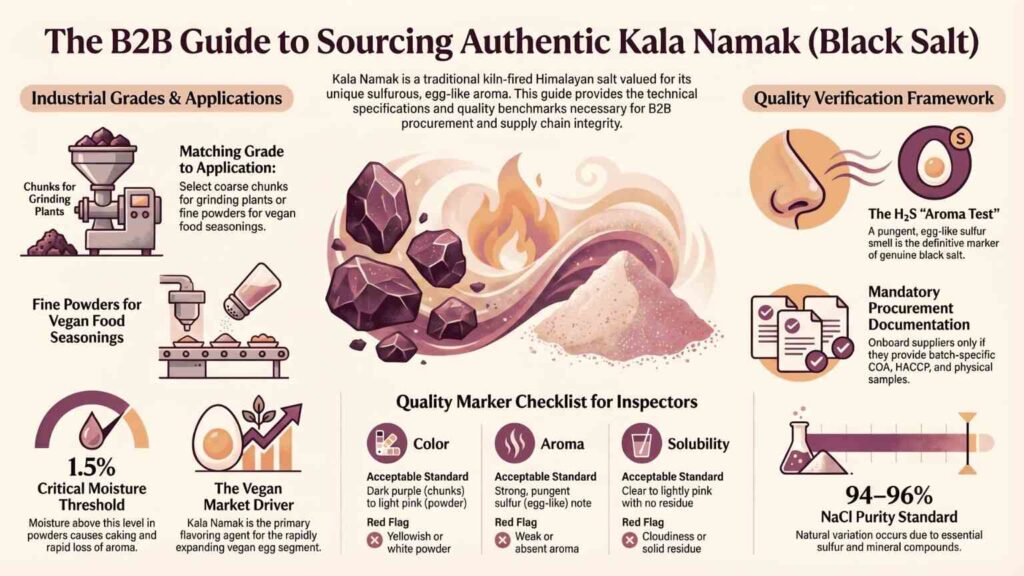
- Black salt (Kala Namak) is not a uniform product. It is traded in at least five distinct grades: coarse chunks, coarse granules, medium granules, fine powder, and extra fine, each with different specifications, applications, and quality criteria.
- The global gourmet salts market, which includes Kala Namak, was valued at approximately USD 3.2 billion in 2024. Growing demand from vegan food manufacturers, South Asian cuisine distributors, and wellness brands is the primary commercial driver. [1]
- The defining quality marker for genuine black salt is Sulphur aroma. Absent or weak aroma in a product labelled Kala Namak indicates adulteration, over-processing, or mislabeling.
- Always request a batch-specific Certificate of Analysis (COA) before placing a bulk order. The COA must confirm NaCl purity, moisture content, and ideally heavy metal limits for food-grade applications.
- Pakistan, specifically from the Khewra Salt Mine region in Punjab, is one of the leading producing and exporting countries for Kala Namak, alongside India. [2]
- Fine and extra fine powder grades carry the highest moisture risk. Moisture above 1.5% causes caking, aroma loss, and shelf-life reduction, making moisture specification the most critical quality parameter in powder grades.
What Is Black Salt (Kala Namak)? A Precise Definition for B2B Buyers
Kala Namak is a kiln-fired mineral salt traditionally produced in the Himalayan region. Raw rock salt, primarily sodium chloride, is combined with small amounts of sodium sulphate, harad seeds, and other mineral compounds, then heated in a sealed ceramic or iron furnace at high temperatures.
This firing process generates hydrogen sulphide (H₂S) and iron sulphide (FeS), the compounds responsible for the distinctive sulphureous aroma and the dark purple-black color of the raw crystal. When ground, the color fades to pinkish-grey, but the aroma remains and it is the aroma that defines the product’s quality and authenticity for end users.
Kala Namak is not the same as black lava salt (activated charcoal-infused) or black sea salt. Buyers must specify clearly which product they require and verify the specification in the COA and product description to avoid receiving the wrong product.
Did You Know?
Black salt’s popularity in the global vegan food segment has accelerated significantly since 2022. The H₂S compound in Kala Namak produces an aroma nearly identical to cooked egg yolks, making it the primary flavoring agent in vegan egg scrambles, vegan mayonnaise, and plant-based ready meals. [3]
Black Salt Grades: What Exists in the Market and What Each Grade Is Used For
The grade you source directly affects your product quality, yield, and processing cost. Specifying the wrong grade is one of the most common procurement mistakes for first-time Kala Namak buyers.
Grade / Form | Appearance | Grain Size | Primary B2B Application | Key Spec to Request |
Coarse Chunks (Raw / Lump) | Dark purple–black crystals, hard and dense | 10–40 mm irregular lumps | Wholesale distribution, repackaging, grinding plants | Hardness, moisture content, Sulphur aroma intensity |
Coarse Granules | Dark to reddish-brown granules | 3–5 mm | Food manufacturing, spice blend processors, industrial use | Grain consistency, NaCl purity, Sulphur compound profile |
Medium Granules | Reddish-pink granules once crushed | 1–3 mm | Spice blends, chaat masala, restaurant kitchen supply | Color consistency, iron sulphide content, free-flowing property |
Fine / Powder | Light pinkish-grey powder | 0.3–0.5 mm | Vegan food manufacturing, snack seasoning, ready-meal flavoring | Moisture content (critical, max 1%), caking tendency, aroma retention |
Extra Fine Powder | Near-white fine powder | < 0.3 mm | Flavor industry, seasoning blends, supplement formulation | Particle size distribution, moisture, stability in blends |
Most Pakistani suppliers export primarily in coarse chunks and medium granules for reprocessing. Fine and extra fine powder is produced domestically or ground at the importer’s facility. If your application requires fine powder, confirm whether the supplier processes the final grade in-house or supplies raw material for your own grinding line.
Read More: How to Make Black Salt (Kala Namak)
Quality Verification: 8 Markers Every B2B Buyer Must Check
Sourcing black salt without verifying these markers creates risk across your supply chain, from inconsistent product performance to food safety exposure. Use this as your pre-order verification framework:
Quality Marker | What to Check | Acceptable Standard | Red Flag |
Color | Chunks: dark purple-black. Ground: reddish-pink to light grey-pink | Uniform color within the same grade and batch | Yellowish or white powder: likely adulterated or over-processed |
Aroma | Distinct hydrogen sulphide (H₂S) smell, egg-like, pungent | Strong, consistent sulphur note across the batch | Weak or absent aroma: indicates low sulphur compound content or old stock |
Moisture Content | Request lab test, especially critical for powder grades | Max 1.0–1.5% moisture (powder); up to 3% for coarse | Clumping or caking in fine grades: indicates high moisture and storage problems |
Solubility | Dissolve a sample in warm water | Clear to lightly pink solution with no residue | Cloudiness or solid residue: suggests insoluble impurities |
NaCl Purity | Request Certificate of Analysis (COA) | ≥ 94–96% NaCl (natural variation with sulphur compounds) | No COA available or purity below 90% |
Sulphur Compounds | Iron sulphide (FeS) and hydrogen sulphide (H₂S) | Naturally present, gives the defining aroma. Must be present | Absence of aroma in ‘black salt’ is a disqualifier: product is not genuine Kala Namak |
Grain Consistency | Visual inspection of sample | Uniform particle size within the stated grade | Mixed grain sizes in a claimed-grade product: poor quality control |
Heavy Metals | COA from accredited laboratory | Within Codex Alimentarius food-grade limits | No lab test offered; arsenic, lead, or cadmium not assessed |
For food-grade applications, minimum documentation is required before placing a bulk order: Certificate of Analysis (COA), Certificate of Origin, HACCP certification of the processing facility, and a physical sample from the batch you are purchasing. A supplier that cannot provide all four should not be onboarded as a primary supplier.
Read More: The B2B Buyer’s Guide To Himalayan Salt Quality Assurance
Who Buys Kala Namak in Bulk? B2B Applications by Industry
Understanding which segment you are sourcing for or supplying into determines your grade, quality specification, volume, and documentation requirements:
Industry / Buyer Type | How Black Salt Is Used | Grade Required | Volume Profile |
Food Manufacturers | Seasoning blends, chaat masala, snack coatings, spice mixes | Fine / Extra Fine | High, regular reorder, annual contracts |
Vegan Food Brands | Egg-substitute flavoring in tofu, scrambles, vegan mayonnaise, plant-based products | Fine Powder | Medium-High, brand-specific recipe consistency required |
Spice Blenders & Processors | Component ingredient in branded spice blends, particularly Indian and South Asian ranges | Medium to Fine | Medium, batch-based ordering |
Restaurant Chains & Catering | Finishing salt for chaats, salads, and regional Indian dishes. Also used in Ayurvedic menus | Coarse to Medium | Low-Medium, service industry volumes |
Health & Wellness Brands | Digestive health supplements, Ayurvedic formulations, detox products | Fine to Extra Fine | Medium, requires food-grade or supplement-grade COA |
Cosmetic & Bath Salt Brands | Detox bath salts, therapeutic soaks, spa-grade mineral products | Coarse to Medium | Low-Medium, niche segment, growing interest |
Private Label Distributors | Re-brand and sell under own label in retail or e-commerce markets | All grades | Variable, depends on market positioning |
Read More: Does Black Salt Expire
Did You Know?
Black Himalayan salt is categorized under the Himalayan Salt market, which is projected to grow at a CAGR of 5.1% from 2025 to 2035. [4]
The vegan food segment, one of the fastest-growing Kala Namak end-users, is expanding at double that rate across North America and Europe, creating sustained demand for consistent, food-grade supply from certified exporters.
Supplier Evaluation Criteria: What to Assess Before You Order
The black salt market has a high proportion of unverified intermediaries and undocumented supply chains. A structured supplier evaluation is non-negotiable for serious B2B buyers.
Production Capability
Confirm whether the supplier mines, processes, and grades in-house or is a trader buying from third parties. Direct manufacturers offer better quality control, traceability, and pricing. Ask for facility details, processing capacity, and quality control checkpoints.
Certifications
At minimum, look for: HACCP (food safety system), ISO 22000 (food safety management), Certificate of Origin from the Chamber of Commerce, and Halal/Kosher certifications if required for your end market. For EU-bound products, also verify the supplier’s compliance with Regulation (EC) 178/2002 and EU contaminant limits under Regulation (EU) 2023/915.
Sample and COA Process
A credible supplier provides a physical sample from the actual production batch before you confirm the order, not a generic showroom sample. The COA should be batch-specific, issued by an accredited third-party laboratory, and match the sample you received.
Packaging Options
Standard bulk export packaging for Kala Namak is 25kg moisture-resistant PP bags or multiwall kraft paper sacks. For fine powder, moisture-barrier inner lining is essential. If you require private label packaging (branded retail jars, pouches, grinders), confirm the supplier’s in-house capability and lead times before committing.
Consistency Across Batches
Request batch records or quality reports from previous shipments. A supplier that cannot provide evidence of batch-to-batch consistency particularly for aroma intensity and grain size carries procurement risk for buyers who need reproducible product performance.
Sourcing Black Salt from Sobaan Salts
Sobaan Salts Exporters supplies certified Himalayan black salt (Kala Namak) directly from Pakistan in all major grades: coarse chunks, medium granules, and fine powder. For food manufacturers, spice blenders, vegan food brands, and private label distributors globally.
Every shipment includes batch-specific COA, Certificate of Origin, HACCP certification, and export documentation formatted to destination market requirements. Private label packaging: branded pouches, jars, and crushers. is available with full importer labelling.
Frequently Asked Questions
Q: What is the difference between black salt and regular Himalayan pink salt?
A: Black salt (Kala Namak) is a kiln-fired product, raw Himalayan rock salt is heated at high temperature with sulphur compounds, harad seeds, and sodium sulphate. This process creates hydrogen sulphide and iron sulphide, giving it a dark color and the distinctive egg-like aroma. [2] Himalayan pink salt undergoes no such firing and has no sulphur aroma. They are different products with different applications, different taste profiles, and different pricing.
Q: How do I verify if the black salt I’m receiving is genuine Kala Namak?
A: Genuine Kala Namak has a strong hydrogen sulphide (H₂S) aroma, the characteristic egg-like smell. When dissolved in water, it should produce a lightly pinkish clear solution. Request a COA that confirms the presence of sulphur compounds and iron sulphide. Absent aroma or a white/yellow color indicates the product is either adulterated or not genuine Kala Namak.
Q: What is the minimum order quantity (MOQ) for bulk black salt from Pakistan?
A: MOQ varies by supplier and grade. For export shipments, most Pakistani manufacturers require a minimum of 500kg–1 MT for fine grades, and 1–5 MT for coarse and medium granule grades. Full container loads (FCL approximately 20–25 MT) attract the best pricing and reduce per-unit logistics cost significantly.
Q: Can black salt be used for vegan egg flavouring in commercial food products?
A: Yes. The hydrogen sulphide content in Kala Namak produces an aroma and flavor nearly identical to cooked egg, which is why it is now a standard ingredient in commercial vegan food formulations globally. [3] For commercial food use, always source food-grade certified Kala Namak with a COA confirming compliance with food safety standards applicable to your destination market.
Q: What certifications should a black salt supplier hold for export to the EU or USA?
A: For EU: HACCP, ISO 22000, Certificate of Origin, and a batch COA tested within EU contaminant limits (Regulation (EU) 2023/915). For USA: HACCP, FDA facility registration, and a COA from an ISO/IEC 17025 accredited laboratory. [5] Halal certification is required for GCC and Muslim-majority markets. Always verify certifications directly with the issuing body.
Q: What is the shelf life of bulk Kala Namak?
A: Coarse and chunk grades have an indefinite shelf life when stored dry, salt does not expire. Fine powder grades are more susceptible to moisture absorption and aroma degradation. Store in sealed, moisture-resistant packaging in a cool, dry environment. For fine powder, expect a practical shelf life of 18–24 months before significant aroma degradation. Moisture content at time of packing is the single most important factor.
References
[1] Verified Market Reports. (2024). Global Gourmet Salts Market — Valuation and Forecast to 2033. Market Research Report.
https://www.verifiedmarketresearch.com
[2] Sobaan Salts / Regional Trade Data. Black Salt (Kala Namak) Production & Export from Pakistan — Himalayan Salt Range, Punjab.
https://sobaansalts.com/black-salt-manufacturer/
[3] Vehgroshop B2B Wholesale. (2024). Kala Namak Fine 0.3–0.5mm — Product Specification and Application Notes.
https://www.vehgroshop.com/natural-salts/kala-namak
[4] Future Market Insights. (2025). Himalayan Salt Market Size, Trends & Forecast 2025–2035 — Black Salt Segment.
https://www.futuremarketinsights.com/reports/himalayan-salt-market
[5] European Commission. (2023). Regulation (EU) 2023/915 — Maximum Levels for Certain Contaminants in Food. EUR-Lex.
https://eur-lex.europa.eu/eli/reg/2023/915/oj
[6] FAO/WHO Codex Alimentarius. (2025). Standard for Food-Grade Salt CXS 150-1985.
https://openknowledge.fao.org/handle/20.500.14283/cd8957en
Share This Post
Article By