
Himalayan Salt Tiles: Benefits, Uses & Buyer's Guide
- Zayan Rauf
Key takeaways
- Himalayan salt tiles are flat slabs cut from pink rock salt mined at the Khewra Salt Mine in Pakistan
- They are mainly used for three things: cooking and serving food, building decorative salt walls, and constructing salt rooms used in spas and wellness centers
- As a cooking surface, salt tiles add a subtle salty flavor and hold heat or cold extremely well — this is the most evidence-backed use
- Wellness claims about negative ions and air purification are popular but not well supported by current scientific evidence
- Standard tile sizes are 8″ × 4″ × 1″ for walls and larger 8″ × 8″ or 12″ × 12″ for cooking; bulk orders typically start at 100 pieces
Himalayan salt tiles are flat slabs cut from solid pink rock salt mined at the Khewra Salt Mine in Pakistan. They have three main uses: as cooking and serving surfaces in kitchens, as decorative tiles for accent walls in homes and businesses, and as construction material for salt rooms in spas, wellness centers, and saunas. This guide explains what salt tiles are, what they are used for, where the evidence behind the wellness claims is solid, and where it is limited, so you can make an informed buying decision.

What Are Himalayan Salt Tiles?
Himalayan salt tiles are solid pink rock salt cut into flat, uniform shapes. They are mined at the Khewra Salt Mine in Punjab, Pakistan, the same source as all authentic pink Himalayan salt. The pink color comes from trace amounts of iron oxide trapped in the salt crystals. Sobaan Salts is a certified Himalayan salt manufacturer producing tiles in standard and custom sizes for global buyers.
Unlike lamps or cooking blocks, tiles are cut with flat, parallel sides so they can be installed like ceramic tiles. They are dense, surprisingly heavy, and naturally hygroscopic, meaning they absorb moisture from the air, which affects how they are installed and maintained.
Quick facts about salt tiles
- Source: Khewra Salt Mine, Pakistan
- Chemistry: about 97-99% sodium chloride with trace minerals (iron, calcium, magnesium, potassium)
- Color: pale pink to deep reddish-orange depending on iron content
- Common sizes: 8″ × 4″ × 1″ (walls), 8″ × 8″ × 1.5″ (cooking), 12″ × 12″ × 2″ (saunas)
- Weight: solid salt is dense, a 1-inch thick wall tile weighs about 2 lbs
What Are Himalayan Salt Tiles Used For?
Salt tiles have three primary categories of use, each with different requirements for size, thickness, and finish:
Use Category | What They Are Used For | Typical Setting |
Cooking and serving | Hot or cold cooking surfaces; serving platters that hold temperature | Restaurants, gourmet kitchens, catering |
Decorative walls and floors | Accent walls, backlit feature walls, statement floors | Homes, hotels, restaurants, retail spaces |
Salt rooms and wellness construction | Floor-to-ceiling salt walls in spa rooms and saunas | Spas, wellness centers, salt therapy rooms, saunas |
Can You Cook on Himalayan Salt Tiles?
Yes and this is the most well-established use of salt tiles. They work as cooking surfaces because dense salt holds extreme temperatures very well. You can heat a salt tile to high temperatures for searing meat and vegetables, or chill it in the freezer for serving sushi, cheese, and chilled fruits.
How to cook on a salt tile?
For hot cooking, place the tile on a stovetop or grill and heat it gradually, starting on low for 15 minutes, then medium for 15 minutes, then high for another 15 minutes. Sudden temperature changes can crack the tile. Once heated, it sears food beautifully and imparts a subtle salty flavor without needing additional seasoning.
For cold serving, chill the tile in the freezer for at least 2 hours. It will keep food cold on the table for an extended period.
What does it add to food?
Food cooked or served on a salt tile picks up a mild saltiness from direct contact. The longer and wetter the food sits on the tile, the more salt it absorbs. Quick-cooked items like thin steaks, shrimp, or vegetables pick up flavor without becoming over-salted. Dry items like cheese or chocolate pick up almost no salt.
Care tip: never wash salt tiles with running water, they will dissolve. After cooking, let the tile cool completely, then wipe it with a damp cloth and a stiff brush to remove residue. Stored properly, a single tile can last for hundreds of uses.
How Are Salt Tiles Used for Decorative Walls?
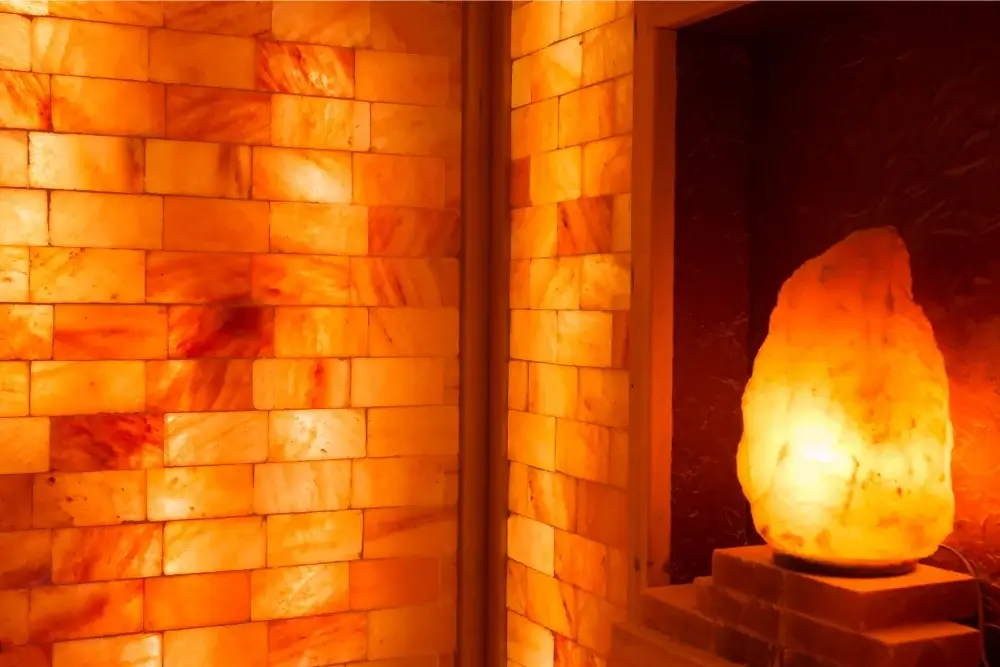
Salt tile walls, sometimes called salt brick walls or pink salt walls are used as accent features in homes, restaurants, hotels, and retail spaces. The tiles are typically installed on a non-porous backing board, glued with a specialized salt-safe adhesive, and often backlit to bring out their natural pink glow.
Standard wall tiles are 8 inches by 4 inches by 1 inch thick. A typical accent wall uses around 200 tiles to cover about 40 square feet. For a detailed look at installation methods, including substrate prep and adhesive choices, see our guide on salt wall construction methods.
Why people choose salt walls
- Visual impact: the natural pink color and translucent quality look striking when backlit
- Unique texture: each tile has slightly different color and grain, so no two walls look identical
- Atmospheric warmth: backlit salt walls give off a warm amber glow
- Conversation piece: they stand out in commercial settings like restaurants and spas
What Are Salt Rooms and How Are Tiles Used in Them?
A salt room also called a salt cave or halotherapy room is a space where the walls, ceiling, and sometimes floor are entirely lined with Himalayan salt tiles or bricks. These rooms are used in spas and wellness centers, where clients sit inside the salt-lined space and breathe the salt-infused air for a typical session of 30 to 45 minutes.
Salt rooms became popular in commercial wellness because of their dramatic visual appearance and atmospheric quality. For the construction process, including substrate, salt block sizing, and lighting integration, see our guide on how to make a Himalayan salt bricks room.
What does The Evidence Actually Say?
Salt rooms are often marketed for respiratory benefits and claims that the salty air helps with asthma, allergies, and other respiratory conditions. This practice, called halotherapy or dry salt therapy, has limited supporting evidence. Some small studies suggest possible short-term symptom relief for certain conditions, but major medical bodies including the Cleveland Clinic note that more rigorous research is needed before halotherapy can be recommended as a medical treatment.
What is clearly true: salt rooms create a calm, low-stimulus environment that many people find relaxing. The visual atmosphere of a backlit salt room genuinely has aesthetic and ambient value. Whether the salt-infused air provides medical benefit is still an open scientific question.
If you are building a salt room for a spa or wellness business, position it honestly as a relaxing, visually striking environment rather than as a medical treatment. This protects your business from regulatory issues and matches what the current evidence supports.
Do Himalayan Salt Tiles Release Negative Ions?
This is one of the most repeated claims about salt tiles and lamps and it deserves an honest answer. The popular theory is that Himalayan salt releases negative ions into the air, which then “purify” it or counteract positive ions from electronics.
In practice, the evidence does not support this. Studies have shown that salt lamps and salt tiles release very few negative ions at room temperature far below the levels that any commercial ionizer produces. The minor ionic effect, if it exists, is essentially negligible. The air purification and electronic-counteraction claims popular in marketing copy are not supported by reliable scientific evidence.
What salt tiles do reliably is absorb moisture from the air (because salt is hygroscopic) and emit a warm pink glow when backlit. Those two qualities, atmospheric and aesthetic are the honest reasons to choose them.
Who Buys Himalayan Salt Tiles in Bulk?
Bulk buyers of salt tiles fall into four main categories:
Buyer Type | What They Order | Typical Volume |
Spa and wellness center operators | Tiles and bricks for salt rooms, sauna construction, accent walls | 500–5,000 pieces |
Restaurants and hospitality | Cooking blocks for direct-flame searing; serving platters | 100–500 pieces |
Interior designers and contractors | Decorative wall tiles for residential and commercial projects | 200–2,000 pieces |
Retail distributors | Mixed tile sizes for resale to end consumers | Full container loads |
For specifications, available sizes, and bulk pricing, see our Himalayan salt tiles. For sauna-specific blocks and bricks, see the salt blocks for sauna.
How Do You Choose the Right Salt Tile for Your Project?
The right tile depends entirely on what you are building. The four factors that matter:
- Size and thickness: wall accent tiles are thinner (1 inch); cooking blocks and sauna tiles are thicker (1.5 to 2 inches) to hold heat and structural weight
- Surface finish: natural rough finish for rustic salt walls; smooth machine-cut finish for cooking and modern installations
- Color grade: light pink for bright, modern spaces; deep red-orange for dramatic backlit walls
- Quantity: most manufacturers have minimum order quantities of 100 pieces; full container orders give the best per-tile price
Frequently Asked Questions
Can you cook on Himalayan salt tiles?
Yes. Salt tiles are commonly used as cooking surfaces for searing meat, vegetables, and seafood, and as chilled serving platters for sushi and cheese. They need gradual heating to avoid cracking and should never be washed with running water.
Do Himalayan salt tiles really purify the air?
Not in any measurable way. Studies show salt tiles and lamps release very few negative ions at room temperature, far below levels that would purify air. They are best chosen for visual and atmospheric qualities rather than air purification claims.
What size are standard Himalayan salt tiles?
Standard wall tiles are 8″ × 4″ × 1″. Cooking blocks are typically 8″ × 8″ × 1.5″ or 12″ × 12″ × 2″. Custom sizes are available from manufacturers for specific projects like salt rooms or sauna walls.
How do you install salt tiles on a wall?
Salt tiles are installed on a non-porous backing board using a specialized salt-safe adhesive — not standard tile mortar. The surface must be clean and dry, and the substrate must support the weight (about 2 lbs per 8″ × 4″ × 1″ tile).
Do salt tiles cure asthma or other respiratory conditions?
No. Salt tiles and salt rooms are not medical treatments. While halotherapy is popular in spas, the scientific evidence for medical respiratory benefits is limited. Anyone with a respiratory condition should consult a doctor rather than rely on salt therapy.
Sources:
- Cleveland Clinic Health Essentials — Halotherapy: Is Salt Therapy Real?: https://health.clevelandclinic.org/salt-cave-benefits
- National Institutes of Health (NIH) PubMed — Studies on halotherapy efficacy in respiratory conditions: https://pmc.ncbi.nlm.nih.gov/articles/PMC4153239/
- Mayo Clinic — Salt therapy and respiratory health: https://connect.mayoclinic.org/discussion/halotherapy/
- McGill University Office for Science and Society — Pink Himalayan Salt: marketing vs science: https://www.mcgill.ca/oss/article/student-contributors-health-and-nutrition/taking-rose-coloured-glasses-pink-himalayan-salt-grift
- American Lung Association — Salt therapy and asthma claims: https://www.lung.org/blog/promising-placebo-salt-halotherapy
- Trade Development Authority of Pakistan (TDAP) — Salt Sector Report: https://tdap.gov.pk/wp-content/uploads/2024/02/Pakistan-Salt.pdf
Share This Post
Article By