
Kosher Salt vs Himalayan Salt: Differences, Uses, and Which One to Buy
- Zayan Rauf
Key takeaways
- Both salts are about 97–99% sodium chloride, the health difference between them is minimal
- Kosher salt is best for cooking, brining, and baking because its flakes are easy to pinch and measure
- Himalayan salt is best as a finishing salt and for visual appeal because of its pink color and crystal structure
- By volume, kosher salt is less salty than Himalayan salt never substitute 1:1 by teaspoon, only by weight
- Neither salt naturally contains iodine, get iodine from seafood, dairy, or iodized table salt
Kosher salt and Himalayan salt look different, taste slightly different, and behave differently in cooking but nutritionally, they are almost identical. Both are around 97–99% sodium chloride. The real choice between them is about texture, taste, and what you are cooking, not about health. This guide explains the differences clearly and helps you decide which one fits your kitchen.
What Is Kosher Salt?
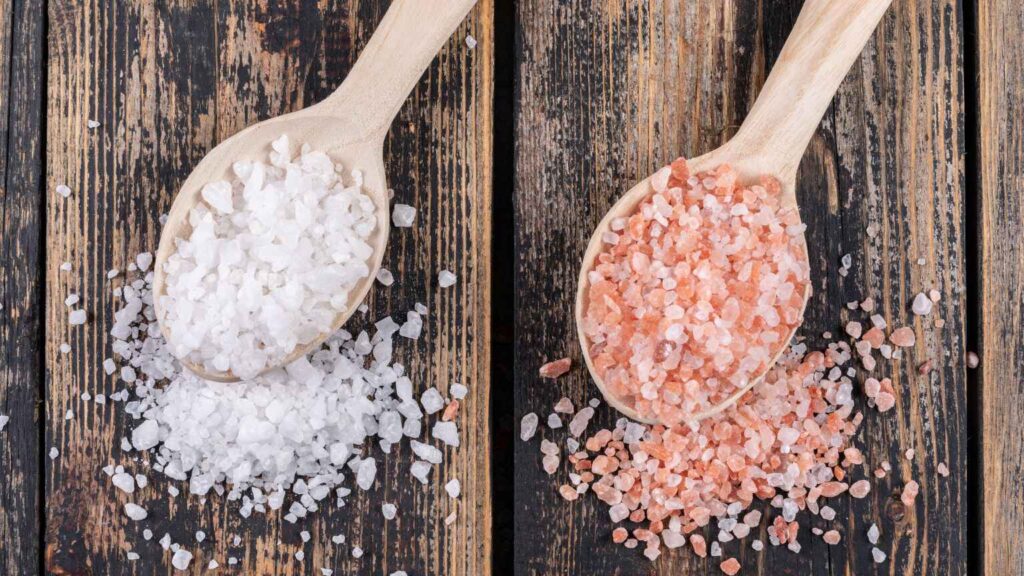
Kosher salt is a coarse-grained salt with large, flaky crystals. The name comes from the Jewish koshering process, drawing blood out of meat, where the large flakes worked well for the job. Kosher salt is not religiously kosher by itself, the name describes its traditional use, not its certification.
Most kosher salt sold today is mined from underground salt deposits or produced by evaporating seawater. It is then processed into flat, hollow, or pyramid-shaped crystals. It usually contains no iodine and no anti-caking agents.
Quick facts
- Color: white
- Texture: large, flat, flaky crystals
- Flavor: clean, neutral salty taste
- Common uses: brining, seasoning meat, baking, everyday cooking
What Is Himalayan Salt?
Himalayan salt is rock salt mined from the Khewra Salt Mine in Punjab, Pakistan. The deposit formed over 250 million years ago when an ancient sea evaporated. The salt’s distinctive pink-to-red color comes from trace amounts of iron oxide and other minerals trapped inside the crystal structure. Sobaan Salts is a Himalayan salt manufacturer that supplies food-grade pink salt directly from this region to global buyers.
Quick facts
- Color: light pink to deep red, depending on iron content
- Texture: dense, hard crystals, sold as fine, coarse, or chunks
- Flavor: clean salty taste with a faintly mineral edge
- Common uses: finishing dishes, gourmet plating, salt grinders, decorative serving
What Are the Key Differences Between Kosher Salt and Himalayan Salt?
Here is a side-by-side comparison of the two salts:
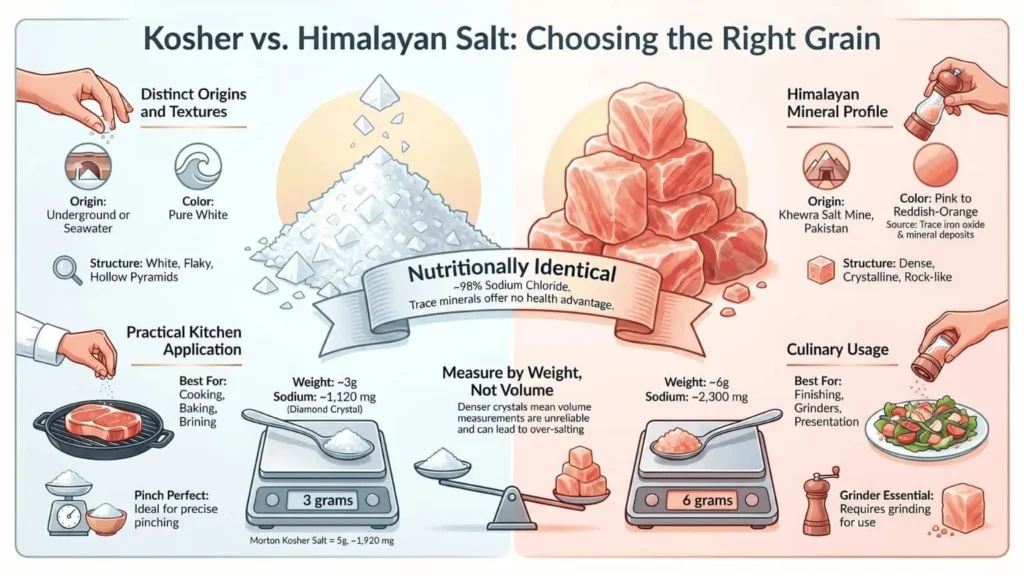
Feature | Kosher Salt | Himalayan Salt |
Origin | Underground salt deposits or evaporated seawater | Khewra Salt Mine, Pakistan |
Color | White | Pink to reddish-orange |
Texture | Large, flat, flaky crystals | Dense, hard, varying grain sizes |
Flavor | Clean, neutral salty taste | Clean salty taste with faint mineral note |
Sodium chloride content | ~97–99% | ~97–99% |
Trace minerals | Minimal | Iron, calcium, magnesium, potassium (in tiny amounts) |
Iodine | None unless fortified | None naturally |
Best for | Cooking, baking, brining | Finishing, presentation, gourmet plating |
Cost | Inexpensive, widely available | More expensive — specialty salt |
Is Himalayan Salt Healthier Than Kosher Salt?
Not in any meaningful way. Both salts are over 97% sodium chloride. The minerals in Himalayan salt like iron, calcium, magnesium, potassium are real, but they exist in such tiny amounts that they have no measurable nutritional impact in the quantities people consume.
A 2020 study published in Frontiers in Communication analyzed 31 samples of pink Himalayan salt sold in Australia. Researchers confirmed the salt does contain more minerals than table salt, but they were so small per serving that they would not contribute meaningfully to daily nutrition. One sample even showed lead levels above the safe limit, which is why buying from a verified manufacturer matters.
Both salts also contain about the same amount of sodium per gram. So if you are limiting sodium for blood pressure or heart health, neither salt has an advantage. What matters is how much you use, not which one you choose.
Why Does One Teaspoon of Each Salt Have Different Saltiness?
This is the most practical difference between the two salts and the one most home cooks miss. Because kosher salt has large, flat flakes with air gaps between them, a teaspoon of kosher salt weighs less and contains less sodium than a teaspoon of densely packed Himalayan salt.
Salt Type | Approximate Weight per Teaspoon | Approximate Sodium per Teaspoon |
Table salt (fine) | 6 grams | ~2,300 mg |
Diamond Crystal kosher salt | ~3 grams | ~1,120 mg |
Morton kosher salt | ~5 grams | ~1,920 mg |
Fine Himalayan salt | ~6 grams | ~2,300 mg |
Coarse Himalayan salt | ~5 grams | ~1,900 mg |
This is why cookbooks and chefs measure salt by weight (grams), not volume (teaspoons). If you swap kosher salt for Himalayan salt at a 1:1 teaspoon ratio in a recipe, your dish will turn out too salty. Use a kitchen scale, or adjust by tasting as you go.
When Should You Use Kosher Salt vs Himalayan Salt?
Each salt has specific kitchen applications where it works better than the other. Here is a practical guide:
Cooking Use | Better Choice | Why |
Brining meat or poultry | Kosher salt | Flaky crystals dissolve evenly and don’t over-salt the brine |
Salting pasta water | Either | Both work, kosher dissolves faster |
Baking bread or pastry | Kosher salt | Easier to measure precisely; consistent results across recipes |
Seasoning during cooking | Kosher salt | Easy to pinch and sprinkle; chefs prefer it for control |
Finishing salt on steak or salads | Himalayan salt (coarse) | Crystal crunch and pink color add visual and textural appeal |
Salt grinder for the table | Himalayan salt | Hard crystals work well in a grinder; kosher flakes don’t |
Salt blocks for grilling/serving | Himalayan salt | Sold in solid block form, kosher salt cannot be used this way |
Everyday seasoning at the stove | Either | Personal preference, taste the difference and decide |
Can You Substitute One Salt for the Other?
Yes, but adjust the amount, never substitute by volume. The safest method is to substitute by weight: 1 gram of kosher salt equals 1 gram of Himalayan salt in terms of saltiness. If you are using teaspoons, here is a rough conversion guide:
- If a recipe calls for 1 teaspoon of fine Himalayan salt → use 1½ to 2 teaspoons of Diamond Crystal kosher salt, or 1 teaspoon of Morton kosher salt
- If a recipe calls for 1 teaspoon of Diamond Crystal kosher salt → use about ¾ teaspoon of fine Himalayan salt
- If a recipe calls for 1 teaspoon of table salt → use 1½ to 2 teaspoons of Diamond Crystal kosher salt, or 1 teaspoon of fine Himalayan salt
These ratios assume fine-ground Himalayan salt. Coarse Himalayan salt has more air between crystals so the ratio shifts again. When precision matters, weigh the salt rather than measuring by spoon.
Cost and How to Buy the Real Thing
Kosher salt is inexpensive, typically USD 2–5 for a 3-pound box at any supermarket. Himalayan salt costs more because it is mined from one specific region in Pakistan and exported globally. A 1-pound retail container of food-grade pink salt usually sells for USD 5–15 depending on grade and packaging.
Authentic Himalayan salt is naturally pink, never bright magenta or artificial-looking. Some products on the market are dyed pink or are cheaper rock salts marketed as Himalayan. Buying directly from a verified manufacturer is the safest way to get genuine products. Sobaan Salts supplies food-grade Himalayan edible salt sourced directly from the Khewra mine, with full traceability and certifications available.
Frequently Asked Questions
Is Himalayan salt healthier than kosher salt?
No, not significantly. Both salts are about 97–99% sodium chloride. Himalayan salt contains trace minerals, but in amounts too small to make a real nutritional difference.
Can I use Himalayan salt instead of kosher salt in a recipe?
Yes, but adjust the amount. Himalayan salt is denser than kosher salt, so 1 teaspoon of Himalayan salt is roughly equal to 1½ to 2 teaspoons of Diamond Crystal kosher salt. Always taste as you go.
Which salt is best for cooking and baking?
Kosher salt is generally the better choice for cooking and baking. Its flaky crystals are easy to pinch, distribute evenly, and dissolve consistently in liquid.
Does kosher salt or Himalayan salt contain iodine?
Neither salt naturally contains iodine. Some kosher salt brands add it as a fortification, but most do not. If iodine is important in your diet, get it from seafood, dairy, eggs, or iodized table salt.
Why is Himalayan salt pink?
The pink color comes from trace amounts of iron oxide and other minerals trapped inside the salt crystals. The depth of the color depends on iron content and varies between mining areas.
Sources
- U.S. Department of Agriculture (USDA) FoodData Central — Sodium content in different salt types: fdc.nal.usda.gov
- National Institutes of Health (NIH) PubMed — “Mineral and metal content of pink salt available in Australia” (Frontiers in Communication, 2020): pubmed.ncbi.nlm.nih.gov/33102849/
- National Institutes of Health (NIH) PubMed — “Effect of Himalayan pink salt and table salt on hypertensive women” (clinical trial, 2022): pubmed.ncbi.nlm.nih.gov/35137791/
- Harvard T.H. Chan School of Public Health — The Nutrition Source: Salt and Sodium: https://nutritionsource.hsph.harvard.edu/salt-and-sodium/
- McGill University Office for Science and Society — “Table Salt, Kosher Salt, Sea Salt, Himalayan Salt: Which One Should I Buy?”: https://www.mcgill.ca/oss/article/health-nutrition-you-asked/table-salt-kosher-salt-sea-salt-himalayan-salt-which-one-should-i-buy
- Cleveland Clinic Health Essentials — Pink Himalayan Salt vs. Sea Salt vs. Table Salt: health.clevelandclinic.org
Share This Post
Article By