
EU Food Safety Regulations for Himalayan Salt Imports: A Complete Guide
- Zayan Rauf
Key takeaways
- EU Regulation (EC) 178/2002 requires all imported food including Himalayan salt from Pakistan to meet the same safety standards as EU-produced food. No exceptions.
- RASFF monitors every shipment. Any batch flagged for heavy metals or contamination can be rejected at the border or recalled from the market across all 27 member states simultaneously.
- Regulation (EU) 1169/2011 governs all retail labelling. Product name, origin (Pakistan), net quantity, and nutrition declaration in the destination country’s language. Sodium must be declared as ‘Salt’.
- HACCP certification is a legal requirement under Regulation (EC) 852/2004. A supplier without HACCP cannot legally sell food products into the EU.
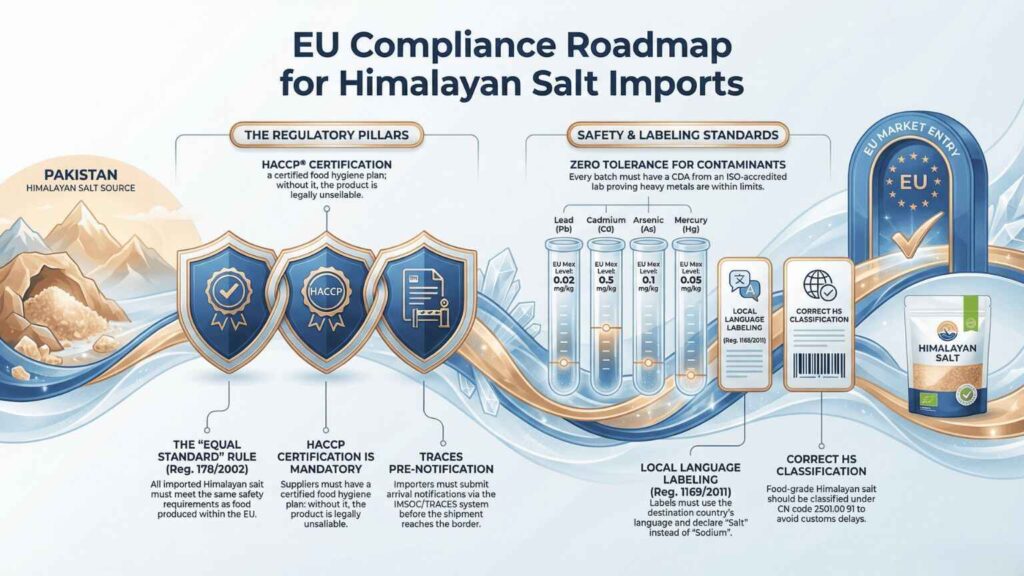
- Regulation (EU) 2023/915 sets hard contaminant limits: lead 0.02 mg/kg, cadmium 0.5 mg/kg, arsenic 0.1 mg/kg, mercury 0.05 mg/kg. Your COA must confirm compliance for every batch.
- HS Code 2501.00.91 is the correct EU customs classification for food-grade Himalayan salt. Incorrect classification causes customs delays and potential duty reclassification.
- Germany leads EU Himalayan salt imports followed by France, the Netherlands, and Italy all enforcing the same EU framework uniformly across all member states.
Why EU Compliance Is Non-Negotiable for Himalayan Salt Importers
The EU is one of the world’s most tightly regulated food markets. For importers bringing Himalayan pink salt from Pakistan into Europe for food, wellness, or spa use, regulatory compliance determines whether your shipment clears customs, reaches shelves, or gets rejected at the border.
The EU does not have a separate framework for Himalayan salt. It falls under the General Food Law and its supporting regulations, the same rules governing every food product entering Europe from a third country. [1]
This guide maps every applicable regulation, explains what each requires, and lists the exact documents EU border controls expect from supplier selection to customs entry to retail packaging.
The EU Food Safety Regulatory Framework: 6 Regulations That Apply to Salt Importers
Six EU regulations directly govern Himalayan salt imports. Each one carries enforcement consequences. Here is what each requires:
REG 01 Regulation (EC) No 178/2002 – General Food Law
What it covers: Sets the fundamental principles of EU food law, including the requirement that all imported food must comply with EU standards, or conditions the EU recognises as equivalent.
Why it matters for salt importers: Article 11 requires imported food to meet the same standards as EU-produced food. Article 18 mandates full traceability from source to EU border. Article 50 establishes RASFF, the alert system that can block or recall your shipment.
REG 02 Regulation (EU) 2017/625 – Official Controls
What it covers: Governs how EU authorities inspect and control food imports from non-EU countries at border entry points.
Why it matters for salt importers: Requires importers to submit pre-arrival notifications via IMSOC/TRACES. Border Inspection Posts can conduct documentary, identity, and physical checks including contaminant sampling and testing.
REG 03 Regulation (EU) 2023/915 – Maximum Contaminant Levels
What it covers: Sets legally binding maximum levels for heavy metals, mycotoxins, and persistent organic pollutants in food. Replaced Regulation (EC) 1881/2006.
Why it matters for salt importers: Your COA must confirm every batch of Himalayan salt stays within these limits. Products exceeding any maximum level cannot legally enter or remain on the EU market. Violations trigger RASFF alerts and border rejection.
REG 04 Regulation (EU) No 1169/2011 – Food Information to Consumers
What it covers: Governs all food labelling requirements in the EU product name, country of origin, nutrition declarations, language, and minimum font sizes.
Why it matters for salt importers: Every retail-packed Himalayan salt product must display: product name, origin (Pakistan), net quantity, best before date, and a nutrition declaration. Sodium must be expressed as ‘Salt’. All text must appear in the destination country’s official language.
Read More: Packaging Requirements for International Salt Export
REG 05 Regulation (EC) No 852/2004 – Food Hygiene (HACCP)
What it covers: Requires all food business operators handling food for the EU market to implement certified HACCP systems.
Why it matters for salt importers: Any Pakistani Himalayan salt processing facility exporting to the EU must operate under a certified HACCP plan. This is a legal requirement not a buyer preference. No HACCP certificate = non-compliant with EU food hygiene law.
REG 06 Regulation (EU) 2018/848 – Organic Production (if applicable)
What it covers: Rock salt and sea salt are included in EU organic rules since 1 January 2022. Himalayan salt can carry an EU organic label only if it meets certified production rules under this regulation.
Why it matters for salt importers: Claiming ‘organic’ without EU certification violates EU regulations. Importers selling Himalayan salt as organic in the EU must ensure their supplier holds a valid EU organic certificate.
Heavy Metal Limits: What the EU Requires in Every Shipment
Regulation (EU) 2023/915 sets the following legally binding limits for contaminants in food-grade salt. [3] These are enforced at the border and in ongoing market surveillance:
Contaminant | EU Max Level (in salt) | Reg. Reference | Testing Method |
Lead (Pb) | 0.02 mg/kg (food-grade processed salt) | Reg. (EU) 2023/915, Annex I | ICP-MS; ISO 17294-2 |
Cadmium (Cd) | 0.5 mg/kg (food) | Reg. (EU) 2023/915, Annex I | ICP-MS; ISO 17294-2 |
Arsenic (inorganic) | 0.1 mg/kg (food) | Reg. (EU) 2023/915, Annex I | ICP-MS; EFSA guidelines |
Mercury (Hg) | 0.05 mg/kg (food) | Reg. (EU) 2023/915, Annex I | Cold vapour AAS / ICP-MS |
Nickel (Ni) | No specific limit for salt — monitored | EFSA risk assessment basis | ICP-OES / ICP-MS |
Every COA must be produced by an ISO/IEC 17025-accredited third-party laboratory not in-house by the supplier. EFSA continuously reviews these limits. [6] Monitor Regulation 2023/915 amendments limits on arsenic in particular are subject to ongoing review.
Read More: The Benefits of Sourcing Himalayan Pink Salt in Bulk for Food Manufacturers
Did You Know?
The EU’s Rapid Alert System for Food and Feed (RASFF) under Regulation (EC) 178/2002 [1] allows any EU member state to alert all 27 others within hours. A single heavy metal flag on one shipment can trigger enhanced border controls on every subsequent shipment from the same supplier across the entire EU.
EU Labelling Requirements for Himalayan Salt: What Must Appear on the Label
Under Regulation (EU) 1169/2011, [4] all pre-packed Himalayan salt for EU consumers must carry the following mandatory elements:
- Product name: e.g., ‘Himalayan Pink Salt‘ or ‘Rock Salt – Pakistan’.
- Country of origin: ‘Pakistan’ required under Regulation (EU) 2018/775.
- Net quantity: In grams or kilograms (metric only).
- Best before date: Most labels state ‘Best before end: [date]’.
- Nutrition declaration: Energy, fat, saturates, carbohydrates, sugars, protein, and ‘Salt’ not sodium. Pure salt has 0 values for all except Salt.
- Language: All mandatory information in the official language of the destination member state.
- EU importer name and address: Must appear on the label.
- Minimum font size: x-height of 1.2mm for all mandatory information.
Note: Where sodium content is exclusively from naturally occurring minerals, a note to this effect may appear near the nutrition declaration. [4] The declaration itself remains mandatory.
Border Entry: What Happens When Your Shipment Arrives at the EU
Under Regulation (EU) 2017/625, [2] food imports undergo three types of inspection at EU Border Inspection Posts. Here is the exact process:
- Pre-arrival notification: EU importer submits via IMSOC (TRACES) before shipment arrives.
- Documentary check: All export documents verified invoice, Bill of Lading, COA, Certificate of Origin, Health Certificate. Every document must be accurate and consistent.
- Identity check: Physical shipment confirmed to match documentation product, packaging, labelling, and origin.
- Physical check (if triggered): Sampling and lab analysis for contaminants. Results must comply with Regulation 2023/915 before clearance is granted.
- Customs clearance: On clearance, shipment enters free EU circulation movable between all member states without further food safety checks.
Important: Incomplete, inconsistent, or failed documentation means detention, hold, or outright refusal at the border. Refused products must be re-exported or destroyed at the importer’s cost. There is no partial entry.
Read More: THE B2B BUYER’S GUIDE TO Himalayan Salt Quality Assurance
Did You Know?
Food-grade Himalayan salt for human consumption is classified under CN code 2501.00.91 in the EU Combined Nomenclature. Incorrect HS code classification triggers reclassification at customs causing duty adjustments and delays of days or weeks. Always confirm your CN code with an EU-based customs broker before shipment.
EU Himalayan Salt Import Compliance: Complete Requirement Summary
Requirement | Regulation / Standard | What You Must Provide | When Required |
Food Safety Compliance | Reg. (EC) 178/2002 | Product must meet EU food law standards same as EU-produced food | Every shipment |
Official Controls Compliance | Reg. (EU) 2017/625 | IMSOC pre-notification via TRACES system before shipment arrives | Before shipment |
HACCP Certification | Reg. (EC) 852/2004 | Valid HACCP certificate; processing facility must implement HACCP plan | Pre-order due diligence |
Heavy Metal Limits | Reg. (EU) 2023/915 | COA showing lead, cadmium, arsenic, mercury within EU maximum limits | Every batch COA |
Food Labelling | Reg. (EU) 1169/2011 | Name, origin, net quantity, nutrition declaration in local language | All retail-packaged product |
Country of Origin | Reg. (EU) 2018/775 | Must state exact country of origin (Pakistan) on label and documents | All labelled product |
Salt expressed as ‘Salt’ | Reg. (EU) 1169/2011 | Nutrition label must say ‘Salt’ not ‘Sodium’ | All labelled product |
Traceability Records | Reg. (EC) 178/2002, Art. 18 | Full batch traceability from mine to EU border kept minimum 5 years | Ongoing compliance |
HS Code Declaration | EU Customs Code | Declare under HS 2501.00 (salt other) or 2501.00.91 (food grade) | Customs clearance |
RASFF Readiness | Regulation 178/2002 | Supplier must respond to RASFF alerts and have recall procedures | Ongoing readiness |
Required Documents: Complete EU Import Documentation Checklist
Every document below must be accurate, consistent with the physical shipment, and ready before departure from Pakistan:
Document | Who Issues It | Required For | EU Entry Point Check? |
Commercial Invoice | Exporter (Sobaan Salts) | Customs valuation and tariff calculation | ✓ Yes |
Bill of Lading / AWB | Freight carrier | Proof of shipment and ownership | ✓ Yes |
Certificate of Origin | Pakistan Chamber of Commerce | Confirms HS 2501.00 origin for EU customs | ✓ Yes |
Health / Sanitary Certificate | Pakistan DRAP or Certifying Authority | Confirms food safety compliance | ✓ Yes (some member states) |
Certificate of Analysis (COA) | Accredited third-party laboratory | NaCl purity, heavy metals, microbials per batch | ✓ Yes — mandatory |
Packing List | Exporter | Customs inspection and port clearance | ✓ Yes |
HACCP / ISO 22000 Certificate | ISO / HACCP Certifying Body | Proves facility compliance required by EU buyers | For buyer due diligence |
TRACES Pre-Notification | EU importer submits via IMSOC | Required before shipment enters EU under Reg. 2017/625 | ✓ Yes |
Customs Entry Declaration | EU-based customs broker | EU customs clearance procedure | ✓ Yes |
Nutrition Label (EU-compliant) | Label designer / exporter | Retail packaging per Reg. 1169/2011 | For retail-packed product |
Read More: Salt Export Documentation & Compliance: A Practical Guide for Importers
Do EU Member State Requirements Differ?
EU food law is fully harmonised. The same regulations apply across all 27 member states, a compliant shipment entering Germany also complies in France, Poland, and Italy. No separate national certification is required per country.
The one area where member states retain discretion is labelling language. Article 15 of Regulation 1169/2011 [4] requires mandatory label information in the official language of the destination country. A multilingual label or separate market-specific label is needed for multi-country distribution.
Germany and the Netherlands apply the most rigorous market surveillance. Germany’s BVL food authority regularly samples imported specialty salts. Third-party heavy metal testing on your COA is essential for German market shipments.
Read More: FDA Requirements for Salt Export to the USA
How Sobaan Salts Supports EU-Bound Buyers
At Sobaan Salts Exporter, every EU shipment includes batch-specific third-party COAs tested against EU contaminant limits, HACCP-certified processing from Khewra-sourced material, and Certificates of Origin from the Pakistan Chamber of Commerce.
For private label buyers, we provide Regulation 1169/2011-compliant labelling guidance per destination market including language, nutrition declaration format, and origin statement placement. For EU organic requirements under Regulation 2018/848, we support buyers in identifying certified supply options. Sobaan’s export team works with buyers across Germany, the Netherlands, France, Poland, Italy, and beyond.
Frequently Asked Questions
Q: Does Himalayan salt from Pakistan need EU certification to enter the EU?
A: Yes. Under Regulation (EC) 178/2002 Article 11, any food imported into the EU must comply with EU food law. [1] The supplier’s facility must hold HACCP certification (Reg. 852/2004), the product must meet contaminant limits (Reg. 2023/915), and all documentation must be complete before border clearance.
Q: What HS Code should I use for Himalayan salt when importing to the EU?
A: Himalayan pink salt (rock salt) is classified under HS Code 2501.00. Food-grade salt for human consumption typically falls under CN code 2501.00.91 in the EU Combined Nomenclature. Confirm the precise sub-heading with your EU-based customs broker incorrect classification triggers reclassification and duty adjustments.
Q: Do I need a separate label for every EU country?
A: Yes, for retail-packed products. Regulation (EU) 1169/2011 Article 15 [4] requires all mandatory label information in the official language of each destination member state. Bulk salt sold to EU food manufacturers or distributors does not carry the same retail labelling burden it shifts to the EU buyer.
Q: How often should I request a Certificate of Analysis for EU shipments?
A: Every batch. The EU does not accept a single annual COA as evidence of ongoing compliance. Each shipment is treated as an independent consignment under EU official controls. Request a fresh batch-specific COA from an ISO/IEC 17025-accredited third-party laboratory for every container you import.
Q: Can Himalayan salt be labelled as organic in the EU?
A: Yes, but only with valid EU organic certification. Since 1 January 2022, rock salt falls under Regulation (EU) 2018/848. [7] Using the EU organic logo without certification is a regulatory violation. Ensure your supplier holds a recognised EU organic certificate before making any organic claim.
Q: What happens if my shipment is rejected at an EU border?
A: The consignment must be re-exported back to the country of origin or destroyed. The importer covers all associated costs. Safety violations, not just administrative errors, can also trigger enhanced controls on all future shipments from the same supplier or facility across the EU.
Q: Is HACCP certification mandatory for my Pakistani supplier to sell to the EU?
A: Yes. Regulation (EC) 852/2004 [5] requires all food processing facilities supplying food to the EU market to implement certified HACCP-based procedures. A supplier without valid HACCP certification is not legally compliant with EU food hygiene law regardless of product test results.
References
[1] European Parliament and Council. (2002). Regulation (EC) No 178/2002 — General Food Law. EUR-Lex.
https://eur-lex.europa.eu/legal-content/EN/ALL/?uri=CELEX:32002R0178
[2] European Parliament and Council. (2017). Regulation (EU) 2017/625 on Official Controls. EUR-Lex.
https://eur-lex.europa.eu/eli/reg/2017/625/oj
[3] European Commission. (2023). Regulation (EU) 2023/915 — Maximum Levels for Certain Contaminants in Food. EUR-Lex.
https://eur-lex.europa.eu/eli/reg/2023/915/oj
[4] European Parliament and Council. (2011). Regulation (EU) No 1169/2011 — Food Information to Consumers. EUR-Lex.
https://eur-lex.europa.eu/eli/reg/2011/1169/oj
[5] European Parliament and Council. (2004). Regulation (EC) No 852/2004 on Food Hygiene (HACCP). EUR-Lex.
https://eur-lex.europa.eu/legal-content/EN/TXT/?uri=CELEX:32004R0852
[6] European Food Safety Authority (EFSA). Metals as Contaminants in Food — Ongoing Risk Assessments.
https://www.efsa.europa.eu/en/topics/topic/metals-contaminants-food
[7] European Commission. (2018). Regulation (EU) 2018/848 — Organic Production and Labelling. (Salt included from 1 January 2022.) EUR-Lex.
https://eur-lex.europa.eu/eli/reg/2018/848/oj
[8] Future Market Insights. (2025). Himalayan Salt Market Size, Trends & Forecast 2025–2035.
https://www.futuremarketinsights.com/reports/himalayan-salt-market
[9] FAO/WHO Codex Alimentarius. (2025). Standard for Food-Grade Salt, CXS 150-1985 (updated).
https://www.fao.org/fao-who-codexalimentarius/codex-texts/list-standards/en/
[10] USDA GAIN Report. (2022). Food and Agricultural Import Regulations and Standards — EU. USDA Foreign Agricultural Service.
https://www.fas.usda.gov/data/european-union-food-and-agricultural-import-regulations-and-standards-country-report-0
Share This Post
Article By