
THE B2B BUYER'S GUIDE TO Himalayan Salt Quality Assurance
- Zayan Rauf
Key takeaways
- Not all pink salt is equal: Grade, processing, and certification determine whether a product is food-safe, bath-grade, or industrial use
- Always demand a batch-specific COA: A generic or outdated Certificate of Analysis is not proof of what is actually in your container
- Origin matters: Authentic Himalayan salt comes exclusively from the Khewra Salt Mine in Pakistan, producing over 350,000 metric tons annually
- Minimum certifications to require: HACCP, ISO 22000, Certificate of Origin, and FDA facility registration for USA imports
- Pharmaceutical grade needs ≥99.5% NaCl: Standard food-grade salt cannot be substituted for medical or lab applications
- 7 red flags can save your supply chain: No COA, unverifiable certs, unusually low pricing, and reluctance to allow audits are the biggest warning signs
- Private label buyers carry extra risk: Your brand name is on the package, so your QA standards must be higher, not the same
When you source salt in bulk whether for food manufacturing, wellness products, or private label retail quality is not something you assume. It is something you verify. The Himalayan salt market has grown fast, and with growth comes risk. Not every supplier follows the same Himalayan salt quality assurance protocols. Some cut corners in processing. Others ship products that look right but fail independent lab analysis.
For a B2B buyer, that can mean rejected shipments, compliance failures, or damaged brand reputation. A food manufacturer using off-spec salt risks regulatory action. A private label brand shipping contaminated bath salt risks costly product recalls. Quality assurance is not an optional extra, it is the foundation of a safe, profitable supply chain.
This guide gives you a complete, practical framework. You will learn what certifications to demand, how to use a Certificate of Analysis correctly, what grade your application actually requires, and how to identify a supplier you should never work with.
The Source Matters: Why the Khewra Mine Sets the Global Benchmark
Authentic Himalayan pink salt comes from one place: the Khewra Salt Mine in Punjab, Pakistan. This is not a marketing claim, it is a geological fact. The Khewra mine is the world’s second-largest salt mine, operated by Pakistan’s government through the Pakistan Mineral Development Corporation (PMDC). [4]
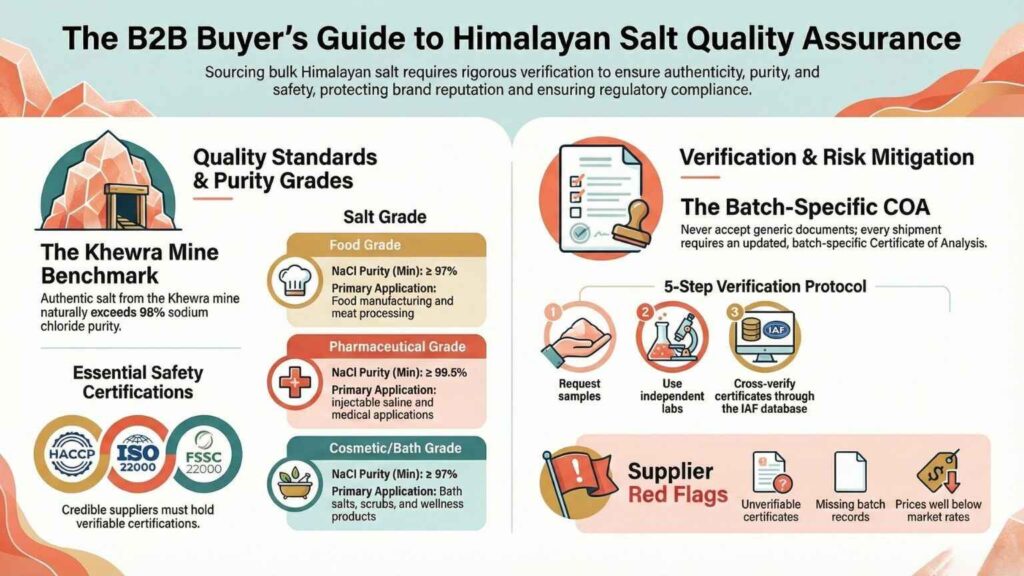
The mine produces approximately 350,000 metric tons of salt annually, with a natural sodium chloride (NaCl) purity exceeding 98%. [4] The salt deposits are estimated to be 800 million years old, formed from ancient seabeds beneath what is now the Himalayan foothills. [6] A peer-reviewed environmental study published in Mining, Metallurgy & Exploration confirmed that the Khewra mine is deemed environmentally sustainable with consistent salt quality. [5]
For B2B buyers, origin verification is Step 1 of any quality assurance protocol for bulk Himalayan salt. Always confirm that your supplier sources directly from PMDC-authorized Khewra operations, not from secondary or undocumented mines elsewhere in the region.
Did You Know?
The Salt Range and Khewra Salt Mine have been placed on UNESCO’s Tentative World Heritage List for their outstanding geological and cultural significance. [6] The mine has been continuously mined for over 1,000 years and at current extraction rates its remaining reserves are estimated to last several more centuries. [4]
Understanding Salt Grades: Matching Quality to Your Application
One of the most common and costly mistakes B2B buyers make is assuming that ‘Himalayan salt’ refers to one single, uniform product. It does not. The grade of salt you need depends entirely on your end application. Using a lower grade than your application requires is a compliance risk. Over-specifying adds unnecessary cost.
Here is a clear comparison of the main salt grades used across industries:
|
Salt Grade |
NaCl Purity |
Primary Applications |
Key Standard |
|
Food Grade |
≥ 97% (min) |
Edible products, food manufacturing, meat processing |
Codex CXS 150-1985 |
|
Pharmaceutical Grade |
≥ 99.5% |
Injectable saline, medical/lab applications |
USP / BP Pharmacopoeias |
|
Cosmetic/Bath Grade |
≥ 97% |
Bath salts, scrubs, spa & wellness products |
ISO 22716 / EU Cosmetics Reg. |
|
Industrial Grade |
Variable |
Water softeners, pool treatment, road de-icing |
Regional specifications |
|
Restaurant/Block Grade |
≥ 98% |
Salt slabs for cooking, grilling & food presentation |
Food safety + density standards |
The global benchmark for food-grade salt is the Codex Alimentarius Standard CXS 150-1985, published by the FAO and WHO, which sets a minimum NaCl content of 97% on a dry matter basis. [1] Premium Himalayan salt from verified Khewra sources naturally exceeds this threshold but only if it is processed and certified correctly.
The Essential Certifications Every Bulk Salt Exporter Must Hold
When you evaluate a wholesale pink salt exporter from Pakistan, the first thing to ask for is a full certification portfolio. Not a list of claimed certifications but actual, verifiable certificates with issuing body names and certificate numbers. Here is what every credible supplier must hold:
1. HACCP: Hazard Analysis and Critical Control Points
HACCP is the internationally recognised food safety methodology endorsed by the Codex Alimentarius Commission since 1993. [7] It identifies, evaluates, and controls food safety hazards at every critical point in the production process. Any serious bulk Himalayan salt supplier with quality certification must hold HACCP certification. Without it, their food safety controls are simply unverified.
2. ISO 22000:2018: Food Safety Management System
ISO 22000 is the most comprehensive international standard for food safety management systems. It combines HACCP principles with broader operational controls, covering raw material sourcing, processing, packaging, and dispatch. [2] Certification requires an independent audit, giving you verified confidence not just a supplier’s word.
3. FSSC 22000: GFSI-Recognised Certification
FSSC 22000 is a GFSI-recognised certification scheme built on ISO 22000, with additional sector-specific Pre-Requisite Programs. [3] Major food manufacturers and global retailers in Europe, North America, and Australia frequently require it. If your downstream customers operate in regulated consumer markets, this certification is often non-negotiable.
4. FDA Facility Registration
For buyers importing into the United States, the supplier’s processing facility must be registered with the U.S. Food and Drug Administration under the Food Safety Modernization Act (FSMA). A missing FDA registration number means the shipment can be detained or refused at the port of entry.
Read More: FDA Requirements for Salt Export to the USA
5. Halal and Kosher Certifications
If you sell to Muslim-majority markets, or to Jewish consumers in North America or Europe, Halal and Kosher certifications are not optional extras they are baseline requirements. Ask for both the certificate and the certification body name so you can verify independently.
6. Certificate of Origin
The Certificate of Origin, issued by the Chamber of Commerce, certifies where the salt was mined and processed. For private label salt manufacturers with quality control, this document is critical because it proves geographic authenticity, supports customs compliance, and protects your brand against mislabelling claims.
Read More: Salt Export Documentation & Compliance: A Practical Guide for Importers
Pre-Order Supplier Certification Checklist
☐ HACCP certification (current — check expiry date)
☐ ISO 22000:2018 or FSSC 22000 certificate (with issuing body name and certificate number)
☐ FDA facility registration number — verifiable on FDA.gov (for USA imports)
☐ Halal / Kosher certificate (if required by your target market)
☐ Certificate of Origin from Chamber of Commerce
☐ Third-party lab reports dated within the last 12 months
☐ Batch-specific Certificate of Analysis (COA) for your order
Certificate of Analysis (COA): Your Most Powerful Quality Verification Tool
The COA is the single most important document in bulk Himalayan salt procurement. Yet many buyers never request one, or they accept one old generic test result as valid for all future shipments. That is a significant risk. Each production batch is different, and a COA from six months ago tells you nothing about what is in today’s container.
A proper batch-specific COA for imported Himalayan salt should include the following:
- NaCl Content: Must meet ≥97% per Codex CXS 150-1985 for food grade; premium grades target ≥98%. [1]
- Heavy Metal Levels: Arsenic, lead, cadmium, and mercury must all fall within legally permitted limits.
- Microbial Count: Total plate count, E. coli, and Salmonella must be absent in food-grade products.
- Moisture Content: Critical for shelf life, packaging integrity, and caking prevention.
- Insoluble Matter: Clay, stone particles, or other inclusions must be within acceptable limits.
- Mineral Profile: Confirms the natural trace mineral composition, verifying the product is not adulterated or blended.
Always insist on a batch-specific COA. Request one for every shipment not one generic document for a year’s worth of orders. If a supplier resists, that resistance itself is your answer.
Did You Know?
The Codex Alimentarius Standard CXS 150-1985 (FAO/WHO) updated most recently in 2025 defines the minimum NaCl content for food-grade salt as 97% on a dry matter basis. [1] Himalayan pink salt from verified Khewra sources naturally achieves ≥98% NaCl purity, which is one reason the COA is so important, it confirms you are receiving genuine, unblended product, not a diluted substitute. [4]
How to Verify Salt Purity: A Practical 5-Step Protocol
Asking the right questions is necessary. But independent verification is essential. Here is the step-by-step protocol that experienced B2B importers use before committing to a full container order:
- Request a pre-shipment sample. Before any bulk order, always request a physical sample from the exact batch you are purchasing. This is non-negotiable.
- Send to a certified, independent third-party laboratory. Use an accredited lab with no supplier affiliation. Request full mineral analysis including heavy metals, NaCl percentage, microbial testing, and moisture content.
- Compare lab results against the supplier’s COA. The results should align closely. Major discrepancies are red flags. Minor natural variation is normal and expected.
- Request production facility batch records. A credible, certified supplier will provide processing records for that specific batch without hesitation or delay.
- Cross-verify certifications with issuing bodies. Every ISO, HACCP, and FSSC 22000 certificate has an issuing body. Check certificate numbers directly on the certifying body’s official website or through the International Accreditation Forum (IAF) public database.
Application-Specific Quality Standards You Need to Know
Different industries require different salt specifications. Sourcing the wrong grade for your application is both a compliance issue and a commercial risk. Here is what matters, broken down by use case:
1. Food Grade Salt for Meat Processing
Food grade salt for meat processing must meet strict microbial limits and contaminant thresholds. Many processors require ≥99% NaCl purity to minimize batch-to-batch variability. [1] Contamination in cured or processed meats is a serious food safety risk that can trigger regulatory action and product recalls.
2. Quality Assurance for Bulk Bath Salt Imports
For bath salt, microbial contamination testing is critical because the product directly contacts the skin. Buyers should ensure the salt meets ISO 22716 Good Manufacturing Practice for Cosmetics and the EU Cosmetics Regulation in European markets. Grain size consistency also matters when buyers specify coarse, medium, or fine grain for different product formulations.
3. Himalayan Salt Block Quality for Restaurants
Salt blocks used in restaurant cooking or food presentation must be dense, crack-free, and visibly free of impurities. They require high NaCl purity (≥98%) and must pass basic compression or density assessment to confirm they will not fracture under cooking heat. Inconsistent or porous blocks are a commercial liability in a professional kitchen.
4. Salt for Water Softener Purity Standards
Water softener salt purity standards typically require ≥99% NaCl content, with very low levels of calcium, magnesium, and insoluble matter. These impurities foul resin beds and reduce system efficiency over time. Iron content is another key parameter, it must typically fall below 5 ppm for effective water treatment performance.
5. Pharmaceutical Grade Salt Specifications
Pharmaceutical grade salt specifications are the most demanding in any category. NaCl content of ≥99.5% is standard, with strict limits on all trace elements. Processing must occur in a GMP-certified facility, and the product must meet either the United States Pharmacopeia (USP) or British Pharmacopeia (BP) monograph specifications.
Red Flags: 7 Warning Signs of a Low-Quality Salt Supplier
Experienced importers know that the warning signs are usually visible before you place the order. Here are the seven most common indicators that a supplier does not meet the quality standards required for serious B2B procurement:
|
# |
Warning Sign |
What It Means |
|
1 |
No batch-specific COA available |
Only a generic or outdated document is offered. Reject immediately. |
|
2 |
Certifications cannot be verified |
Certificate numbers do not match issuing body records. Fake cert red flag. |
|
3 |
No third-party lab testing |
Supplier only provides in-house results. Independent testing is the standard. |
|
4 |
Vague or unconfirmed origin details |
Cannot confirm mine location or PMDC authorization. Origin fraud risk. |
|
5 |
Unusually low price |
Well below market rate almost always means quality shortcuts somewhere. |
|
6 |
Reluctance to share facility details |
A credible, certified supplier welcomes audits and inspection without hesitation. |
|
7 |
Inconsistent color or grain across samples |
Indicates poor processing standards or undisclosed mixed sourcing. |
Private Label Salt: How Quality Requirements Change
When you are sourcing salt for a private label brand, quality assurance does not just protect your end buyers it protects your brand identity. Your name is on the packaging. A quality failure is attributed to you, not to the supplier behind the scenes.
Private label salt manufacturers with quality control need to provide more than just certified products. They need label-ready documentation that you can pass along your entire supply chain. This includes batch-specific COAs, allergen declarations, nutritional data, and country of origin certificates formatted for your destination market.
Look for suppliers who have prior experience producing private label salt for EU, North American, or GCC markets. These regions have the strictest labelling and compliance requirements. [8] A supplier who understands your market’s regulatory framework is as valuable as one who has the right product because they can anticipate issues before a shipment is at risk.
How Sobaan Salts Approaches Quality Assurance
At Sobaan Salts, quality assurance is built into every stage of the process not checked at the end. From direct sourcing at the Khewra Salt Mine to final shipment preparation, every batch goes through multi-stage testing, independent verification, and thorough documentation.
Sobaan Salts holds internationally recognised certifications and provides full export documentation for each order, including batch-specific COAs, certificates of origin, and compliance paperwork tailored to markets across 70+ countries. For buyers who require private label production, the team provides product-specific labelling documentation aligned to destination market requirements.
Whether you are buying edible Himalayan pink salt, bath salt, or industrial-grade products, the quality baseline at Sobaan never changes. Every shipment is tested, documented, and traceable from the Khewra mines to your warehouse door.
Frequently Asked Questions
Q: Do I need a Certificate of Analysis (COA) for salt import?
A: Yes. A COA is required or strongly recommended in most regulated markets including the USA, EU, UK, and Australia. It is your contractual and regulatory proof that the product you ordered matches what you actually received. Even in markets where it is not legally mandatory, a batch-specific COA protects you commercially and legally.
Q: Is all pink salt from Pakistan food grade?
A: No. Not all pink salt from Pakistan is food grade. The grade depends entirely on how it was processed, tested, and certified by the specific supplier and facility. Salt that has not been processed in a certified facility or independently tested to Codex CXS 150-1985 standards should never be used in food applications. [1]
Q: What certifications should a salt exporter have?
A: At minimum: HACCP, ISO 22000, a Certificate of Origin, and an FDA facility registration number for USA imports. For European markets: FSSC 22000 or BRC/BRCGS. For specialty or religious markets: Halal and Kosher certifications as required by your customer base.
Q: How do I verify if a supplier’s ISO certificate is real?
A: Every ISO certificate has an issuing certification body. Cross-check the certificate number directly on that certification body’s public website, or through the International Accreditation Forum (IAF) public database at iafcertsearch.org. If the certificate number does not appear, treat it as invalid and do not proceed.
Q: What purity standard is required for pharmaceutical grade salt?
A: Pharmaceutical grade salt requires a minimum NaCl content of ≥99.5%, processed in a GMP-certified facility, meeting either the United States Pharmacopeia (USP) or British Pharmacopeia (BP) monograph specifications. Standard food-grade or industrial-grade salt cannot be substituted for pharmaceutical applications.
Q: Can Himalayan salt be used in meat processing?
A: Yes. Food grade Himalayan pink salt is suitable for meat processing, provided it meets the minimum 97% NaCl requirement under Codex CXS 150-1985 and passes all required contaminant thresholds. [1] Many commercial meat processors specify ≥99% NaCl for greater batch consistency in curing and brining applications.
Q: What does a complete quality assurance process look like at a supplier level?
A: A proper supplier-level QA process includes: raw material inspection at intake, in-process monitoring at certified critical control points (CCPs), third-party lab testing of finished batches, and documentation review before each dispatch. A certified facility maintains traceable records for every production batch.
References
[1] FAO/WHO. (2025). Standard for Food-Grade Salt. Codex Alimentarius Standard, CXS 150-1985. Codex Alimentarius Commission.
https://www.fao.org/fao-who-codexalimentarius/codex-texts/list-standards/en/
[2] International Organization for Standardization. (2018). ISO 22000:2018 — Food Safety Management Systems: Requirements for Any Organization in the Food Chain.
https://www.iso.org/standard/65464.html
[3] Foundation FSSC. (2022). FSSC 22000 Certification Scheme for Food Safety Management Systems. GFSI-Recognised Scheme.
https://www.fssc.com/fssc-22000/
[4] Pakistan Mineral Development Corporation (PMDC) / Wikipedia. Khewra Salt Mine — Production Data and Reserve Estimates. Government of Pakistan.
https://en.wikipedia.org/wiki/Khewra_Salt_Mine
[5] Ahmad, N. et al. (2020). Semi-Quantitative Environmental Impact Assessment of Khewra Salt Mine of Pakistan. Mining, Metallurgy & Exploration, Springer.
https://link.springer.com/article/10.1007/s42461-020-00214-9
[6] UNESCO World Heritage Centre. The Salt Range and Khewra Salt Mine. Tentative Lists of States Parties.
https://whc.unesco.org/en/tentativelists/6118/
[7] Hong Kong Centre for Food Safety. What are HACCP and ISO 22000 and How Can They Help Food Safety? Food Safety Focus, Issue 218. CFS.gov.hk. https://www.cfs.gov.hk/english/multimedia/multimedia_pub/multimedia_pub_fsf_218_02.html
[8] U.S. Geological Survey. (2024). Mineral Commodity Summaries 2024: Salt. U.S. Department of the Interior. USGS.
https://www.usgs.gov/publications/mineral-commodity-summaries-2024
[9] NQA Certification. ISO 22000 — A Complete Guide to Food Safety Management Certification. Accredited Certification Body.
https://www.nqa.com/en-us/resources/blog/february-2019/guide-to-iso-22000
[10] EuSalt (European Salt Producers’ Association). Standard for Food Grade Salt and Analytical Standards for Salt. Referenced in Codex Standard CXS 150-1985.
https://eusalt.com/about-salt/salt-quality/
Share This Post
Article By